


For 13 years, the “U.S. and the Middle East” history seminar—offered exclusively to seniors—has been a widely sought-after course at Lick-Wilmerding High School. Beyond history, the class explores culture, identity and tackles misconceptions through a human-centered approach, creating a class environment that aims to approach complex topics in a way that enables students of all backgrounds to engage meaningfully.
In “U.S. and the Middle East,” Dr. Shaun Lopez does not just teach Middle Eastern history, but examines the topic through the lens of the United States. Students learn both about the history of the region, and the widely-held American misconceptions. “The big thing I do in that class that I introduced really early is that they should take everything they hear about the Middle East with a grain of salt,” Dr. Lopez said.
According to Dr. Lopez, one of the course’s primary purposes is to equip students with the skills to take in what is taught in the classroom and then form their own opinions. “I’m a human, you know, I have my own worldviews,” Dr. Lopez said. “I don’t think there is one truth.” Starting with their first reading, students are taught to research the creator of the source, prior to engaging with it, in an effort to better understand their worldview, perspective and how that bias may appear in the content.
Alongside his goal to keep the class relevant, Dr. Lopez also works to emphasize that where one decides to begin telling the history of the Middle East can deeply influence its meaning. In the same vein, students are educated that much of what appears in the news is rooted in long and complex histories, often unfamiliar to many Americans.
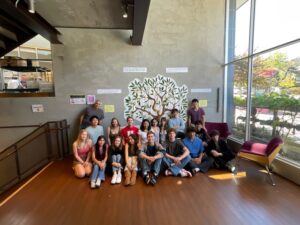
Photo courtesy of Dr. Lopez
“I don’t think I had a lot of previous knowledge on what has happened and is currently happening in the Middle East,” Matthew Rivadeneyra ’26, who is currently taking the seminar, said. “So, I feel like going into a class that talks about the politics and humanities of such a big part of the world is really informational for me.” Beyond academics, Rivadeneyra shared that, for him, another special charm of the class is Dr. Lopez’s personality. “Dr. Lopez’s teaching style and humor make it one thousand percent better than I thought it would be.”
“We are exploring the concept of Orientalism and how the West has historically created an exaggerated, often negative perception of the Middle East through media and literature that reinforces Western superiority,” Greta Samaha ’26, who is also in the seminar, said. “As a Middle Eastern student myself, it astonishes me how little I even know about my own culture, the history and everyday life.”
After being hired by LWHS in 2013, Dr. Lopez was tasked with taking over an existing history seminar, “Politics and Power.” “It was taught kind of like a government class,” Dr. Lopez said. “And I said, ‘Well, I can’t really do that. I have a PhD in Middle Eastern history [from the University of Michigan]. That’s my specialty.’” Although the name remained “Politics and Power,” the earliest version of the current seminar explored the experience of Arab, Persian and Muslim Americans after 9/11. “The feedback was that we really needed a class about the Middle East. So at that point, it became a class,” Dr. Lopez said.
According to many, one of the most unique and powerful aspects of this class is how Dr. Lopez’s personal experience informs his understanding of the history of the region. After graduating from the University of Arizona, Dr. Lopez completed his Master’s degree in Middle East Studies at the University of Utah. It was at that point that he decided to fly to Jordan. “I just bought a one-year, open-ended ticket with no plan,” Dr. Lopez said. “I think it was the most formative time in my life.”
Dr. Lopez recounted living in Jordan and learning more about his identity—an experience that continues to influence the teachings of his class. Each year, Dr. Lopez begins by humanizing the Middle East. “It’s always presented as this place of extremism and violence…Here they are skateboarding and going to rock concerts, and they care about fashion and they get married and they love their kids,” Dr. Lopez said. “All this stuff is not surprising at all. But we don’t think about it in the context of the Middle East.”
As for the future of “U.S. and the Middle East,” Dr. Lopez shared his intention to further humanize the region to students by connecting the class to our surroundings—focusing, in particular, on the immigrant communities in the United States, “like the Palestinian community in Anaheim and the Lebanese community in Dearborn, Michigan, and the Moroccan community in Montreal,” he said. “It doesn’t feel like it’s over there. It feels like it’s here.”
Dr. Lopez’s “U.S. and the Middle East” goes beyond a standard history class. It’s an intentional space for meaningful conversation and personal growth on a subject often misunderstood. Ultimately, the seminar encourages students to confront both their own bias and ways of learning about the world around them with inquiry.


+ There are no comments
Add yours