


Possessing roughly a quarter of President Donald Trump’s TikTok following and a powerful, albeit controversially expansive, golf presence, it is difficult to ignore this rapidly rising influencer: President Trump’s granddaughter, Kai Trump. Boasting a variety of digital content, from professionally edited golf clips to intimate self-filmed “day in my life” vlogs, 18-year-old Kai has developed her own fanbase, garnering Trump’s supporters and critics alike. While many view her as a pawn of the Trump empire and an emblem of the Make America Great Again (MAGA) movement, her unique branding persuades others to separate her from President Trump. This popularity, with a notable absence of meaningful political engagement, begs the question: is she truly apolitical?
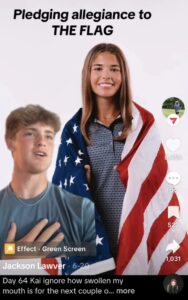
Her approach to social media, while not revolutionary, is believed by many fans to be the “freshest” and “most influential” of the Trump family brand. “She takes those daily vlogs and takes us throughout her days. I feel like that’s an inside look at what future politics could look like,” Jackson Lawver, an online fan who accumulated 20,400 followers for his viral “Asking Kai Trump to Prom” posts, said. In one of her most-viewed vlogs, titled “I Went to the Ryder Cup with My Grandpa”, she boasts late-night golfing on the White House Lawn, reviews so-called “presidential chocolate” and reminisces about trying to persuade the Secret Service to play soccer with her.
Kai’s fanbase hit the ground running on July 17, 2024, when she gave her personal testament of her grandfather’s “caring and loving” side that she believes the media does not often highlight. Though she spoke to the audience of the Republican National Convention (RNC), she focused on Trump’s role as a family man rather than a political figure. For Lawver, who asked Kai Trump to prom in a 200-part series of TikTok videos—achieving a ‘like’ from Kai herself along the way—politics are intertwined with his admiration for her. “I was watching the RNC with my grandparents…it was cool to see what she was doing from such a young age of politics, campaigning with President Trump,” Lawver said.
Having gained almost two thirds of her current TikTok following since this event, her rapid rise to TikTok stardom has also fast-tracked her golf career. From November 13 to 16, 2025, Kai participated in the ANNIKA Ladies Pro Golf Association (LPGA) tournament, placing last out of 108 participants. Just four days later, she announced that she will play in the Internet Invitational tournament—a move that many found surprising given her performance earlier that week.
While her social media persona presents an average teenage girl, her golf career takeoff can be attributed to her unique position of power. Golfer Brock Pola, former Lick-Wilmerding High School student and current University High School senior, commented on her entry into the competition. “I think it was a good business decision by the LPGA…pure merit-based, definitely not. For the long run of the LPGA, it was beneficial that she was a part of it, but skill-wise, she’s nowhere near that,” he said.
He also criticized the facility with which she was able to enter the tournament as an amateur. “I personally think it’s very clearly nepotism. I can name 40-50 kids our age who are better golfers than she is,” he said. Pola contended that family wealth and influence are also factors of her special entry into the tournament. “‘It’s usually a CEO of a company that’s very successful…[who asks] Hey, can this person play?’” Pola said.
While the Internet Invitational may not be as highly regarded as the ANNIKA and mainly features influencers, the prize pool is estimated to exceed $10 million, according to Yahoo Sports. Kai and the Women’s National Basketball Association (WNBA) star, Caitlin Clark, are the only two to confirm their participation thus far.

photo courtesy of @kaitrump
Aside from tournament representation, Kai—a high school senior—is already gaining traction in the network of professional athletes. The energy drink brand Accelerator chose her, alongside big-name athletes like Travis Kelce and Olivia Dunne, to represent their new ‘Rocket Pop’ flavor.
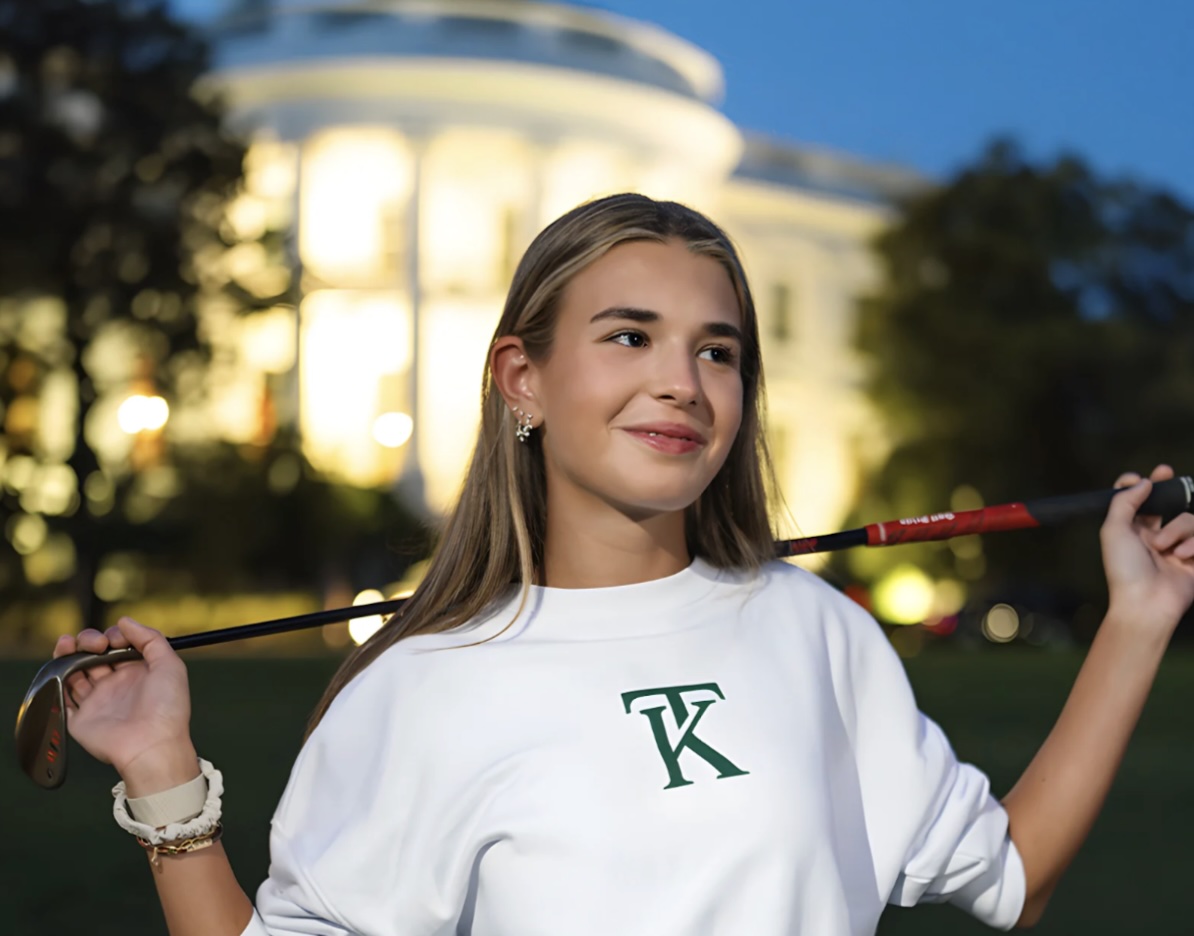
In September, she launched onogrammed ‘K.T.’ merchandise, leaving many fans shocked. “130 Bucks for a piece of clothing that has the initials of an 18-year-old kid…that’s wild,” one social media post read. The Wall Street Journal joined the discourse on X: “Promotional images in front of the White House have drawn scrutiny,” the post said. Many critics argue that the inclusion of the White House in the photo appealed to aesthetics rather than a symbol of American democracy. Others see it as an uncomfortable reminder of her grandfather’s clout.
Psychologically, viewers desire to see themselves in influencers. While she often draws online attention due to her unique social and political position, some believe that Kai is remarkably skilled at compelling viewers to forget her $16 million trust fund. Kindra Briggs, who teaches Propaganda and Communications at LWHS, explained the allure of media influencers. “You want to connect to that and say, ‘Oh, I am a common folk, and I have access to that’…You want to see something relatable, because that gives you the chance to be able to put yourself in that position,” Briggs said, connecting Kai’s branding to the MAGA Movement. “She’s very relatable. And that’s what the Trump campaign was built on. She’s maintaining that human, down-to-Earth character,” Pola said.

photo courtesy of @kaitrump
Kai has not directly spoken on any political issues, only mentioning that her grandfather is “doing a good job” and humanizing him as a “great grandpa” during her RNC speech. She highlights the phenomenon of young people searching for their political identity. Books such as Network Propaganda studied differences between the political outlets on the left and right, including news sources, social media and political figures. Briggs explained their findings on polarization. “Polarization is asymmetric…the media outlets, the social media and the podcasters and news stations on the right are more condensed and less connected to mainstream news,” Briggs said. She further elaborated that while echo chambers exist across the political spectrum, they are more solidified on the right, creating a breeding ground for the idolization of public figures.
Meanwhile, Kai has publicly addressed online hate and harassment from anti-Trump youth. “She knows that she’ll probably get a little bit of backlash and hate just for being Trump’s granddaughter, but that gives her the platform she wants to fulfill her golf dreams,” Oliver Save de Beaurecueil ’27, leader of LWHS’s Golf Club, said.
Though she has not explicitly addressed her position on MAGA ideas, Briggs warned that apoliticism is inconceivable—not only for a member of a presidential family, but for any person. “To be apolitical is a political stance. To say I am above the politics, beyond the politics, is a point of privilege,” she said.