
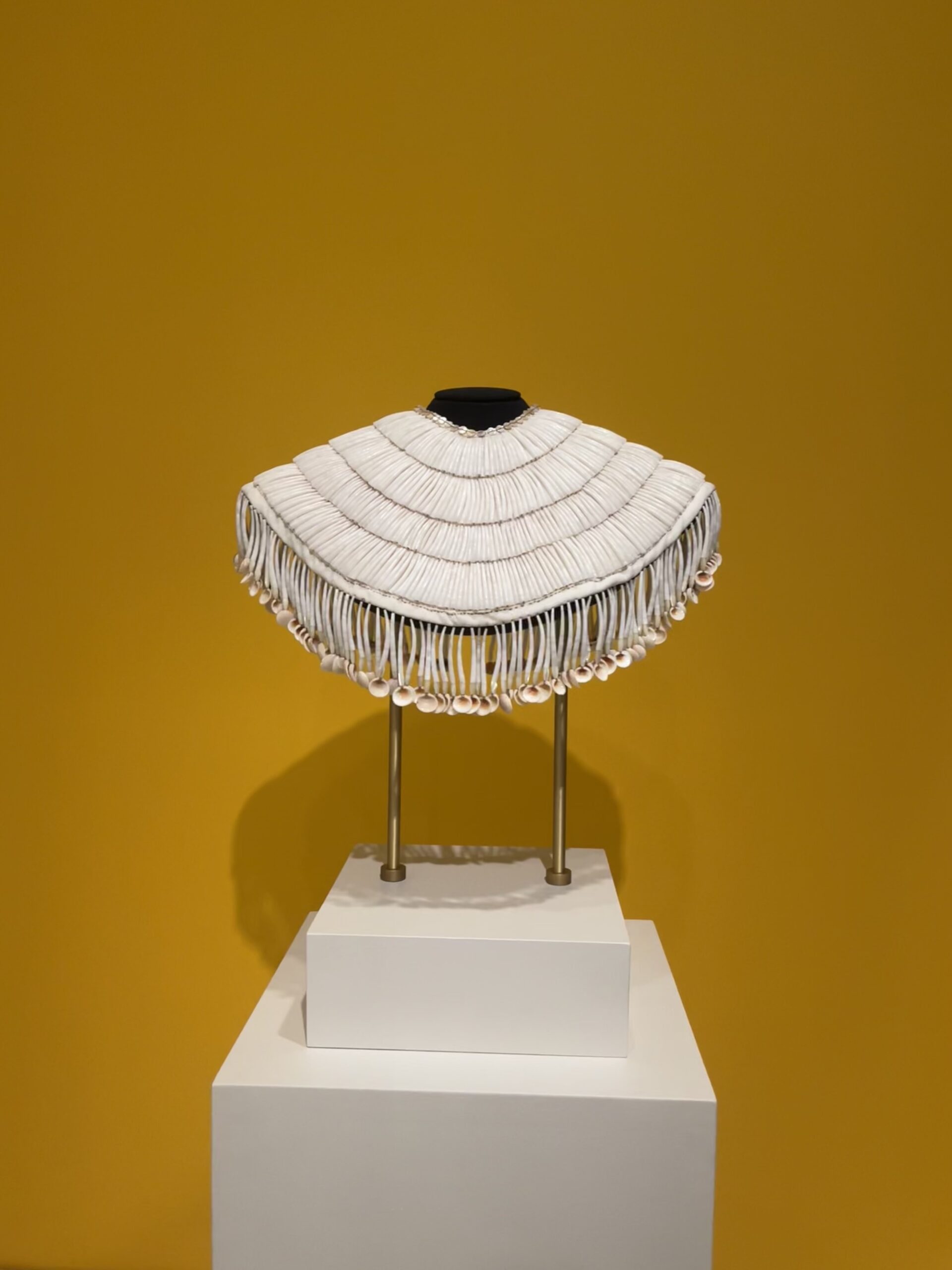
On August 26, The de Young Museum reopened its “Arts of Indigenous America” galleries. Through the theme “Relationship to Place,” the permanent exhibition celebrates historical and contemporary Indigenous works, highlighting diverse Native voices to combat prevailing expectations around what defines Native art. While these reworked galleries move towards authentic Indigenous representation, they also indicate a national need for museums to continue working to justly uplift Native works and communities.
For centuries, museums have contributed to processes of colonization across the globe. Renowned institutions in the United States—known to Indigenous communities as ‘Turtle Island’—and Europe pay homage to brutally constructed empires, displaying objects that Western colonial powers stole from Indigenous communities.
The 1906 Antiquities Act permitted the removal of Native American human remains and cultural objects from federal lands. This enabled looting and led to U.S. museums amassing significant collections of stolen Indigenous remains. Displaying these items, museums continue to profit significantly, while Indigenous communities suffer economic disadvantages. According to the National Community Reinvestment Coalition (NCRC), 25.4% of Native Americans live below the poverty line. Native wealth, what the NCRC describes as the combined value of assets, minus debt, is only 9% of the national wealth average.
In the 1960s and ’70s, a movement emerged protesting museums displaying wrongfully taken Indigenous pieces, led by activist Maria Pearson, a member of the Turtle Clan of Yankton, Dakota. The U.S. Congress passed the 1990 Native American Graves Protection and Repatriation Act (NAGPRA), which aimed to facilitate the return of human remains, funerary objects and sacred items to Indigenous communities.
Since then, many museums have initiated repatriation efforts—and, many have not. Further, Indigenous artists and curators are rarely the ones guiding the display of Native art and artifacts. “Unfortunately, museums and academia are very dominated by white voices,” said Karen Fry, who teaches Lick-Wilmerding High School’s senior History seminar “Hidden in Full View: Colonialism and the Universal Museum.”
Among those aiming to enact justice for historical wrongs is The de Young, and its parent organization, the Fine Arts Museums of San Francisco (FAMSF). As of 2024, FAMSF officially removed all Native American human remains from its collection. With these revamped galleries, FAMSF also hopes to combat exclusion and change the top-down, singular voice of authority traditionally seen in museum curation. Rather than consulting after the exhibit was curated, The de Young engaged Native communities and advisors from the project’s inception.
Hillary C. Olcott, the Curator of the Arts of the Americas at FAMSF, worked with four Indigenous co-curators: archeologist Joseph Aguilar (San Ildefonso Pueblo), curator and artist Meyokeeskow Marrufo (Robinson Rancheria/Eastern Pomo) and curators Will Riding In (Pawnee/Santa Ana Pueblo) and Sherrie Smith-Ferri (Dry Creek Pomo/Bodega Miwok).
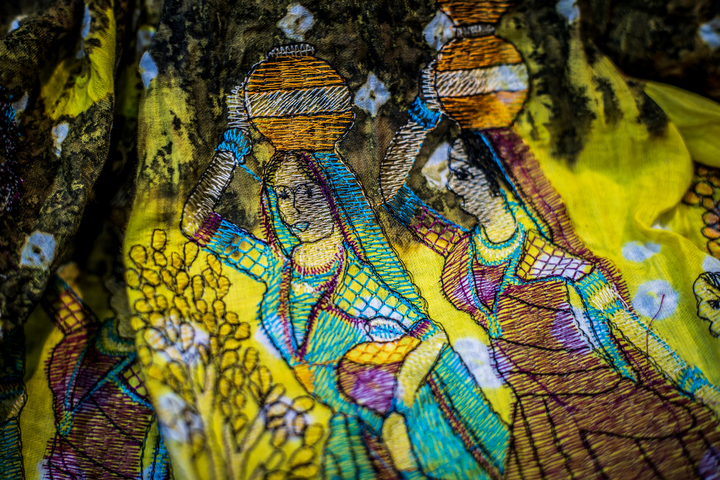
“Native voices have been silenced, ignored and overlooked for so long. Give them the mic,” said René Villicaña, who teaches the LWHS senior History seminar “Indigenous Peoples & Voices in the Present.” As part of this effort, FAMSF collaborated with Native communities to create detailed descriptions for objects displayed, diving into the cultural practices illustrated in various items.
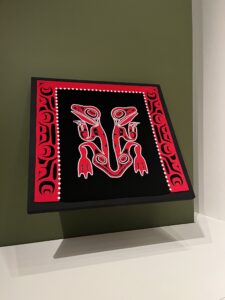
photo by Sanya Sohal ’26
Samu Cortez, who teaches in the woodshop and serves as the faculty advisor for the Indigenous Alliance Club at LWHS, highlighted care in the display of Indigenous artifacts. “The way you are showcasing sacred items…there has to be a lot of intention,” Cortez, who is also an artist, said. For example, when a museum names work as sacred, but has dug it up from the ground—where they were intended to be buried forever—they illustrate a lack of respect for Native practices.
In addition, Cortez pointed out that museum exhibitions are often structured in a rigid, linear manner, perpetuating hierarchical Western values. “I think if you were to ask a Native to uplift these objects, they might do it in a more community-centered, circular manner,” they said.
“Arts of Indigenous Americas” includes four galleries: “Rooted In Place,” which features rotating art from Indigenous nations in what is now known as California, “Home and Away,” arranged thematically rather than along colonial borders, “Of Courts and Cosmos: Ancestral Mayan Art” and a collection of mural fragments from Teotihuacan, detailing the multiyear preservation collaboration between FAMSF and the Mexican Instituto Nacional de Antropología e Historia.
“Recognize that there’s diversity,” Villicaña said. “Study all this, face up to the history and then use all of that intellectual capital that you have, along with these amazing collections, to reinterpret and present in new ways.” The galleries feature a range of historical and contemporary artworks by Indigenous artists, aiming to represent the breadth of experiences of the over 500 Indigenous nations on Turtle Island.
The presentation of modern and contemporary art, in addition to artifacts, acts as a valuable mirror for Indigenous youth. “It’s like, oh my God, I can see so much of myself in the art,” said Lucas Bratt ’26, co-leader of LWHS’s Indigenous Alliance Club.
Highlighting contemporary Indigenous voices also sparks discussions around the multidimensionality of Indigenous experiences and promotes Native activism today. Showcasing works from Native nations in California amplifies local Indigenous voices, such as the Ramaytush Ohlone nation, whose ancestral land encompasses the Bay Area, Monterey Bay region and Salinas Valley, and yet, is not a federally recognized tribe. The exhibition includes a welcome message from artist Brian D. Tripp of the Karuk nation, one of the largest Native nations in Northern California.
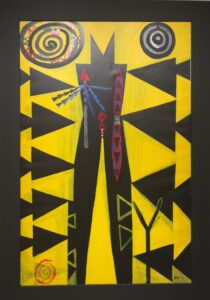
photo by Sanya Sohal ’26
Cortez advocated for more focus on the complex contemporary identities of Native peoples. “I would love to see something beyond the de Young…more into contemporary art galleries…where you are bringing in contemporary artists with Indigenous roots, where you are opening spaces for dialogue, where you’re opening spaces to share these lived experiences,” they said.
While these galleries are a step towards respectful Native representation, there remains significant work to be done for museums, which have long profited off stolen land and art, to embody equity in presenting Indigenous works. “If you’re going to center Native voices, awesome…But are you making sure they’re getting paid commensurately? Because you’re the one that’s going to benefit from all these people coming to see the museum,” Villicaña said.
Many are looking for museums to step into a role of active and meaningful allyship. “In a way that’s not rooted in white savior complex, that feels respectful, where there’s the possibility for reciprocity,” Villicaña said.
Cortez explained that in their art, which explores reconnecting with their Native roots and uplifting Indigenous wisdom, they center an idea called treque, an exchange that focuses on creating something better through collaboration. Treque, and the reciprocity that Villicaña highlighted, points towards the steps institutions can take to uplift Indigenous communities.
One way to practice this reciprocity is a voluntary land tax, in which participants give to Native nations or organizations upon whose ancestral land they reside. Voluntary land taxes are a way for settlers to acknowledge they benefit from the theft of Indigenous land and indicate respect for Native sovereignty.
“You’re always on Native land,” Bratt said. “You’re borrowing their land, you’re displaying their art…maybe you should give back something to them.”
To uplift the Ohlone nation, whose land encompasses the Bay Area, see the Shuumi Land Tax, which supports the Sogorea Te Land Trust’s work to restore Indigenous lands and contribute to healing the colonization, displacement and genocide experienced by the Ohlone.