


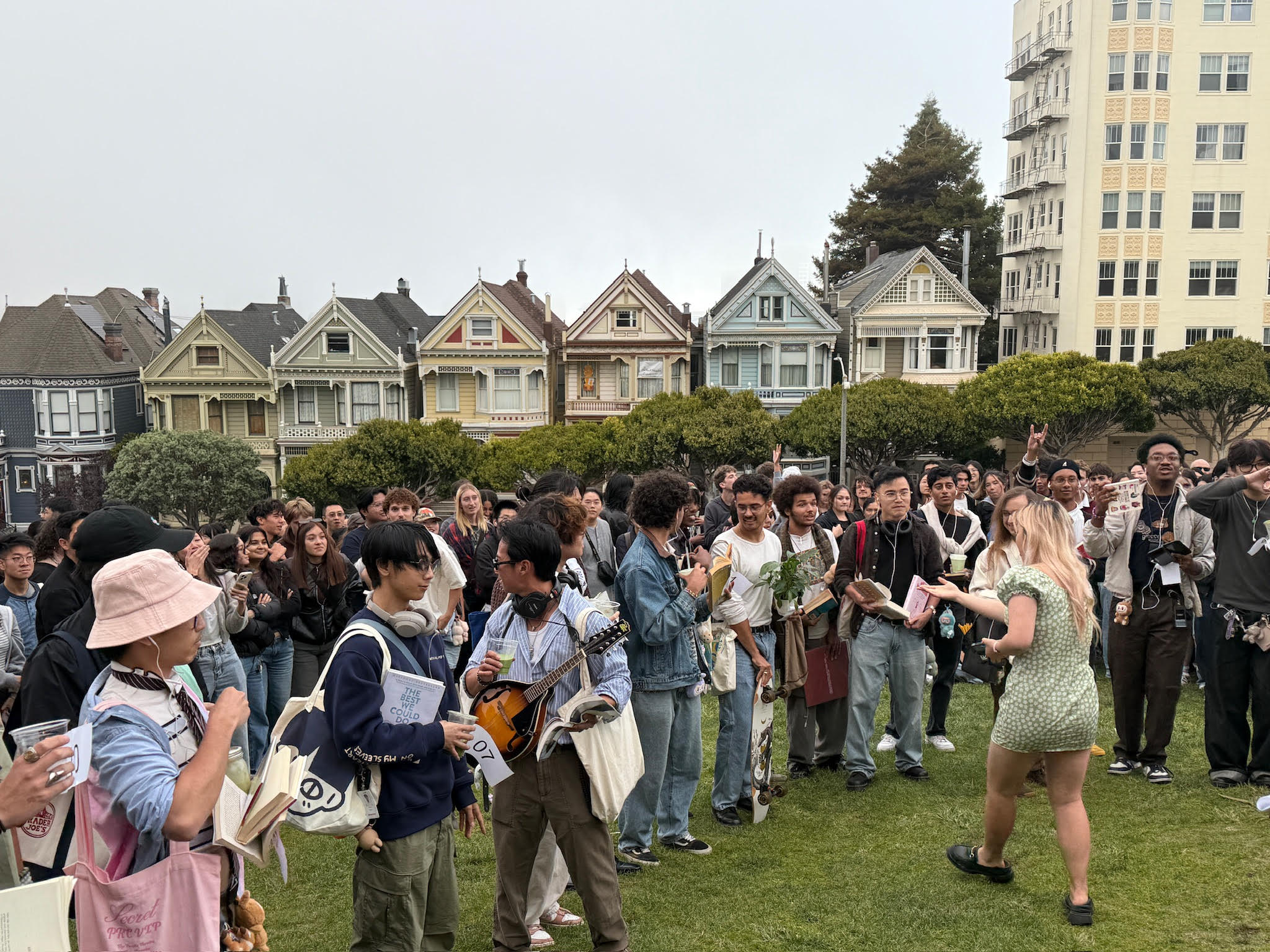
On August 22, over 1,000 matcha-drinking, Labubu-collecting, Clairo-listening young men filled San Francisco’s Alamo Park to participate in the city’s first-ever Performative Male contest. Hosted by Kake Jin and friends, it was inspired by similar events in New York, Seattle, Chicago and even Jakarta. It’s safe to say, performative males have taken the world by storm.
The performative male is a hyper-niche aesthetic popularized by social media. They project sensitivity, feminist values and an indie ethos. Performative males are notorious for their meticulously curated look: wired headphones, baggy jeans and tote bags, all accompanied by the latest feminist fiction.
“I think of them visually first, honestly, because it’s been pushed by social media,” said Ronan Spreyer ’28, an attendee of the contest.
To judge, Jin and her friends used AI tools to recognize certain visual identifiers. “We did it based on object detection,” Jin said. Flashing your Labubu? That would register. And showing off your ceremonial-grade matcha latte with oak milk? You have just earned major performative points.
The name “performative male” comes from the concept of male performativity: the act of adopting an inauthentic persona with fake values and interests to attract romantic partners—in this case, progressive women.
But performativity is not a new phenomenon. In the 90s, there were “posers,” the 2010s had “soft-boys,” and now we have performative males.
Why do some men engage in performativity? “Most of us perform in some way. It can often come from experiencing family trauma or systemic oppression,” said Zoë Wong-Weissman, an associate marriage and family therapist working in San Francisco. “We learn that our true selves, or parts of ourselves, are not safe to share, so we perform in order to protect ourselves.”
Videos tagged #performativemale on TikTok have received over 149 million views. Scroll a while and you will notice familiar tropes: guys in trendy cafés, reading feminist novels (upside down of course) and sipping matcha. The scenes are meant to be funny, lighthearted and slightly over-the-top. “Performative males are a fun little jab at the depiction of what women actually want,” said Jin. Sensitive, easy-going, well-read—what’s not to like?
Wong-Weissman commented that while performative males might seem sunny and relatable, there may be a darker side to the story. “I worry about the parts of a person that get cut off and silenced,” she said. She also expressed concerns that projecting a false self can be harmful to others. “It takes on a different connotation when we’re talking about cis men or white men, who have historically had some kind of structural or systemic power,” she said.
With the rise of social media alongside social movements like #MeToo, many have become aware of the harmful social norms that pressure men into being tough, emotionally stoic and adverse to feminine traits.
While on the surface, performative males project the opposite, at their core, the deception and inauthenticity depict those same toxic masculine traits. But might this be a step in the right direction?
“In a way, I’d rather have them be performing these things than some of the more toxic or violent or aggressive behaviors,” Wong-Weissman said. She added, “I just hope they don’t hurt people in the process of that.”
While performative males continue flashing their vintage vinyl and thrifted tees, their shelf life is short. Soon enough, there will be a new archetype lining up behind them, with a new name, a different style and possibly a brand new contest to celebrate their arrival. But at their core, we’ll see the same thing: inauthenticity, manipulation and performance.
For now, all we can do is sit back and watch the performance. After all, as Wong-Weissman said: “It makes for great content.”