



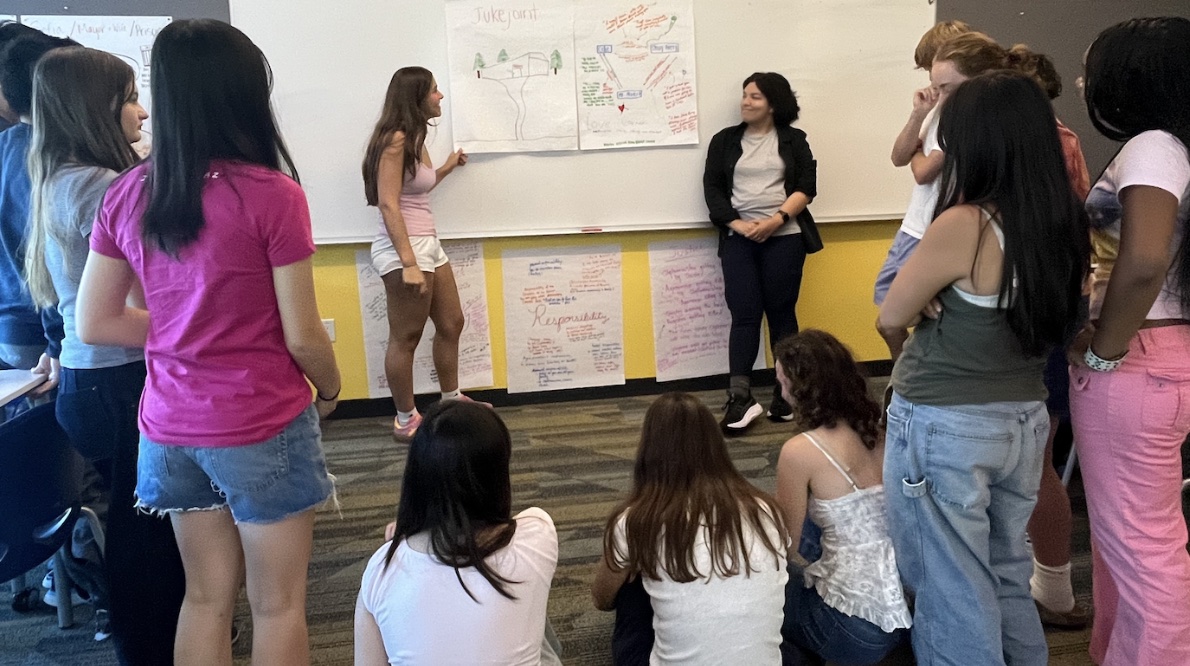
This fall, Lick-Wilmerding High School’s (En)Gendered Violence Senior Seminar dives into the theory and literature from which systems of oppression—namely, gendered violence—stem. Aided by news coverage of current events and United States literature spanning decades, Dr. Kim Bowers teaches the class by drawing connections between gender dynamics and institutions present in our country’s history.
While the class assumes the same ‘English 4 Honors’ title as every other senior seminar, its teaching style is unorthodox.
The class calls students to action. As high school seniors in the class approach voting age and migrate to college campuses where rape is increasingly common, discussions of how to dismantle rape culture are relevant. According to The Journal of Sex Research, one in five women are sexually assaulted while in college in the U.S. “I think talking about it as a class gives us practice for being good bystanders, so that we can interrupt,” Bowers said. According to the documentary The Bystander Moment, progression of the gendered violence prevention movement in the past 25 years is marked by the diffusion of responsibility among “the bystanders, the teammates, the colleagues and coworkers.” The film, which students viewed as summer homework to prime their understanding of rape culture, emphasizes the importance of interrupting the subtleties of rape culture that are ingrained in U.S. customs and history.
“I do think it’s really troubling that Donald Trump has gotten a pass on all this [sexually harassive speech],” Bowers said. She recounted the story of growing up in Texas during the 1990 gubernatorial election between Clayton Williams and Ann Richards. Williams made an infamous remark comparing bad weather—which delayed his spring cattle roundup—to rape: “If it’s inevitable, just relax and enjoy it.” Public outrage pervaded Texas news in the following days, and Ann Richards condemned his words. Richards, on track to lose, eventually won the election by a margin of 4%.
“And then you fast forward twenty-something years, and we have an elected president who can say that kind of thing,” Bowers said.
Bowers’ activism-driven curriculum was received positively by students. “It’s an issue that I’ve been kind of interested in and passionate about, and the course description was really interesting to me,” Maggie Buchholz ’26 said.
Course material does not adhere strictly to the texts outlined in the rubric. It takes the form of various media, including photography, film and journalism. Pertinent current events might take over two whole class periods, as was the case for the Epstein developments. “We looked at the Epstein files and the birthday book [and] watched a press conference with some of the survivors of Epstein,” Bowers said.
The class is largely discussion-based with a focus on analyzing literature and philosophy. Students note the dynamic feeling in the room and how it differs from other classes.
“It’s less rigid. You come to class more curious and excited to learn. It feels less like you’re being graded and judged,” Simone Hare ’26 said. “My favorite thing about this class is the discussion. You’re engaging so much with your peers that you’re able to talk through the difficult scenes and difficult subjects.” One line in particular stood out to Buchholz from the course syllabus: “We’ll read and discuss texts about domestic violence, rape, and filicide; asking how US institutions, history, and belief systems contribute to those violent acts.”
While the class centers the perspectives of women, students noted the recognition of non-female identifying people and their role as a cog in the larger machine of oppression. “One of our most interesting discussions was in one of our first classes. We talked about the first time we noticed gender. You could see how gender doesn’t just hurt girls. It hurts guys, too,” Ilana Zimmerman ’26 said.
“You would think that it would be a hard class for a male, not wanting to overpower other voices in a space that’s mostly taught from the female perspective. But it’s really easy to talk, whether you’re male-identifying or female-identifying,” Troy Hegwood ’26 said. He highlighted that civil discourse is encouraged for all students regardless of their perspectives and identities.
Over the summer, students read excerpts of various gender theory texts to gain a general understanding of gender-based violence’s causes and effects. One of these is bell hooks’ Feminist Theory: From Margin to Center. “I found hooks’ theory really interesting because it talks about the roots of gendered violence, both as a reaction to women gaining power in the world and in how it is taught, especially in the media,” Zimmerman said.
Then, students applied the theories to literature that grapples with themes of such violence. Among the literature read are the novels The Color Purple by Alice Walker, Black and Blue by Anna Quindlen and Shell Shaker by LeAnne Howe.
In the past, Hegwood struggled to understand why individuals, especially women, stay in abusive relationships. “My brain is wired, as a man, to think, ‘if that happened to me, I would just leave.’ Reading Black and Blue made me realize that even after moving across the country, she was still affected by the domestic violence in her relationship. It’s always a cycle of violence that keeps repeating,” Hegwood said. While he always had felt sympathy for victims, he experienced a newfound sense of injustice within the society we live in.
Bowers noted in the course syllabus that the class content leaves room for optimism: “We will also discuss texts that illustrate ways to heal and form healthy, supportive relationships.” She has a broader, long-term goal in mind when teaching about ongoing issues. “It’s important that they’re aware of these problems and that we’re talking about them, for the health of our country,” Bowers said.