


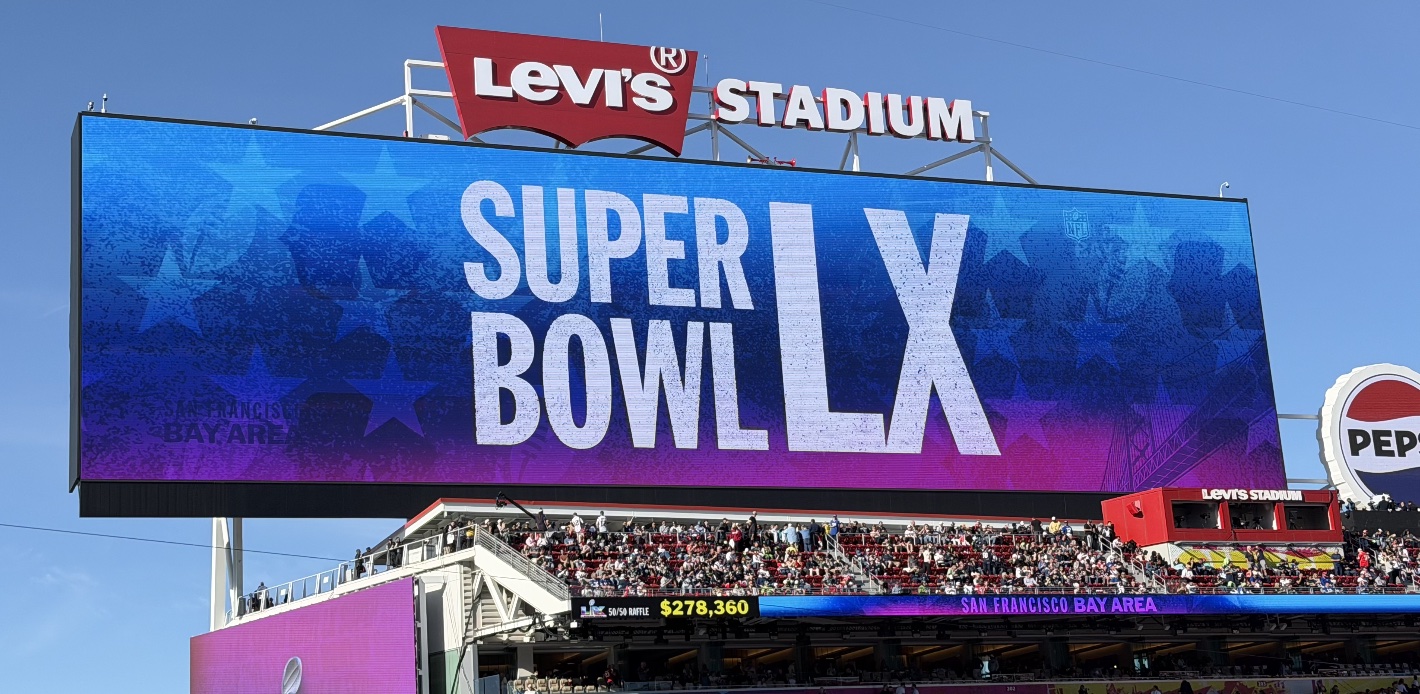
The week leading up to Super Bowl LX, the San Francisco Bay Area opened its doors to a surge of 1.3 million visitors that officials estimate generated upwards of $500 million for the local economy. From packed restaurants to star-studded events—including the Pro Bowl held at Moscone Center—Super Bowl LX transformed the city with not only business, but enthusiasm. Yet, amid the celebration and record-breaking revenue, not every corner of the city benefited equally.
Created in 1967 as the championship game between the National Football League and the American Football League, the Super Bowl has evolved into the most-watched annual television event in the United States, with an average yearly viewership of 110 million.
Each year, a different city—as host of the event—has the opportunity to welcome thousands of fans and media personel. For the first time since 2016, Santa Clara, home of the 49ers, rose to the occasion.
Super Bowl week kicked off on Monday, February 2, with Opening Night celebrations that drew fans to downtown San Francisco. In particular, San Francisco’s Moscone Center served as a home base for many fans. Throughout the week, the center hosted both the Pro Bowl exhibition, an annual flag-football game between the best players in the National Football League (NFL), as well as the NFL Super Bowl Fan Experience, where fans could play interactive games and take photos with everything from Super Bowl rings to bedazzled football helmets.
For local businesses, this week delivered a welcome surge during an otherwise relatively slow season. Glen Zorrilla, a manager at the restaurant Underdogs Cantina, described the experience as chaotic and rewarding. “Normally, February is quieter, and to have that influx of concentrated business was really appreciated on our end,” he said. The restaurant was invited to be a part of the NFL vendor network and was in charge of hosting official fan rallies in addition to catering media and national broadcasts. “Working with the NFL vendors looped us into a bunch of different possibilities that we wouldn’t have otherwise had at our disposal and opportunities that we were able to take advantage of,” Zorrilla said.
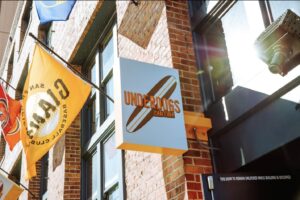
photo courtesy of @underdogscantina on Instagram
As the week carried on, football blended seamlessly with entertainment. Concerts featuring headliners Kehlani and Calvin Harris attracted crowds beyond those interested in football. Noa Solomon-Carmel ’26, a die-hard San Francisco 49ers fan, was excited about the incoming tourists. “I think it’s a great opportunity to show everyone who we are and see how great it is here,” she said.
This year’s matchup between the Seattle Seahawks and the New England Patriots carried high stakes as both franchises entered the match with postseason success and dedicated fan bases. Ultimately, after a game defined by stifling defense, the Seattle Seahawks emerged victorious with a final score of 29-13. Lifelong fan and LWHS Math Teacher, Ernie Chen, expressed his excitement for the new era of Seahawks football. “It’s like a Christmas gift that you didn’t expect,” he said.
For many fans and Bay Area locals, the Super Bowl experience included celebrity sightings and a halftime performance that added to the spectacle. “It definitely was more exciting and surreal to see people you see on TV in-person,” Asa Wendler ’26 said.
However, the Super Bowl’s impact was not only measured in concerts, touchdowns and celebrity-sightings. Economically, the numbers were staggering with around 5,000 temporary jobs created and more than 100,000 hotel rooms booked; many chains entirely sold out.

photo by Jason Kilar
“We’ve done about $500 million of economic impact in the Bay Area. Over 100,000 room nights, countless events in the communities…we’ve donated close to $10 million back in the community just this week, and that’s part of the lasting impact,” Jed York, the principal owner of the San Francisco 49ers, said in a press conference following the Super Bowl.
However, the economic boom did not benefit everyone equally. In preparation for the Super Bowl, many street vendors were relocated from high-traffic areas. Dayrys Perez, a local street vendor who sells empanadas outside the Bart station on 24th street, was told he and other street vendors weren’t allowed to set up their stands during Super Bowl week in order for the city to clean the plazas.
“I was left with nothing, without the ability to sustain myself or my family,” Perez stated in an interview with Mission Local. Maria Villegas, another local street vendor who typically sells tamales at the 24th Street and Mission intersection, emphasized the cultural impact of the displacement. “People who came to this event wanted to see San Francisco’s culture. We are a part of that culture…[and] unfortunately, we couldn’t fully express that culture,” she said.
For vendors like Perez and Villegas, the week was a reminder that the spectacle of the Super Bowl is built on many layers of labor and culture, not all of which are equally visible.
As the stages came down and fans traveled home, San Francisco and the wider Bay Area returned to their usual rhythm. But for a brief week, the region pulsed with the energy—and tensions—of hosting Super Bowl LX.




+ There are no comments
Add yours