


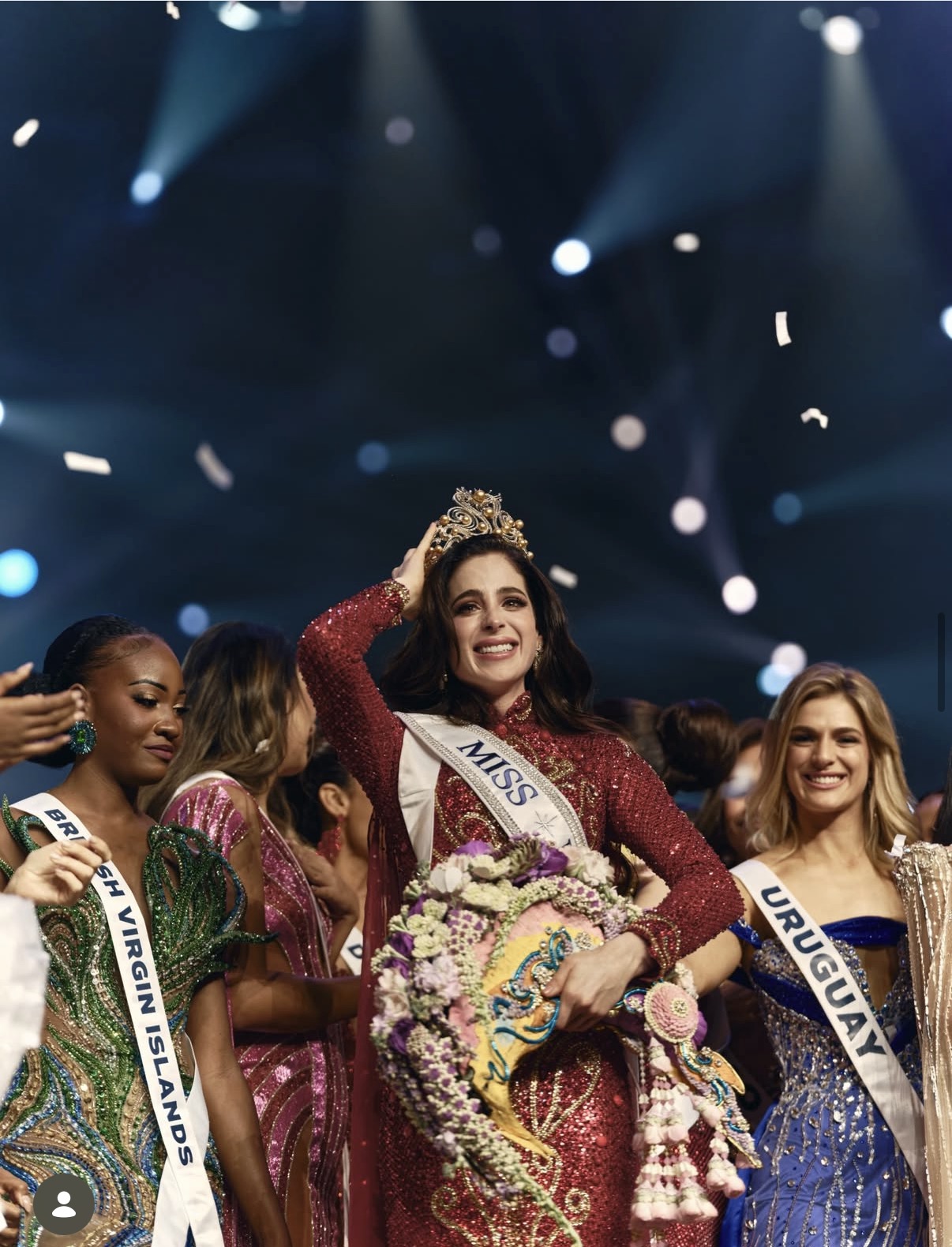
On November 21, Miss Mexico, Fátima Bosch, was crowned the 2025 Miss Universe at the 74th annual Miss Universe Pageant in Bangkok, Thailand. Her victory followed weeks of walkouts and judge resignations, raising questions for many about what women’s empowerment truly means.
Reactions to Bosch’s win revealed a broad split in how pageants are understood. For some, the controversies surrounding this year’s pageant reinforced long-standing concerns, while others saw her victory as a sign of strength and progress. At LWHS, Karen Fry’s senior history seminar, “Deeds Not Words: American Feminism,” is having conversations about pageant culture. What students are discussing now reflects a long legacy of tension inside the world of pageants, one that has shifted over decades.

photo courtesy of Miss Universe Instagram
To understand why this year’s crowning matters so much, it helps to look back at Miss Universe’s inception. The global pageant originates from a moment of protest: in 1952, when Miss America winner Yolanda Betbeze refused to pose in a swimsuit for their sponsor, Catalina Swimwear. In retaliation, Catalina Swimwear cut ties with Miss America and created two new pageants, Miss USA and Miss Universe, which were designed to center on physical beauty, particularly to highlight their swimwear. Miss USA winners would advance to Miss Universe, while Miss America evolved into something very different: a talent-based scholarship competition that emphasized public speaking, volunteer service and academic achievement.
Since 1952, the divide between the organizations has only grown. Miss Universe removed the swimsuit competition entirely in 2018 and expanded its emphasis on talent and service, rewarding winners with thousands of dollars for academic scholarship. Miss USA, however, still requires contestants to compete in swimwear, a rule that is maintained at the Miss Universe level. While Miss USA and Miss Universe have taken steps in 2023 and 2024 toward inclusivity by allowing married women, divorced women and older contestants to compete, questions persist about whether these changes represent real progress or simply maintain a system rooted in judging women.
In addition to these organizational updates, pageants have shifted the types of questions they ask contestants, focusing more on how they plan to change the world. Prompts such as ‘how will you use your platform to empower young women?’ or ‘what will you do as the next Miss Universe to uplift the voices of young women?’ reflect this shift. For Anakarina Moya ’26, cousin of Miss Universe 2023 winner Sheynnis Palacios, these questions left her feeling inspired. “That made me think like, oh shoot, this change that these women are describing could really happen. It made me feel some sort of hope for women all over the globe,” she said.
In the weeks leading up to this year’s pageant, tensions inside the Miss Universe Organization became increasingly public. Earlier in November, Bosch was publicly called a “dumbhead” by a pageant executive, Nawat Itsaragrisil, who accused her of not promoting the pageant enough. After, Bosch calmly responded to his criticism. “I have a voice,” she said, “You are not respecting me as a woman.” Quickly after, Itsaragrisil called security to escort her out. This exchange prompted several contestants to walk out in solidarity and sparked debate on social media criticizing Itsaragrisil and the Miss Universe organization’s power dynamics.
Additionally, just days before the competition, the pageant faced further backlash when two judges abruptly resigned—one publicly claiming that the competition “lacked transparency” and that “key decisions were being made by a second, undisclosed panel.” While the Miss Universe Organization denied both allegations, the resignations added to public concerns, suggesting that even insiders were unsure about the fairness of the process.
For many viewers, the events reinforced concerns that, despite new rules pushing for inclusivity, the contests are still shaped by longstanding expectations about how women should look and behave.
That skepticism is shared by 1995 Miss Los Angeles Chinatown Pageant participant, Diana Lee Sonne. “I think the controversy shows that there are still many people who don’t take these women seriously, even within the pageant management, which is disappointing,” she said. While Sonne recognizes that pageants are adapting to become more inclusive, she admits it is still difficult to avoid the pressure of lasting norms and cultural biases within pageant culture. “I think, fundamentally, it is difficult to get away from the beauty standards and hetero-normative bias, no matter how intelligent, talented and ambitious the contestants are,” Sonne said.
According to Fry, the structure of pageants fundamentally relies on comparing women’s bodies rather than uplifting them. “I think it is problematic, I think that it is about competition versus uplift,” she said. Even with global representation, Fry believes that the core message of critiquing women will remain unchanged. “You would have to take out the judging,” she said. “But then if you take out the judging, there is no pageant.”

photo courtesy of Miss Universe Instagram
While many critics view pageants as reinforcing traditional beauty standards, not all experiences fall under that interpretation. A current contestant and several viewers described environments defined by friendship, mentorship and confidence-building rather than pressure or scrutiny.
Maddison Graf, a current county-level title holder in the Miss America system, shared an experience filled with support. Graf, who has grown up in the pageant world since she was a kindergartener, described how pageants have helped teach her how to overcome her fear of public speaking, show off her talent, receive thousands of dollars for her academics and make many lifelong friendships. “The best part is the sisterhood of the organization. Everyone becomes such great friends and is really there to support one another,” she said.
While Bosch’s win was followed by many critiques on social media—many claiming that “she only won “because of the controversy”—some view her win as proof of the strength and the sisterhood that the pageant world creates. “While there are many comments saying she only won because of the bullying, I think it’s nice to see the fact that the other participants were in support of her despite technically competing against her,” Moya said.
For many in Mexico, Bosch’s win carried symbolic weight after the controversy earlier in the month. Dalai Taba, who lives in Mexico City, emphasized the significance of Bosch’s win despite the controversy and her belief that Bosch’s win was not only a national achievement but also a reflection of personal strength. “Fáti is a shining example of true light that cannot be extinguished by criticism or controversy. Despite the pressures, comments, and demands of such a large stage, she remains steadfast, dignified and true to her beliefs,” she said.
These differing perspectives—critical, supportive, or anywhere in between—shape how this year’s Miss Universe outcome is being interpreted. Bosch’s path to winning Miss Universe highlights the broader debate today surrounding pageants: whether recent rule changes and moments of contestant self-advocacy signal a meaningful shift, or whether the concept of pageants, itself, will prevent true empowerment.