

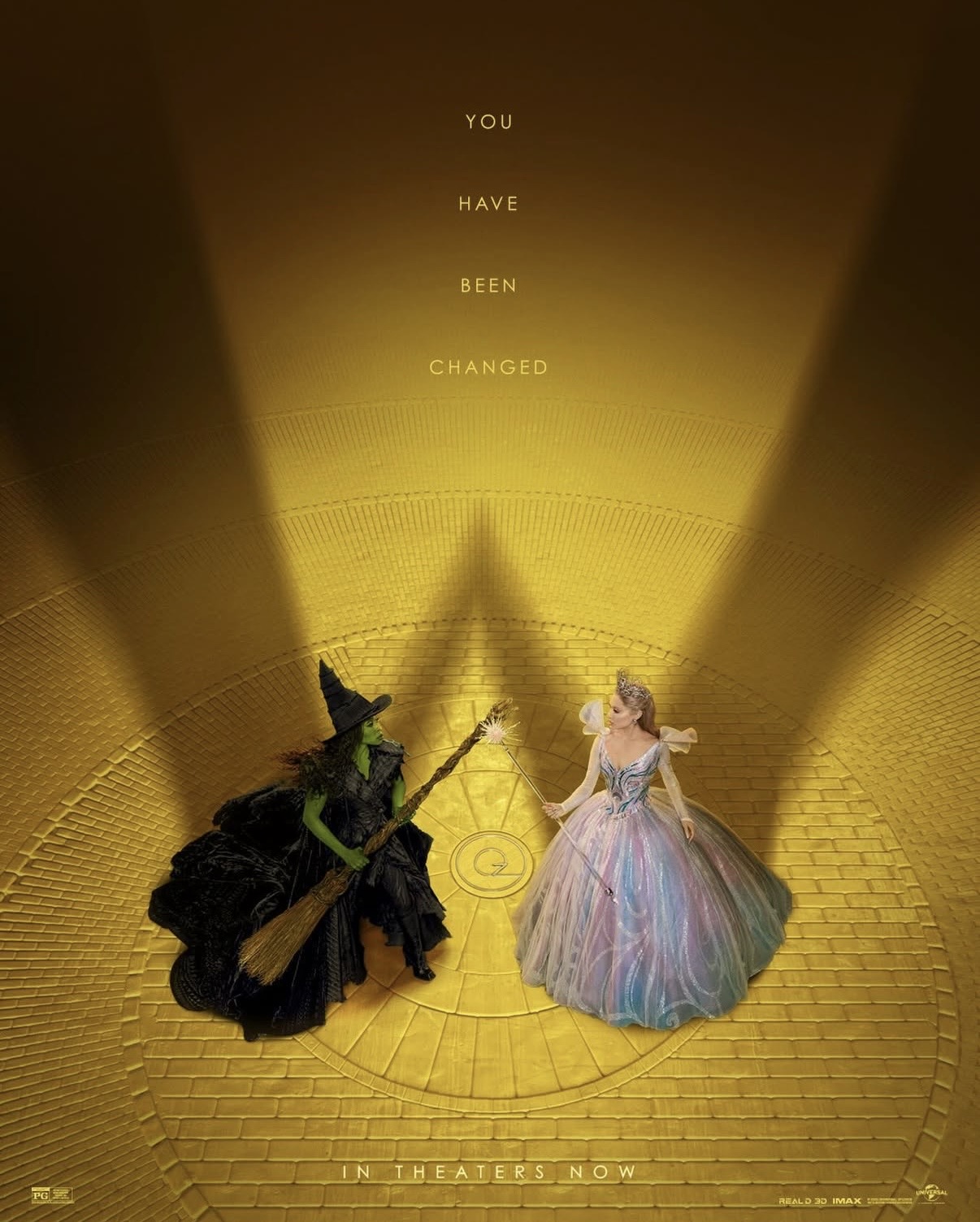
“Because I knew you, I have been changed…For good.”
This line from Wicked: For Good is the heartfelt, magical moment that lingers long after the final note. Estranged best friends Elphaba and Glinda, played respectively by Cynthia Erivo and Ariana Grande-Butera, face each other, their eyes brimming with tears as they tenderly sing about the unexpected friendship that blossomed over nearly five hours between the two installments of the Wicked film adaptation. Afterwards, I stood outside the theater, surrounded by people murmuring their awe and wiping tears, as I reflected on the dazzling, albeit oddly paced, farewell to Oz.
Director Jon Chu breathes glittery, CGI-packed life into the revisionist retelling of The Wizard of Oz that first debuted as a Broadway musical in 2003. After the first film’s success as the highest-grossing stage-to-screen adaptation ever, expectations were high for the sequel’s debut on November 21, 2025.
The result? Wicked: For Good is cleverly packed with inside jokes and sparkling nods to Wicked’s various forms and parallels, making the conclusion feel expertly foreshadowed. The director’s decision to splice between Glinda’s bridal walk down the aisle, surrounded by golden butterflies and pink flowers, and Elphaba’s descent into the shadowy room where the Wizard imprisoned animals, created a particularly striking moment. Though the finale to the two-part story fell short in some areas, the messier, darker sequel delivered on Wicked’s resonant political commentary and emotional depth.
The music was undeniably key to this impact, as layered melodies from the first film threaded the two movies together. Two songs were added to the original score—“No Place Like Home,” in which Elphaba grapples with her responsibility to protect Oz, and “Girl in the Bubble,” through which Glinda rejects the unrealistically perfect life she has curated, instead embracing Elphaba’s struggle. These additions were seamlessly integrated, making it difficult to imagine the plot without their visionary depth.
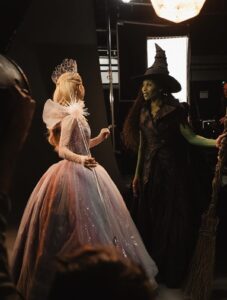
photo courtesy of @wickedmovie
The film’s emotional poignancy delivers one of its most powerful punches during “No Good Deed.” Elphaba’s grief at losing her beloved Fiyero, played by the talented Jonathan Bailey, culminates in her being compelled to embrace the role of the “Wicked Witch of the West.” As Elphaba hovered, framed by an abandoned castle and an army of winged monkeys, I understood exactly how the sincere, smart girl we met at the start of Wicked transforms into the iconic villain of The Wizard of Oz.
This transformation is not, as propagandists Madame Morrible and the Wizard might claim, a result of her inherent evil. Rather, “No Good Deed” conveys Elphaba’s desperation and disillusionment after losing everything in her fight against tyranny and fascism, a message that feels especially potent amidst today’s crackdowns on marginalized communities and widespread misinformation.
However, “Wonderful” was a painful miss in the otherwise gorgeous soundtrack. As Jeff Goldblum’s Wizard and Glinda attempted to lure Elphaba to join them, I was left feeling bored, the scene seeming to repeat Elphaba’s meeting with the Wizard in part one. Compared to the heart-tugging depth of Grande-Butera and Erivo’s characters, Goldblum’s uneven singing and lackluster humor dragged down the film’s impact. Similarly, despite her prowess as an actor in films like Crazy Rich Asians, Michelle Yeoh’s Madame Morrible, mentor to Elphaba, turned evil sorceress, felt misplaced and forced into the narrative.
Poor pacing was another element that disrupted the movie’s magic. Key plot details, like the development of Fiyero and Elphaba’s romance, and Nessarose’s evolution into the loathed governor of Munchkinland and Wicked Witch of the East, felt rushed.
Despite these shortcomings, when the film reaches its climax with the arrival of Dorothy, who embarks on a journey to kill the Wicked Witch of the West, you can’t help but cling to the arms of your seat, enthralled. The scenery descends into darkness as Boq—a former friend of Elphaba and Glinda, now transformed into the Tin Man—stands before a mob intent on hunting down Elphaba with pitchforks and torches, declaring, “So for once I’m glad I’m heartless, I’ll be heartless killing her!” The crowd’s unsettling hunger for violence illustrates how a seemingly idyllic world can be easily corrupted, a particularly sharp and necessary commentary in a time when fascism feels too close for comfort amongst our leadership in the U.S.
Glinda’s nascent growth at the end of the film imbues viewers with a cautious hope and a call to action. After her tearful goodbye, promising to continue Elphaba’s work against tyranny and Glinda hides in a closet while the ending to The Wizard of Oz is spelled out (without violating copyrights that protect certain elements of the 1939 movie, including Judy Garland’s portrayal of Dorothy). She returns to the Emerald City with fresh, fierce intention, revealing that the Wizard is Elphaba’s father before he returns back to Kansas, and imprisoning Madame Morrible with a witty line that mirrors Morrible’s callousness towards Glinda in part one.
At last, we return to the first scene of Wicked: Elphaba’s crooked black hat sitting in water on the floor of an abandoned castle. Fiyero, transformed into the scarecrow of The Wizard of Oz, enters and opens a secret door in the floor to reveal his lover, Elphaba, who has faked her death so the two can escape Oz.
Despite the harrowing journey that Glinda and Elphaba endured over the two movies, the film closes with a tender testament to their enduring friendship. We are transported to a shared flashback of Glinda and Elphaba, golden light shining as Glinda turns her head to whisper in Elphaba’s ear, recreating the original playbill of the Wicked Broadway musical.
Ultimately, Wicked: For Good is beautiful and brilliant, offering a darker, emotionally gripping conclusion to the two-part adaptation. With clever foreshadowing, nods to the story’s various forms and a mostly magical soundtrack, the film breathes new life into the familiar tale while honoring the original Broadway musical. Though the pacing falters and the portrayals of the Wizard and Madame Morrible fall short, the movie’s themes of love, resistance to injustice and friendship remain deeply poignant and powerful.
As I left the theater of Wicked: For Good, “For Good” echoed in my mind, leaving me certain that I, too, had been changed for the better.