


Two months ago in St. Paul, Minnesota, my aunt and uncle sat my ten-year-old cousin Charlotte down to have ‘the talk.’ Not the traditional, and uncomfortable, birds and bees talk. This talk was far worse—about why, on August 27, her basketball teammate was severely injured by a gunshot wound at the Minneapolis Annunciation Catholic Church shooting.
Charlotte’s teammate, Astoria Safe, was in the pews when violence struck. During a mass to commemorate the first week of school, 23-year-old Robin Westman, a former student of Annunciation Catholic School, opened fire through the stained glass windows. Children, mid-prayer, were instructed to drop to the floor; Father Dennis Zehren, mid-homily, ducked behind the pulpit. With doors barred by the gunman, there was no choice but to wait—and pray—for help to arrive.
Astoria held onto two friends. While she survived and is making an astounding recovery, bullet fragments remain lodged in her skull, too dangerous to remove. A girl she clung to, Harper Moyski, aged ten, died instantly. Fletcher Merkel, just eight, was also killed. Westman died of self-inflicted wounds before help arrived.
Charlotte’s parents ended the conversation by inviting her to reflect and ask questions. With that, my cousin joins millions in this generation’s painful rite of passage: exposure to gun violence in America.
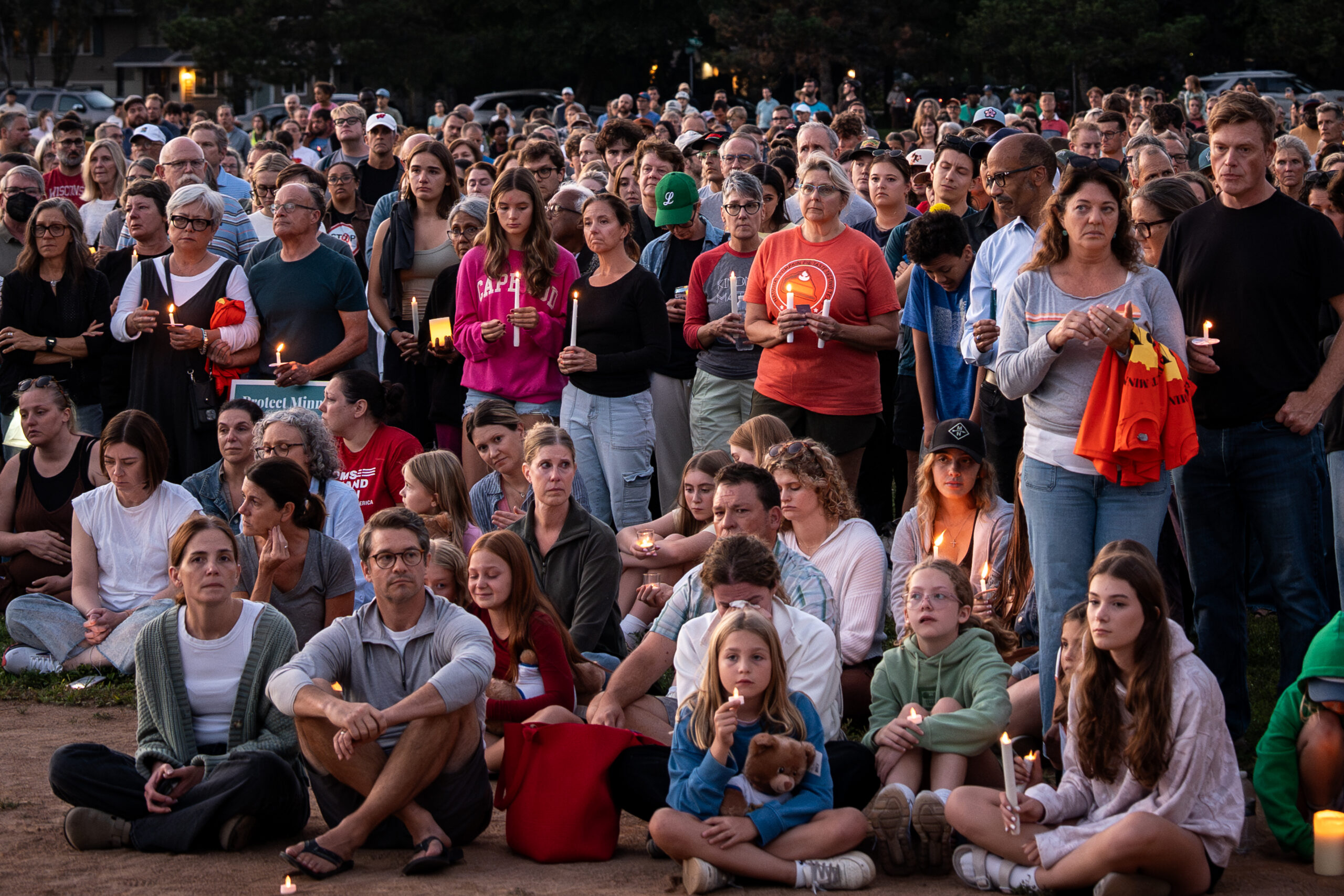
At the first mass following the shooting, Father Zehren said, “We are in a lower place than we could have ever imagined.” Yet for many readers, this news likely felt like just another headline in an endless cycle of American violence. Another shooting. Another round of “thoughts and prayers.” And, if we’re honest, most of us have grown numb. That’s part of the problem.
“How could we lose so much humanity?” Ashley Yuckenberg, a journalist and assistant professor at George Mason University, said.
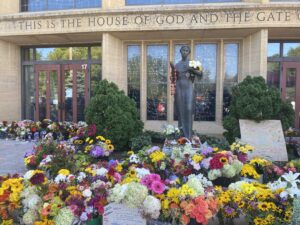
photo courtesy of Wikipedia Commons
The Annunciation shooting was 158 of 188 U.S. K-12 school shootings in 2025 alone. 2024 totaled 336. In 2023, 351. According to the Centers for Disease Control, gun violence is the leading cause of death among adolescents ages 0-19. Despite centuries of development against famine and disease, the leading cause of death for children is inflicted by the very people tasked with protecting them.
According to Everytown for Gun Safety, the largest gun violence prevention organization in the U.S., a majority of Americans have been directly or indirectly affected by gun-related forms of violence. In Minneapolis alone, multiple events of gun-related violence have followed in the weeks after Annunciation: North Minneapolis shooting and stabbing; South Minneapolis mass shooting; the list continues. The seed of one act of violence sprouts a chain of others in a “contagion effect,” Yuckenberg said.
During my last trip to Minneapolis in 2022, I was present during a fatal shooting at the Mall of America. Following this event, my childhood image of Minnesota, filled with Midwestern warmth and family memories, has darkened. Yet, when I returned to the Bay Area, I caught myself feeling a guilty relief that, at the very least, it did not happen at home.
Sadly, even this no longer remains true. The very day after Annunciation, a shooter was reported outside of Convent and Stuart Hall High School in San Francisco.
“It was very sudden,” Charlotte Gesell, Convent ’26, said. “I was frantically going through my friends’ schedules, wondering, who has class on the other campus?” As word of a potential shooter infiltrated the campus, one teacher, wrapped in the momentary chaos, wrapped a belt around the door hinge and armed himself with staplers. “[His students] were like, are you gonna throw the staplers at the intruder or something?” Gesell said.
This was not the Bay’s first confrontation with shooter threats. Last year, Balboa High School locked down over warnings, as did Capuchino High School in San Bruno. Though the Convent report thankfully proved false, the growing frequency of these incidents has made the possibility of a school shooting at ‘home’ feel all too real.
Whenever these events occur, it is natural to search for a culprit to blame. A certain type of person; a particular environment. However, the only way to prevent the next shooting is to admit that current gun policies are inadequate and that mental health resources are dangerously scarce. The National Institutes of Health reports that 70% of American counties lack access to a child psychiatrist. If help is unavailable for those seeking it, what chance do the silent have?
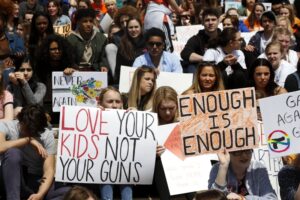
photo courtesy of The Mane Street Mirror
Even preventative measures hold little impact. In the past several years, U.S. schools have implemented lockdown drills alongside fire and natural disaster drills. However, because shooters are often current or former students, these drills serve as what David Riedman, founder of the K-12 Database, calls: “A tutorial and rehearsal for how to commit a school shooting.”
While Yuka Hachiuma, Lick-Wilmerding High School counselor, acknowledges that she would rather be prepared than not, she notes the controversy of having kids rehearse such a traumatic event. Beyond drills, many schools have enforced TSA-airport style security. In Texas, students are even required to take “Stop the Bleed” training on how to save wounded classmates. Such measures prepare students to “accept and handle fear,” Jaime Treviño, a sophomore at St. Mary’s University and former student of Sharyland High School in Mission, Texas, where this training was implemented, said.
United Nations Deputy Secretary-General Amina Mohammed said: “No one is safe, until everyone is.” She is right. There will be another school shooting. And another. And another, until we decide to prioritize protecting the lives of everyone over defending weapons that only protect the individual. Somehow, the present has reflected that society has yet to reach this point. So, for the time being, how do we cope?
For my cousin, processing has not been easy. “Charlotte’s kind of tough,” my uncle said. “She goes into herself and asks few questions, so she seems pretty resilient. But I also know she has probably thought about it internally, but not asked us more.”
For the rest of us observing from behind our news tabs, we cycle through initial shock, media consumption and then moving on. Sometimes, we may feel inspired to donate to a GoFundMe or make a somewhat sincere post on Instagram. Most often, we grow indifferent. “Compassion is an unstable emotion…If one feels that there is nothing “we” can do…one starts to get bored,” Susan Sontag, writer and activist, wrote.
Even the media, meant to stimulate action, can be overwhelming. Constant exposure to violence runs the risk of passive media consumption and retraumatizing survivors. “Your mind says, there’s not really anything you can do. So you just sit there, thinking, I can’t believe this is going on,” my uncle said.
“School shooting is the final link in chains of failures,” Riedman said in an interview with Stephen Dubner on Freakonomics Radio. He is right. The only way to break this chain is to confront gun violence head-on with policy reform and greater attention to mental health care.
The time for change is now. But if society still feels incapable of listening, then at the bare minimum, we must not relinquish compassion.