
On July 11, 2025, Bad Bunny launched a 30-show residency at El Coliseo in San Juan, Puerto Rico (PR), to kick off his Debí Tirar Más Fotos (DTMF) World Tour. The residency, producing a $733 million economic boom, marked a homecoming not just for Bad Bunny, but PR at large.
Born Benito Antonio Martínez Ocasio, Bad Bunny is a 31-year-old artist born and raised in PR who first blew up for his trap and reggaeton on SoundCloud in 2016. Since then, he’s become a global name working with artists such as Cardi B and Drake, winning 12 Latin Grammys, and becoming one of the most-streamed artists of all time. He was recently announced as the 60th Super Bowl Halftime performer, which is set to take place in 2026 at Santa Clara’s Levi’s Stadium.
His residency, No Me Quiero Ir de Aquí, was more than a 3-hour concert—it was a tribute to PR start to finish. His most recent album, DTMF, released on January 5, 2025, marked a shift from his mainstream reggaeton to distinctly displaying the diverse and rich PR culture, paying homage to his upbringing. DTMF is a striking blend of modern reggaeton with traditional Puerto Rican sounds such as bomba, plena and salsa. The album even included live instrumentals from the Escuela Libre de Música and features almost exclusively PR artists. More than anything, his lyrics speak up for PR with critiques on tourism, PR upbringing, politics and community.
Songs like “Lo Que le Pasó a Hawái” talk about the annexation of Puerto Rico like that of Hawaii. Although Hawaii is now a state and PR remains unincorporated territory, Bad Bunny expresses his concerns over similar patterns of treatment such as the gentrification due to foreigners.
“Turista,” although seemingly a love song at first glance, uses the metaphor of a tourist’s treatment of Puerto Rico to explain a toxic relationship.
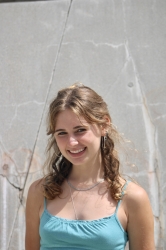
“For Puerto Ricans, for those who have stayed and for those who have left, it feels like someone is staring directly into your soul,” said Puerto Rican resident and musician Mónica Garcia on the impact of Bad Bunny’s music. “You think about all the things you lost, but you find a beauty to it…‘una perdida bonita.’”
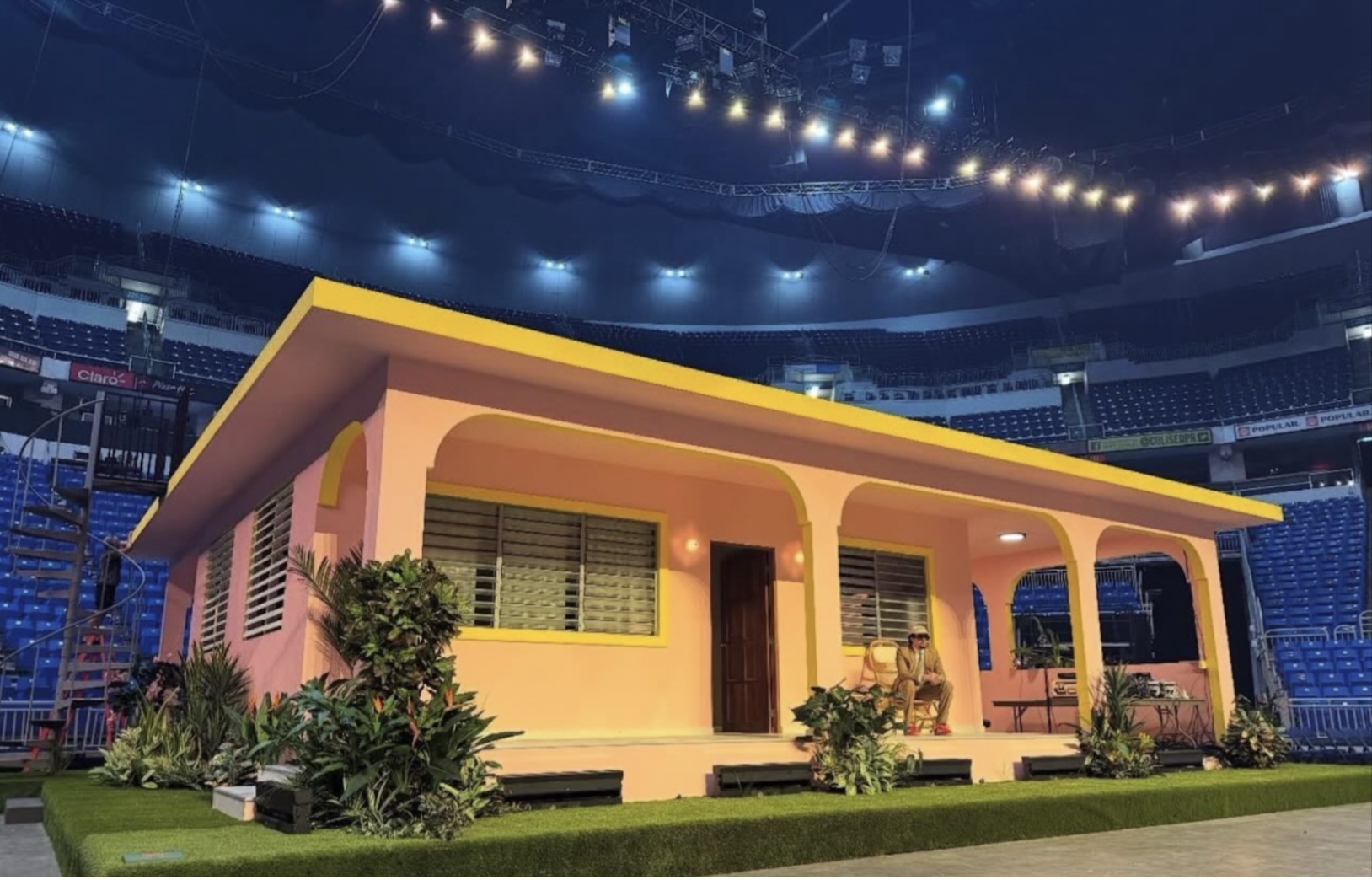
Puerto Rican culture is weaved into the No Me Quiero Ir de Aquí residency. Made by over 1000 Puerto Rican workers, the residency included two concert sets. The first, a mountain: a take on Cerro Mime with native vegetation like plantain trees and the national tree, flamboyan. Second, La Casita: a nostalgic recreation of traditional Puerto Rican houses including chicken coops, a broken satellite, even an AC cooler. “Seeing your culture on a stage, it’s damn cool,” Garcia said.
But Bad Bunny has sparked a wave of PR pride beyond the music world. His residency wardrobe was created by local Puerto Rican brands like Ecliptica, Otero, Yayi Perez and more, all inspired by traditional Puerto Rican clothing, and all quickly making their way from the stage into daily PR life. “Even boys in my friend group…they’re all going out in guayaberas, chanclas and sombrero de pava. Everyone is dressing like him, but this is the way we traditionally used to dress. He’s bringing that back,” Garcia said.
The first nine days of the shows were reserved for Puerto Ricans only, requiring proof of residence to purchase a ticket. For the 21 other shows, PR saw an increased influx of tourists, despite being in its “slow season.” Bad Bunny’s shows drew in an estimate of 400,000 tourists by the end of his residency.
Aware of the effects, Bad Bunny and his team took precautions, creating a list of PR owned hotels, restaurants, brands, nail salons and more for tourists to stay and shop, but fuel their money towards native PR, instead of foreign chains. Overall, he created an economic boom of $733 million.
In an interview with The New York Times, Bad Bunny shared his vision for the residency. “I kept asking myself, what’s the purpose of me being here, in this position?…to give opportunities to young people, to give exposure to young musicians, artists, to give exposure to Puerto Rican rhythms, to my culture,” he said.
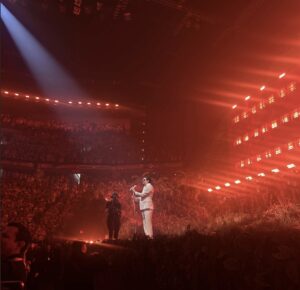
photo courtesy of Mónica Garcia
Bad Bunny doubled down on this sentiment when he announced he would have no U.S. stops for his current world tour due to concerns of ICE raids. Past concert attendee Anakarina Moya ’26 understood why. “I think it’s valid…Am I sad he’s not coming? Of course. But I think it’s very important that he’s looking out for his community.” Isa Burke ’26 agreed. “We have to think about the reality of the time we’re in,” Burke said.
But on September 28, 2025, Bad Bunny announced adding one U.S. stop—the 60th Super Bowl Halftime Show. The announcement was quickly met with racially charged outcry, with many claiming he was “un-American” and citing hypocrisy in his previous statements about staying away from the U.S. In response, Bad Bunny took to X, writing, “This is for my people, my culture and our history. Ve y dile a tu abuela, que seremos el Halftime del Superbowl.”
Bad Bunny has sparked a movement by shaping his current music to highlight the beauty of his culture, rather than just the setbacks, inspiring many PR residents, including Garcia. “Trabajaba en un supermercado, broke as hell, y mira dónde está ahora. Todo es posible,” she said.