

In opposition to the slew of contentious domestic and international policies enacted by President Donald J. Trump, activists have taken to the streets in thousands of demonstrations—from tiny neighborhood rallies to massive national campaigns.
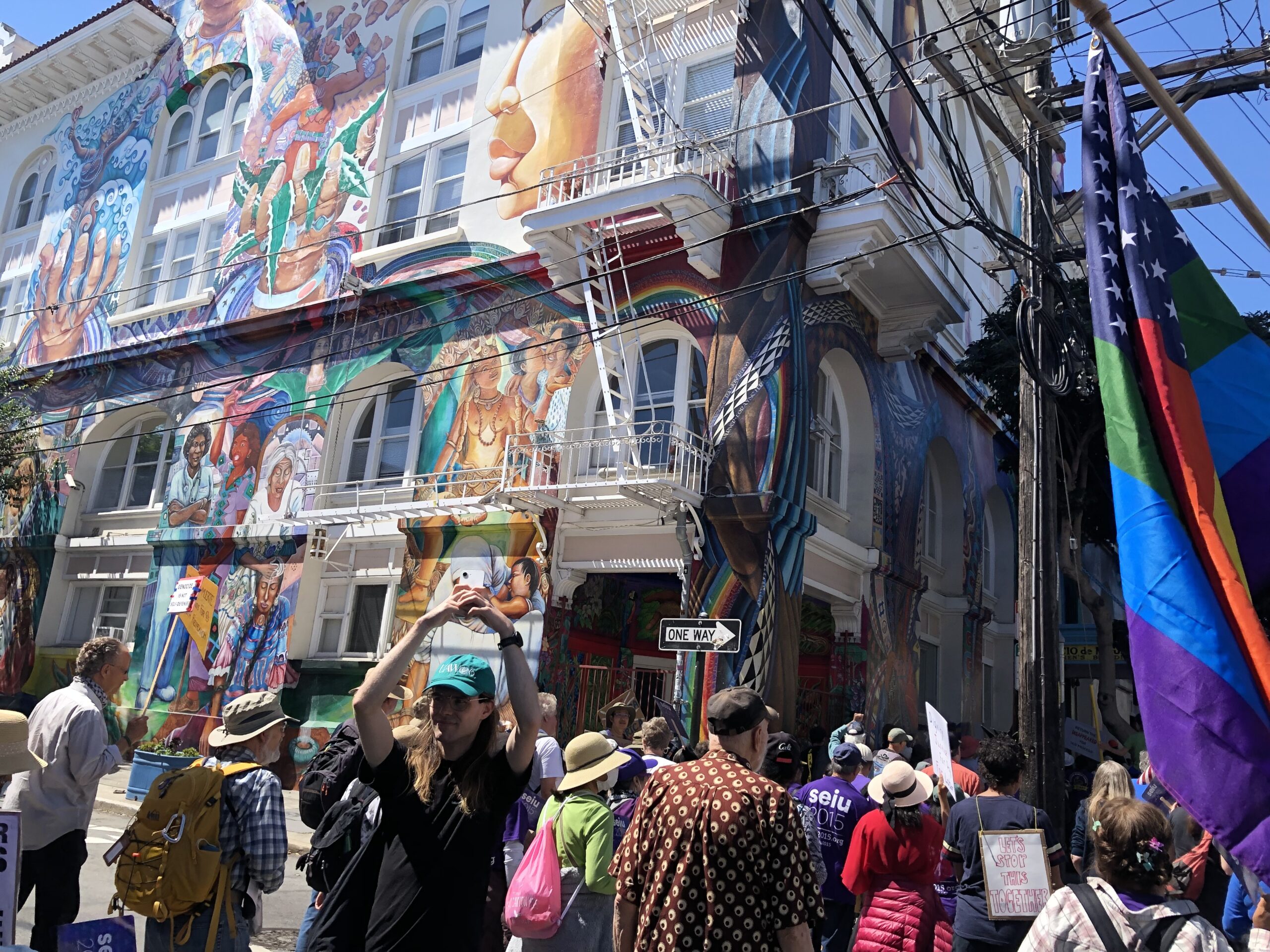
At nearly every protest, Baby Boomers, a generation who came of age during the 1960s and 70s, act together, driven by a deep belief in the power of marching, public resistance and free expression. Over time, this shared commitment has fostered a strong community of older female activists, united through their continued involvement and commitment to social justice.
Trump’s second term has reignited political activism across the nation, as his rhetoric and policies challenge democratic norms—particularly in his attacks on minority rights, encouragement of political hostility and threats to First Amendment freedoms. According to the American Civil Liberties Union, over five million people attended the “No Kings” protests held on June 14, 2025. The estimated 2,100 anti-Trump protests amounted to a nationwide uprising that coincided with the President’s 79th birthday and the U.S. Army’s 250th anniversary parade.
The second wave of the “No Kings” demonstrations is scheduled to take place on Saturday, October 18, 2025, and will include numerous protests, both here in the Bay Area and nationwide.
Dana Cayce, 75, an experienced protestor and resident of San Francisco, is deeply concerned about Trump’s crackdown on women, immigrants and members of other marginalized communities. “The United States is heading into a period of extreme poverty, extreme violence and the loss of human rights,” she said. “The evil and the inhumanity of the people in power is wreaking havoc on our country.” A September 2025 poll by The Washington Post and Ipsos found that 56% of Americans disapproved of Trump’s job performance, specifically his administration’s handling of the economy, foreign relations and domestic issues such as crime.
Frustrated by Trump, countless citizens have exercised their right to the freedom of speech, protesting against harmful actions and legislation just as individuals have for years. Cayce attended her first protest at the age of 17, standing with thousands of others at an anti-Vietnam War rally that took place in San Francisco on April 15, 1967. “I was drawn to these protests because of the outrageous injustices and atrocities of the time,” she said, adding that the same motivation drives her to participate in protests today.
Naomi, 71, who asked to be referred to only by her first name, has been attending protests since 1970. At the age of 12, she joined her first demonstration while attending San Francisco’s A.P. Giannini Middle School, walking out of her classes in order to support better working conditions and higher pay for her teachers.
Naomi’s parents supported her advocacy; as Japanese Americans who lived through the WWII concentration camps, they were familiar with the pain of silence. “Nobody stood up for my family. Nobody said anything. So we did. We spoke up for others at every chance we got,” she said, echoing the words of other incarcerated individuals of her parents’ generation.
For both women, every protest is an opportunity to uplift all voices, including marginalized ones, from the “No Kings” march months ago to recurring efforts such as the Human Banner at Ocean Beach, protests in which participants arrange their bodies to depict words and symbols. Their experience lends them confidence and certainty in these spaces, welcoming newcomers such as Bernadette Kavanagh, 72, whose first protest was the “No Kings” march this past June.
“I finally felt as though I was really doing something about all the devastation I have seen in our country,” Kavanagh said. “We all need to do our part.”
A staunch believer in democracy and the American Dream, Kavanagh immigrated to the United States from Ireland in 1987. She believes that elected officials have a duty to care for their citizens, but does not see that sense of responsibility and care reflected in today’s political sphere. “Dragging immigrants from the streets, separating them from their families, leaving children alone with no one to care for them—all of this is inhumane,” she said.
Her first experience at the “No Kings” protest was transformative; she now believes that activism is one’s civic duty, a view shared by Adrianne Borgia, 75, an avid protestor who previously worked as a member of the Peace Corps from January 2014 to May 2016.
Borgia’s activism is directly informed by her travels around the world and service in many areas, such as Nyanuembe, Tanzania, where she worked as a teacher, agriculturist and medical practitioner from 2013 to 2016. “Protests and marches are integral to affecting change, but I do best when I am really helping individuals,” she said. Borgia has recently sponsored three immigrants from Central America through the Kehilla Community Synagogue located in Oakland, California. She, too, is especially concerned about both current immigration policies and the preservation of women’s rights across the country.
Today, all four women are incredibly active in their communities, grounding their activism in their collective strength and heritage, recalling all the activists who came before them and looking to those who will follow. “There are so many ways in which we are powerless. We cannot control what is going on, especially now,” Cayce said. “But protesting is power.”