



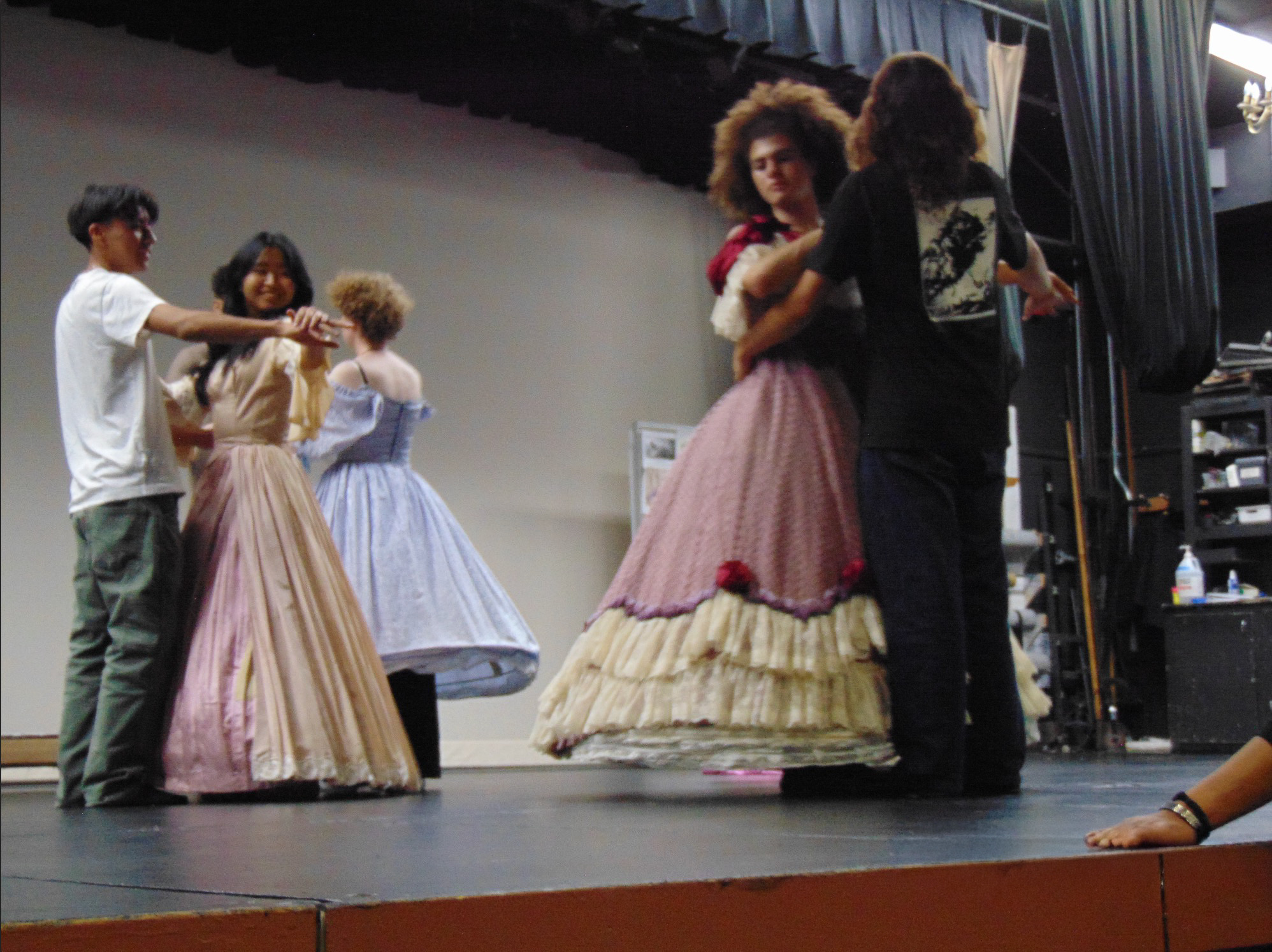
On November 6, the Ehrer Theatre’s stage will be sent back to the time of the Civil War, as Lick-Wilmerding’s Theatre Department brings Little Women to life. Louisa May Alcott’s classic American novel, adapted by self-described radical feminist playwright Kate Hamill, recontextualizes the 1868 story for the modern era. The cast reflects on what it means to reimagine a classic, bringing old stories to new audiences.
The original story by Alcott follows the four March girls: Meg, Amy, Jo and Beth, as they traverse through life in this coming-of-age tale. The misadventures of the March sisters have been told throughout film and theatre dozens of prominent and unique times, but Hamill’s adaptation reshapes the story. “Traditionally, adaptations are sort of copy-and-paste jobs. That’s not a uniform rule, but a lot of people really want to be very faithful to the original,” said Hamill in an interview with PBS, “I believe in creating something that’s much more surprising and theatrical.”
Miguel Zavala, LWHS’s theatre director, describes these types of stories as “cultural touchstones.” “I think classics are very important because they’re cultural touchstones, which we go back to over and over again. Though we keep growing, we keep moving ahead in time, and so our culture starts to change. So, how do we work with these classics in a modern world without losing their essence?”
Zavala mentioned the school’s previous rendition of A Midsummer Night’s Dream. “I’ve seen Midsummer Night’s Dream done many different ways. We’ve done that here…why not do something new, putting it in a different reality and fresh without taking away, you know, the messages that it has at its core.”
photo courtesy of Artemis Boda ’27
The production features Nola Kra-Caskey ’26 as Jo and Tarek Wilks ’26 as Laurie. Wilks believes that there is still value in classic stories, despite their often outdated ideas. “It’s really just about taking the core ideas of those classics, but also applying some more modern aspects of how you would treat those storylines,” Wilks said. He describes modernization as altering the way characters talk or removing outdated dialogue to make the play more accessible and inclusive. For Wilks, modernization creates more relatable characters and therefore allows the audience to connect more authentically with the story, instead of needing to shift their mindsets to relate to outdated characters. “There isn’t a need to…Teleport into this time period,” Wilks said.
One modernization made by Hamill is placing Jo March as the protagonist. In the play, Jo is the self-appointed “man of the house,” following her father’s deployment in the Civil War. A novice writer whose sisters do not see as ladylike, Jo grapples with expectations of the world around her, as some people pressure her to conform to non-feminist ideals. She meets Theodore “Laurie” Laurence, with whom she bonds over the expectations set for them; Laurie is poised to head off for college, and Jo is expected to realign herself into becoming a proper wife.
For Emilia Duncan-Munoz ’26, fully transporting herself is essential to her acting. Duncan-Munoz plays Beth, the second-youngest March girl. “It’s one of my favorite parts,” she said, describing her research process. Duncan-Munoz found a diary written by Alcott’s younger sister and used it as the foundation for her portrayal of Beth. She also pointed out that trivial knowledge, such as favorite foods or favorite animals, might be important to create a “fuller picture of the character,” she said.
photo courtesy of Artemis Boda ’27
Daniel Wydler ’26, who plays Mr. Laurence, reiterates, “I had no bit of acting experience before joining LWHS Theater, and now it’s one of my biggest passions, and it’s something that I want to pursue for the rest of my life,” he said. Wydler hopes to be an inspiration for the younger students. “It’s okay to put yourself out there and risk having others’ perception of you change because you’re just being you,” he said.
Tillie Clayton ’27, who plays Amy, the youngest of the March siblings, compares Hamill’s rephrasing to the original text, saying that the reimagination attempts to capture Alcott’s original intent. “Kate Hamill took into account the elements of the original novel that Louisa May Alcott was encouraged very strongly by her publisher to include,” Clayton said. “I think it’s almost, in a way, even more true to the original text and to what Alcott wanted with her art.”
“[Hamill]’s crafting a new, modern take on [these classics] so that new generations can enjoy the good parts of old pieces without having the burdens of them being outdated or them being sexist or not appropriate for the modern audience,” Wylder said.
The process of acting and adapting a classic has led the cast to dive into their script and analyze their text, while synthesizing with the ideas present both 150 years ago and new ones brought up by Hamill’s reanalysis in the modern day. See this century and a half of storytelling come to life in the Ehrer Theatre from November 6-8!