

In a special election on November 4, California voters passed Proposition 50—also known as the “Election Rigging Response Act”—an amendment to California’s constitution that would temporarily redraw the state’s congressional districts, thereby making it easier for the Democratic Party to gain seats in the House of Representatives.
The November 2025 vote was classified as a special election: an election that takes place between general elections and is often used to vote on an urgent or unprecedented matter.
The creation of Prop 50 was prompted by Texas’s redistricting efforts to gain five more seats in the House of Representatives—a drive largely influenced by President Donald Trump to expand Republican congressional power. In the bill, California defines its goal as responding to Texas’s gerrymandered additional seats with its own.
According to the Democratic Party website, the bill is an essential “opportunity to fight back against the Republican cuts to healthcare, the rising cost of living under tariffs, and the cruel abductions and forced removals of immigrants.”
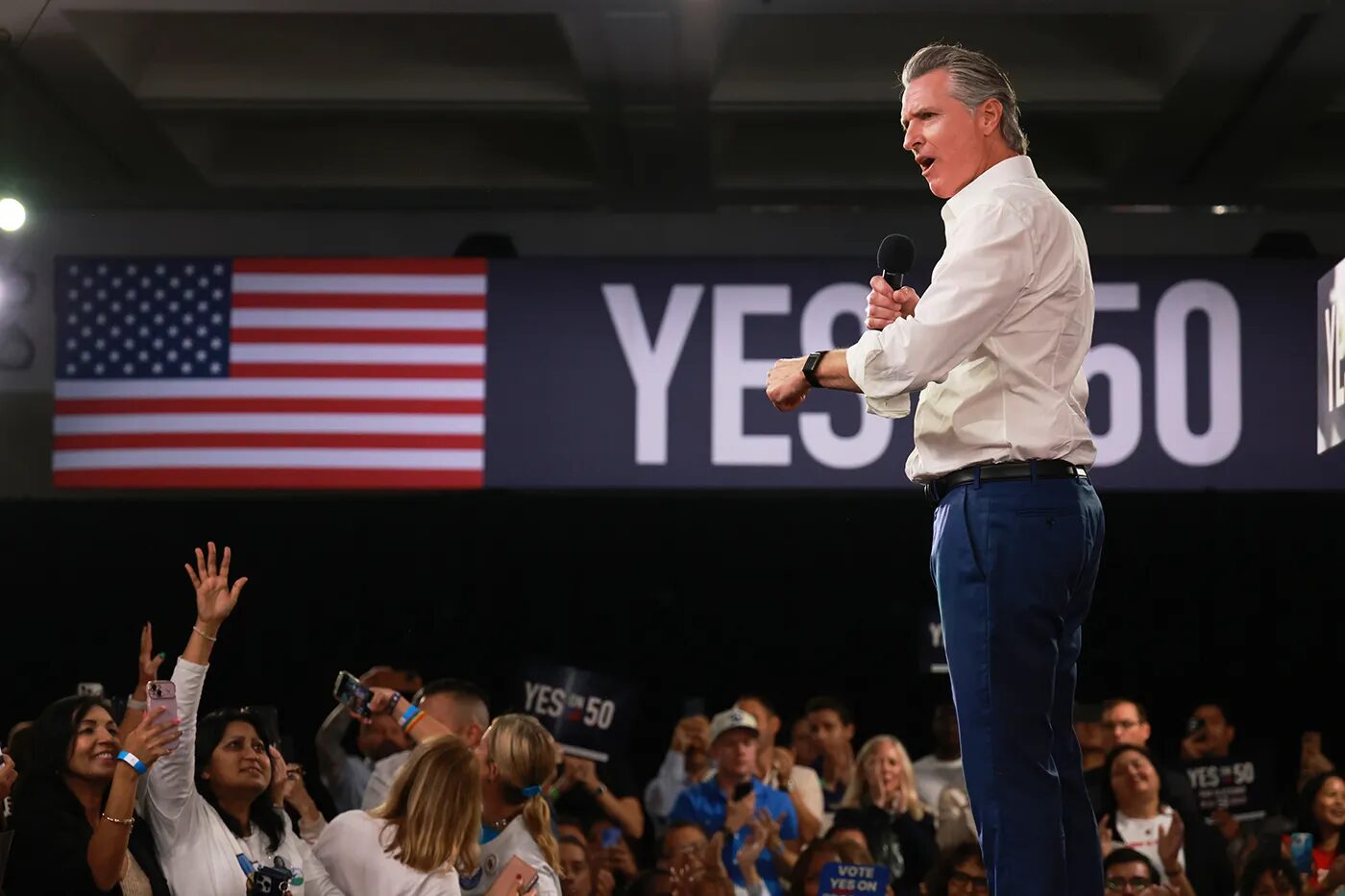
On August 21, California Governor Gavin Newsom signed a package that would put Prop 50 on the ballot for California’s November election. Over the following three months, Newsom became the face of a massive push to pass the bill. The campaign supporting Prop 50 has spent over $26 million on ads that circulated nationally across streaming platforms and cable television, featuring not only state leaders but also well-known faces of the Democratic Party, including former President Barack Obama and New York Representative Alexandria Ocasio-Cortez.
Ad campaigns focused heavily on Trump’s threat to California; over the past few months, California, a heavily Democratic state, has been the target of the President’s controversial immigration crackdowns. Newsom posits that California must fight back. “They didn’t expect we would fight fire with fire. It’s a different Democratic party out here,” Newsom said.
Significant investment and campaigning were also poured into stopping the passage of the bill. Prop 50, Republicans argued, would give potentially biased or self-motivated lawmakers the power to create their own political districts, and therefore the ability to keep themselves in power.
Republican donor Charles Munger Jr. spent over $32 million on the campaign to stop its passage. He has a history of supporting independent redistricting in California and contributing financially to three past bills.
In 2005, he backed Proposition 77, a constitutional amendment that proposed handing power over legislative and congressional redistricting to a panel of judges rather than the state government. He also supported the successful Propositions 11 and 20 in 2008 and 2010, which fully transferred redistricting power to the California Citizens Redistricting Committee, made up of both partisan and nonpartisan Californians.
These measures were passed under former Republican governor Arnold Schwarzenegger, who also opposed the passage of Prop 50. “It doesn’t make any sense to me that because we have to fight Trump, [we have] to become Trump,” Schwarzenegger said.
“They’re going to draw a district that once they win it, the other party can never win it, so they never have to come back to the district to talk to people. People keep voting, and things don’t change,” Munger said concerning partisan redistricting. “No matter how angry the people get about something or how much they believe in a cause, nothing shall change because it’s for the politician’s safety, not for them to be accountable.”
California has a robust history of independent commissioning—its system contrasts with its redistricting rival, Texas, in that California uses an independent committee to redistrict while Texas does so through the state legislature.
“Prop 50 takes the redistricting power away from citizens and gives that power back to the politicians so they can manipulate the lines of election districts for their own personal political benefit,” the website of Reform California, a proponent of “No on Prop 50,” reads.
Additionally, “No on Prop 50” cited the expense of the special election, which will cost $200 million of California taxpayers, not to mention how much organizers are spending, an amount that makes Prop 50 the fifth most expensive ballot measure in California history. To this, however, Newsom argues that there is “No price tag for democracy,” maintaining that California’s execution of Prop 50 is necessary for balancing partisan scales across the nation.
On November 13, the Department of Justice sued to block California’s new congressional district maps, maintaining that the gerrymandered districts were racially categorized. “Governor Newsom’s attempt to entrench one-party rule and silence millions of Californians will not stand,” United States Attorney General Pam Bondi said.
Later this month, California Democrats will defend the bill in the Supreme Court, which has already approved Texas’s redistricting effort.
Ultimately, despite the efforts of the opposition, 62.9% of Californians voted YES on Prop 50, allowing the usage of the new maps until 2030. The majority of Californians supporting a bill that so vastly alters its independent redistricting system shows that voters want change and action—and they’re willing to go to the polls to ensure both happen.