


Around October 22, 2025, over 100 federal agents from agencies including Customs and Border Protection (CBP) and Immigration and Customs Enforcement (ICE) were mobilized to the East Bay’s Coast Guard Base Alameda to plan a mass deportation effort targeting San Francisco, a sanctuary city that limits its cooperation with federal immigration enforcement. Preparing, Mayor Daniel Lurie issued an executive directive opposing militarized immigration operations. Although the planned surge for San Francisco was called off, uncertainty and fear remain as agents continue on call and the daily threat of action still looms.
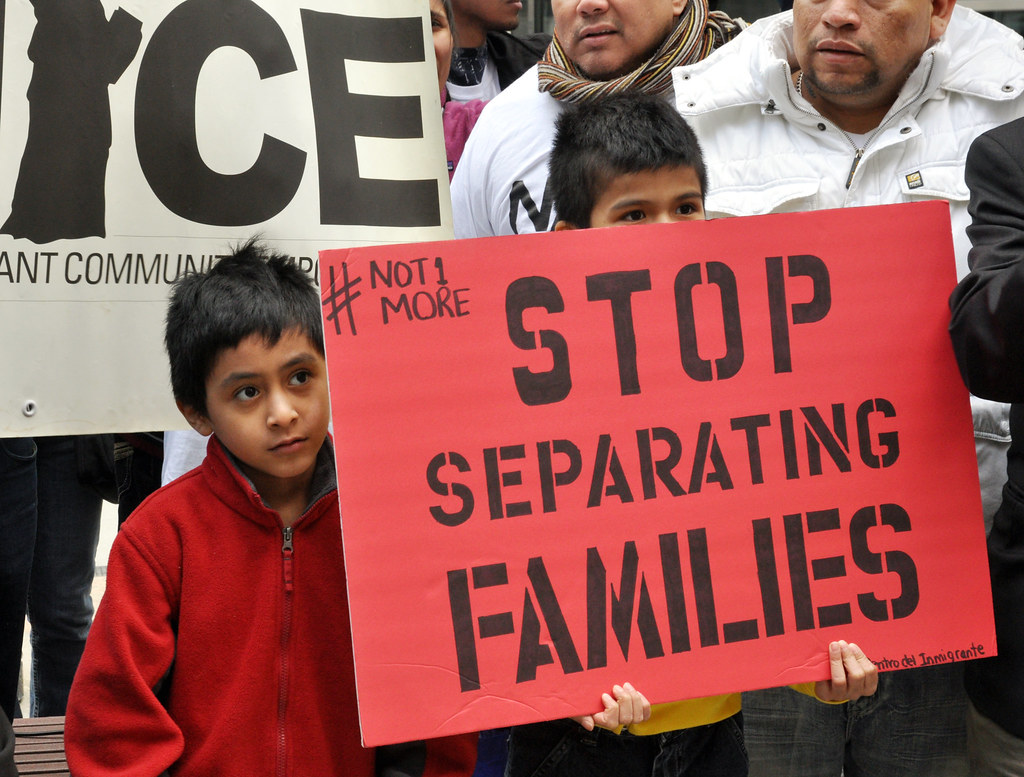
The ongoing immigration crackdown has had a disastrous impact on Bay Area communities: many avoid public spaces, fearful of being stopped by ICE agents, students are increasingly absent from their classes and families are torn apart overnight. When people—many with U.S. citizenship or legal status—begin hiding from the very institutions sworn to protect them, we must confront how far our nation’s promises of liberty and justice have strayed.
President Donald Trump entered office promising the largest mass deportation crusade in U.S. history, targeting more than 10 million undocumented people living in the U.S. In the first seven months of his second term, ICE and the CBP have recorded more than 350,000 deportations.
Trump invoked the Alien Enemies Act on March 14, 2025, to deport as many undocumented immigrants as possible. This act grants the president broad authority during declared invasions to detain or remove non-citizens over the age of 14 without due process protections. This is not just a policy; it is a blatant assault on the rights and dignity of millions of people, including those who are lawfully present in our country, undermining the democratic principles our nation claims to uphold.
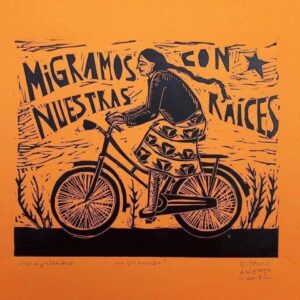
Block print by @espacio_abierto
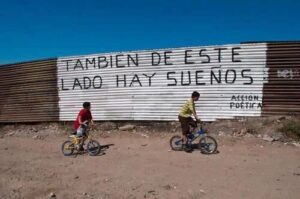
Photo courtesy of public domain
On Tuesday, October 28, 2025, Trump, while speaking to U.S. service members in Japan, pledged to deploy “more than the National Guard,” if necessary, to U.S. cities to enforce his immigration crackdown. His political agenda relies on spreading hatred, misinformation and weaponizing fear, painting immigrants, documented citizens and people of color as “illegal” or inherently criminal to justify his unlawful actions. Trump’s stance directly contradicts America’s professed commitment to liberty, truth and equal dignity, shaking the foundational concepts of the American Dream, which holds that opportunity and belonging are grounded in fairness and shared humanity.
The fear of deportation is not a distant concern that appears only on social media feeds, happens in other neighborhoods or occurs behind closed doors. It lives within the people you work with, the person next to you on the bus, the people you pass on the street or as close to you as your family and friends. Anyone could be experiencing an intense, indescribable anxiety, so deep that it dictates where they go and every word they speak, contrary to the First Amendment principle of freedom of speech. This silent terror does more than isolate individuals; it destabilizes entire communities, serving as a reminder that the consequences of the political leaders our nation elects extend far beyond
those directly targeted.
Javi, a freshman college student in the Bay Area who chose to go by his first name for legal safety, came to the U.S. alone from Guatemala as an asylum seeker under the Deferred Action for Childhood Arrivals Act. “As a child,” Javi said, “My dream was to go to school like the other kids, but unsafe guerrilla conditions [in Guatemala] made it impossible.” He secured a job to support his family back home, now balancing everyday work shifts and English classes, striving for stability. “I just want the chance to live freely like every other kid,” he said. Yet, he remains on his toes, keeping an eye on social media alerts about ICE activity and wearing his apron loosely at work, ready to leave at the first sign of officers. Fear has seeped into and poisoned even the smallest elements of his everyday life.
Reflecting the administration’s determined stance to drive out immigrants, a senior U.S. Department of Homeland Security Assistant Secretary for Public Affairs, Tricia McLaughlin, said, “Illegal aliens are hearing our message to leave now or face the consequence.”
AD, whom I will refer to by her initials for her safety, is a former San Francisco resident who came to the U.S. seeking work opportunities. She was questioned by ICE officers on two separate occasions—once at the end of summer and once in the fall of 2025—on her way to work and at a bus stop in Daly City. The constant surveillance made her feel anxious and paranoid about when officials might strike next. Ultimately, AD decided to return to Brazil, fearing the possibility of violent, unwilling deportation. “I hoped to get a job and move out of the harsh conditions in the Brazilian slums. I was met with backlash and hostility for being an ‘illegal’ that had no place in American society,” AD said. The opportunities idealized in the American Dream were denied to AD. The CBP has tracked 35,000 self-deportations like AD’s in 2025, when an immigrant leaves for fear of imminent involuntary deportation. Masked officials have shattered car windows, broken down doors, beaten innocent people, deployed tear gas to control crowds and pulled people unwillingly from their homes in the middle of the night, handcuffed. Haunting the nation’s most vulnerable communities, federal agents have repeatedly violated natural rights and violently torn apart families.
The masks worn by officials illustrate the government’s focus on protecting the safety of its agents over upholding transparency and “democratic accountability.” This distrust is echoed by JR Arimboanga, the Director of Student Inclusion and Ethnic Studies Program, a second-generation immigrant and contributor to Bay Area immigrant relief efforts.“Patrol activity cultivates a fear that…keeps people fearful, in line and ‘lawful,’ to push people out of our country,” he said.
The harsh treatment of undocumented immigrants has caused significant collateral harm to U.S. citizens and legal residents, drawing widespread concern. ProPublica detailed that, based on reported cases in 2025 so far, more than 170 American citizens have been wrongfully detained without proper warrants or the ability to even make a phone call.
They are parents striving to give their children a better life, students working to support their families back home and asylum seekers fleeing violence and persecution from their home countries, only to be met with unsolicited hate in the day-to-day of their new lives.
We should not have to live in a country where the government can seize anyone who looks “Latino,” speaks Spanish and appears to work a minimum wage job—dangerous biases that reduce whole communities to prejudiced caricatures. Instead of standing by while our constitutional freedoms are trampled, I am committed to fighting for the protection of my community’s innate rights.
Amidst this terror, communities, organizations and individuals are coming together, staying vigilant and spreading critical Know Your Rights resources, refusing to let fear dictate their lives. Together, we are supporting one another, united against injustice..
Nearly a year after Trump’s inauguration, Patrick Kelly, a social studies teacher at South San Francisco High School, noticed that nearly 10% of his students inexplicably stopped showing up to school. Reflecting on the impact of deportations on his students, Kelly said, “These are not snowflakes… They are resilient kids who have grown up in a blue community who are feeling it in a very real way.”
For Arimboanga, immigration is deeply personal, reminding him to think of the people whose lives are upended by deportation, and of his own family who have immigrated to build a new life. “I think about why my parents left the Philippines, and why so many families are often pushed out of their homes,” he said. Arimboanga draws inspiration from the revolutionary Filipino scholar, Jose Rizal, keeping his words close to his heart: “‘If not now, then when? If not you, then who?” If we all did our part to support just causes, “The world would be such a better place,” Arimboanga said.
Now, more than ever, we must stand up, speak out and be unapologetic in defending our community before silence becomes complicity. Without the courage and contributions of immigrant dreamers who have cultivated the U.S, there is no American Dream to chase.