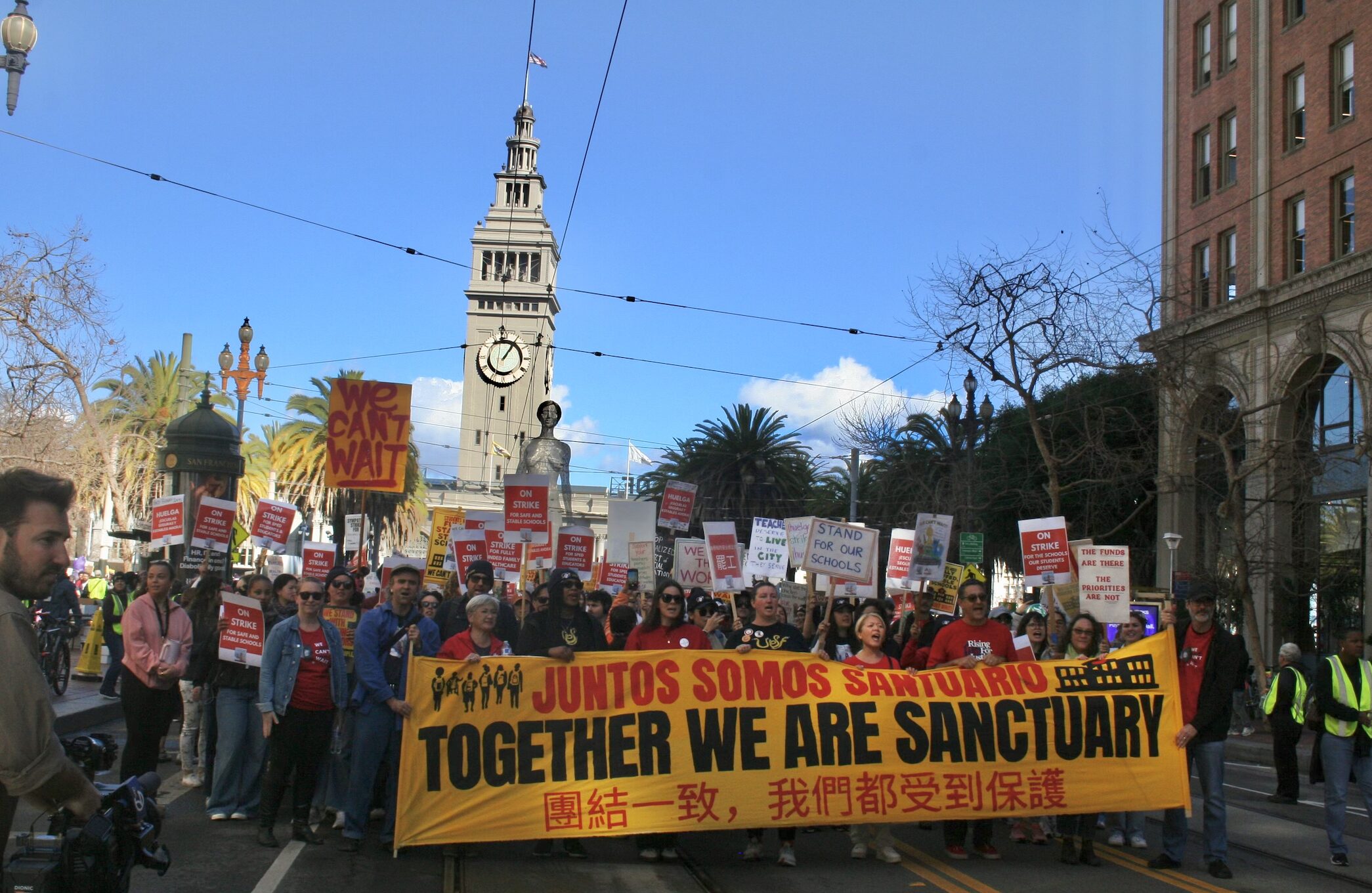
On Monday, February 9, 2026, 6,000 San Francisco Unified School District (SFUSD) educators went on strike for the first time in 47 years, fighting for dependent healthcare and higher wages amid a budget deficit. The four-day strike ended with a tentative agreement, allowing 50,000 students to return to class the following week.
Streets outside public schools were filled with teachers holding bright yellow signs and the honks of passing cars. “Teacher working conditions are student learning conditions,” Matthew Lambert, United Educators of San Francisco (UESF) leader at James Denman Middle School, said. “If teachers are overworked, they can’t give their best to their students, and that’s all we want to do every day, make sure they get the best education they can.”
Teachers, paraeducators, administrators and other SFUSD workers were instructed to report to their schools on Monday, February 9, at 8:00 am to their assigned strike location. Following strike regulations, teachers could not stand still, but instead walked in circles, ensuring not to cross the picket line. Although teachers were not being paid, it was clearly stated that the strike was not a day off and that attendance would be taken each day. Strikes would occur at individual schools from 8:00am-12:00 pm, and at 1:00 pm, all teachers met at a specific location.
At 1:00 pm on February 9, 2026, all striking teachers, alongside administrators and janitors holding sympathy strikes, met at the Civic Center Plaza near the main negotiation site in Herbst Theater. They heard speeches from the president of the California Federation of Teachers—the state-wide union—Jeff Freitas, District 9 Supervisor Jackie Fielder and Mexican band Los Tigres del Norte. After the speeches ended, the speakers blasted Bad Bunny, with hundreds of people joyfully dancing. At around 2:00 pm, teachers received an email from SFUSD superintendent, Dr. Maria Su, stating, “All SFUSD schools will be closed to students tomorrow, Tuesday. Feb. 10.”
Since March 2025, UESF had been bargaining for new labor contracts, as the previous contract expired in late June 2025. During this time of contract uncertainty, teachers’ salaries were frozen while healthcare costs continued to rise, creating financial strain and unpredictability for educators.
As negotiations continued through the summer and fall of 2025, union leaders initially demanded a 9% salary increase and fully funded health insurance for teachers and their families, citing that the affordability of the previous cost-sharing plan for city-based educators was not attainable. “I pay $1500 for Kaiser insurance each month,” read Donald’s sign, a second-grade teacher at Ulloa Elementary, at Civic Center Plaza. When asked about his sign, he said, “Healthcare benefits are really expensive… but I have seen since I started, it has gone from a couple of hundred dollars to almost $1500 a month.” His wife added, “I have to work more to compensate and not necessarily be there as much for my family.”
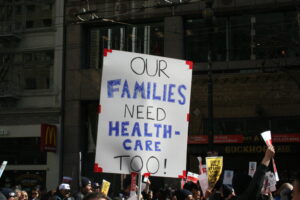
photo by Angie Woo ’27
Additionally, special education teachers called for more resources to support students, as well as a more manageable workload. SFUSD repeatedly stated that the demands were not “budget-neutral,” pointing to a projected $100-$113 million budget deficit and arguing that approving the demands would deepen the district’s financial instability.
After 11 months of negotiations, on Saturday, January 31, 2026, 97.6% of UESF members voted to strike. Su announced on Friday, February 6, 2026, that all district school sites would be closed until further notice, and the strike began on Monday, February 9, 2026.
On February 6, three days before the strike, teachers received emails from their individual schools, collecting personal contact information and informing them not to use RedRover, a school management platform, or other district contacts as they discussed the strike.
Over that weekend, UESF and the SFUSD delegations resulted in only one agreement on sanctuary schools, forbidding Immigration and Customs Enforcement (ICE) from entering schools, which provided immediate protection for undocumented students and their families. With only one demand secured, on Monday, February 9, the strikes began.
The following 3 days held a similar schedule and strikes, with picket lines at each school in the morning, and district gatherings at 1 pm. Tuesday’s reunion was held at Dolores Park, Wednesday’s at Ocean Beach and Thursday’s in the Embarcadero. Although teachers were prepared to strike on Friday, at 5:30 am, after an all-night deliberation, a two-year deal was announced, ending the historic strike in 4 days.
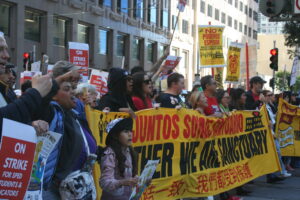
photo by Angie Woo ’27
The Critical Role Schools Play on Children: Childcare and Food
Amid the strike, parents scrambled to find resources for students while schools were closed. “We have to be ready for something else,” Leslie Einhorn, the executive director of Children’s After School Arts (CASA), said. CASA is a Community-Based Organization (CBO) located at Rooftop School TK-8th that provides after-school care for students. In preparation for the 50,000 students kept out of schools during the strike, San Francisco Recreation and Parks worked together to arrange alternative childcare with the support of CBOs stationed at Rec centers, as well as other community spaces around the city.
Because Su closed school sites during the strike, campuses were not able to be used, forcing organizations such as CASA to a temporary off-campus site. Instead, CASA welcomed students in need of child care to Glen Park for a week of outdoor play and enrichment.
The strike also highlighted the critical role that schools play beyond education. “Lots of families get their food at public schools, so where are they going to get their food now?” Einhorn questioned. In response to parent concerns, organized by the San Francisco Department of Children, Youth & Their Families (DCYF) provided free breakfast and lunch pick-up spots around the city for SFUSD students during the strike.
Businesses in the mission, such as La Taqueria, Café La Boheme, and Mi Yucatan, offered educators, students and families free or discounted food while the strike unfolded. Likewise, public libraries around the city opened their doors to families, becoming a community hub for free lunches and a safe space for children to study and play. As classrooms closed, the city saw firsthand how deeply the public education system supports families and the importance of keeping schools open.
Private School with a Public Purpose?
During the strikes, private schools proceeded as normal. “It’s a complicated position working in a private school with my own children in the public system. I feel like those two systems are in opposition every day,” Lizzy Brooks, a Technical Arts teacher at LWHS explained. 30% of students living in San Francisco attend an independent school, dragging wealthier families away from the public school system. “Every kid that’s in private school,” Brooks continued, “[is] money that the public system doesn’t get.”
During the strike, some members of the LWHS community participated in the picket lines and protests, like Christine Godinez-Jackson, Director of the Center for Civic Engagement. She brought breakfast for the teachers to show their support for the movement. “I drove by Balboa, Aptos and Denman to show my support for the protestors and ask them what they needed,” Godinez-Jackson said.
While at Civic Center, Frank Lada, Executive Vice President of UESF, states, “[San Francisco] is a divided city. Not every student gets what they deserve, so we’ve been fighting as a union to make sure every student has the same experience, quality experience to maximize education,” Lada continued. “We have the right to demand higher education and quality education for all schools.”
“At the moment, the way the system is set up, certain groups of people are forced to leave communities, are forced to get scholarships to get the education that should be available to everyone…People who choose to go to a private experience, it’s always because everyone wants something better for their kids,” Lada said. “But that should be an opportunity available to everyone.”