
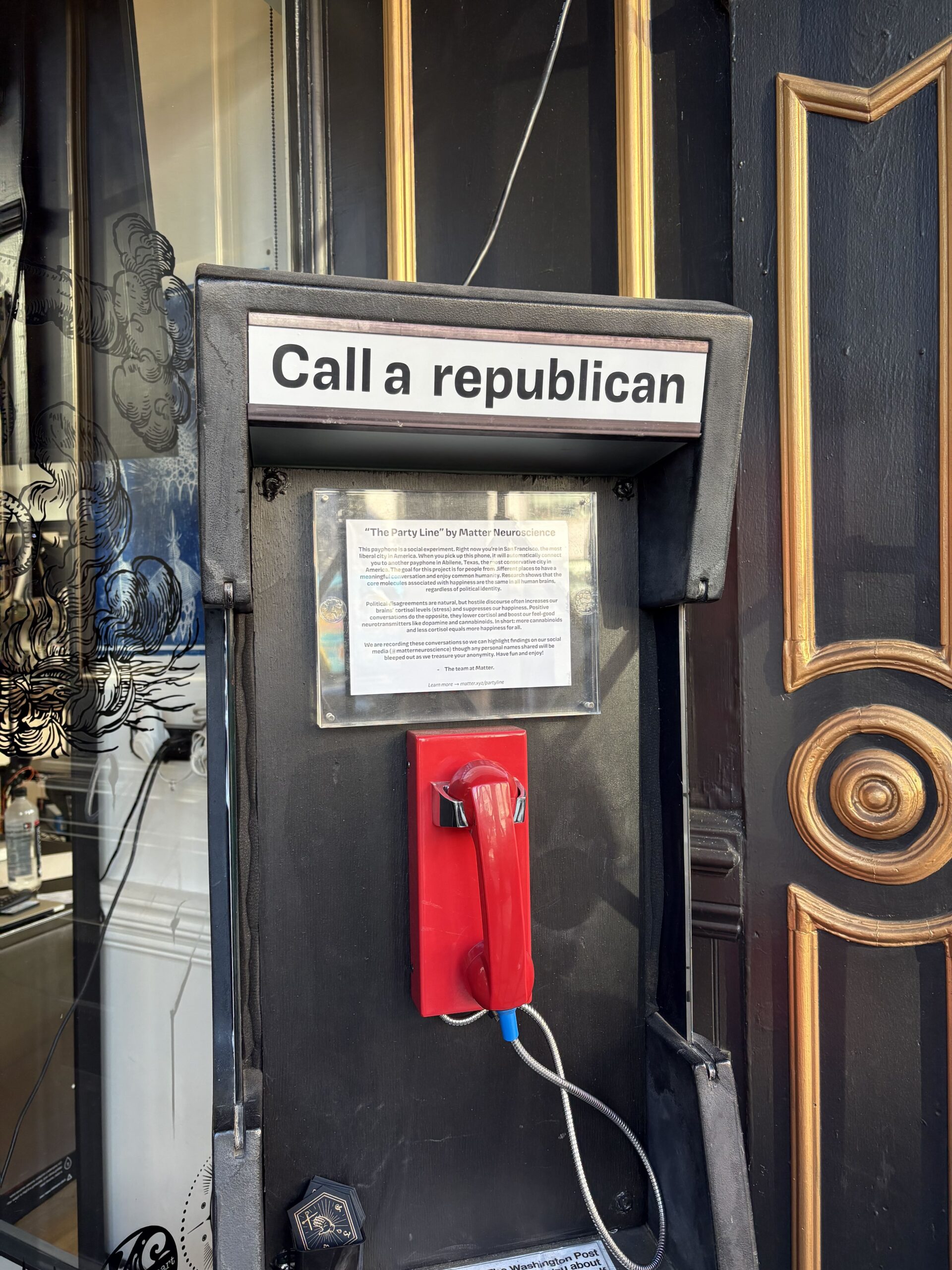
Pick up this payphone at 310 Valencia Street in San Francisco, California, and you might hear the voice of a stranger in Abilene, Texas—an individual whose politics, worldview and life may be entirely different from your own. On January 18, 2026, payphones connecting liberal San Francisco with conservative Abilene were installed by Matter Neuroscience (Matter), a biotech company, in a deliberate attempt to reconnect Americans across widening political divides. Nearly two months later, according to people on both ends of the line, “it’s working.”
“Our goal has always been to educate people on the science of happiness. We saw an opportunity to start a conversation and to connect people across political divides,” Beth Stone, Matter’s head of marketing, said.
Known as the Party Line, these free phones are located outside Black Serum Tattoo on San Francisco’s busy Valencia Street and Seven and One Bookstore in downtown Abilene. Available until March 18, 2026, these phones are respectively labeled “Ring A Republican” and “Ring A Democrat.” They stand freely, available for any passerby to pick up. Once the receiver is lifted, the other phone will ring, inviting residents on the other line to engage in open conversation.
Employing neuroscience to help people live longer, healthier and happier lives, Matter was founded in 2019 by biochemist and neuroscientist Axel Bouchon alongside co-founders Ben Goldhirsh and Chris Shiflett. Working in partnership with Maastricht University, Stanford University and the Happiness Research Institute, the startup is dedicated to finding a universal biological marker for happiness—especially amidst today’s mental health crisis.
In October 2025, Mental Health America reported that in the United States alone, over sixty million individuals are experiencing mental illness. Political polarization only worsens this crisis, according to the Institute for Governance and Civics at Florida State University. In a 2026 data brief, the institute found that more than 60% of Americans believe that discussing politics is stressful, frustrating and detrimental to their mental health.
“[The Party Line] turned out perfectly. It is like a successful science experiment. [Matter] had a really good intent to bring both parties to a common ground,” Brucius Von Xylander, owner of Black Serum Tattoo, said.
The Party Line incentive seeks to rectify this issue, though it is only one aspect of the company’s efforts to solve today’s mental health crisis. With the launch of their wellness app, Matter has created a new “emotional fitness” community dedicated to helping individuals activate their essential “feel-good” neurotransmitters: cannabinoids, dopamine, opioids, oxytocin, serotonin and testosterone.
In findings corroborated by both the National Institute of Health and Harvard University’s Center for Brain Science, Matter’s research shows that these neurotransmitters increase neuroplasticity—one’s ability to form, modify and strengthen neural connections.
“We invite people to choose cannabinoids, connection, friendship, love and meaningful conversations,” Stone said, noting that these factors result in improved cognitive function and emotional regulation, further contributing to one’s overall happiness and mental health.
When approached by Matter, Von Xylander and Seven and One Books owner, Arlene Kasselman, quickly signed on to the initiative.
“It was an immediate yes for me. It is essential to have people talking to each other rather than just believing stereotypes or allowing our curated algorithms be the only thing that informs us,” Kasselman said. She has utilized the phone line multiple times and had conversations covering topics ranging from breadmaking to the recent Immigration and Customs Enforcement activity in Minneapolis.
“I have had amazing conversations,” Kasselman said. “When you hear somebody’s voice, and you learn just a little bit about them, it’s harder to be as divided.”
Often, stereotypes are shattered as San Franciscan callers assume that they are speaking to Republicans in Abilene. Kasselman noted that she and many visitors to her store are self-identified Democrats. Von Xylander similarly noted that individuals attracted to his tattoo shop tend to be left-leaning, though some conservative individuals have made use of the phones, seeking a sympathetic ear in Abilene.
A former journalist and resident of Abilene for nearly 20 years, Nathan Sanders expressed his frustration with the conservative majority in Abilene and his desire for an effective solution for today’s political extremism. He called the phone line but was unable to reach a San Franciscan.
“Calling this phone was almost therapeutic. I wanted to have the opportunity to share my bewilderment and fear of what our country is becoming,” Sanders said. “Honestly, I was going to apologize on behalf of Abilene and the people in my community.”
Though he holds little hope that sociological experiments such as the Party Line could ease today’s political rifts, Sanders believes unification and healing are still possible. “We need what this experiment is trying to do,” he said. “We need someone who can connect us again, as impossible as that may seem.”
By contrast, lifelong San Francisco resident Lila Kangelaris ’26 recalled her positive experience calling the phone line, noting that her initial hesitation quickly gave way to a candid conversation on American foreign policy—along with a handful of unexpected book recommendations.
“Today’s partisan culture conditions us to only believe and accept what is said by individuals who are ideologically aligned with you,” Kangelaris said. She believes that this phone line, though only a small movement among so much division, has already had major impacts. “At our cores, at the end of the day, we are all so similar,” she said. “But without open dialogue, we will lose every opportunity to build coalition.”
Though this incentive is temporary, only lasting through mid-March, the conversations it has inspired are permanent. Current talks are in process to cement the phones outside the two shops.
No one expected that the Party Line would receive as much attention as it did. “It wasn’t intended to be as picked up as it was. I think we were just lucky… people are looking for positive stories of connection, and that’s what this has become,” Stone said.
“On either end of the line, individuals are really choosing to connect with each other,” she said. “People leave these calls feeling really good, really positive. And these emotions last.”