
As of 2026, H.R. 5021: The American Decade of Sports Act has begun moving through Congress, aiming to “strategically leverage” the 2024 to 2034 decade of major global sporting events hosted in the United States. This includes the 2024 Copa América, 2025 Club World Cup, 2026 Fédération Internationale de Football Association (FIFA) World Cup, 2028 Summer Olympics and Paralympics, 2031 Men’s and 2033 Women’s Rugby World Cups and 2034 Winter Olympics and Paralympics. While fans have celebrated this historic streak for the U.S., behind the spectacle lies a calculated goal: leveraging international sport as an instrument to “enhance the United States soft power, diplomatic relationships, and global leadership,” as cited in the Act’s legislation.
“I mean, [sports have] always been political,” Derek Van Rheenen, Faculty Director of the Cultural Studies of Sport in Education at the University of California, Berkeley, said. For more than a century, international sporting events—particularly the Olympics and the World Cup—have served as stages for geopolitical rivalry, with the U.S. often at the center.
From Jesse Owens’s anti-Nazi salute at the 1936 Berlin Summer Olympics, to Tommie Smith and John Carlos’s Black Power salute at the 1968 Mexico City Summer Olympics and medal counts reflecting ideological conflict as much as athletic victories between the U.S. and the Soviet Union during the Cold War, international sporting events have long served as settings for U.S. geopolitical rivalry. This pattern has continued into the modern era: political tensions between the U.S. and Iran played out symbolically on the 1998 and 2022 World Cup fields, while the U.S. enacted a diplomatic boycott of the 2022 Beijing Olympics over China’s treatment of the Uyghur minority, and Russian athletes were banned following the invasion of Ukraine.
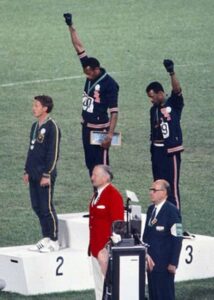
photo courtesy of PICRYL
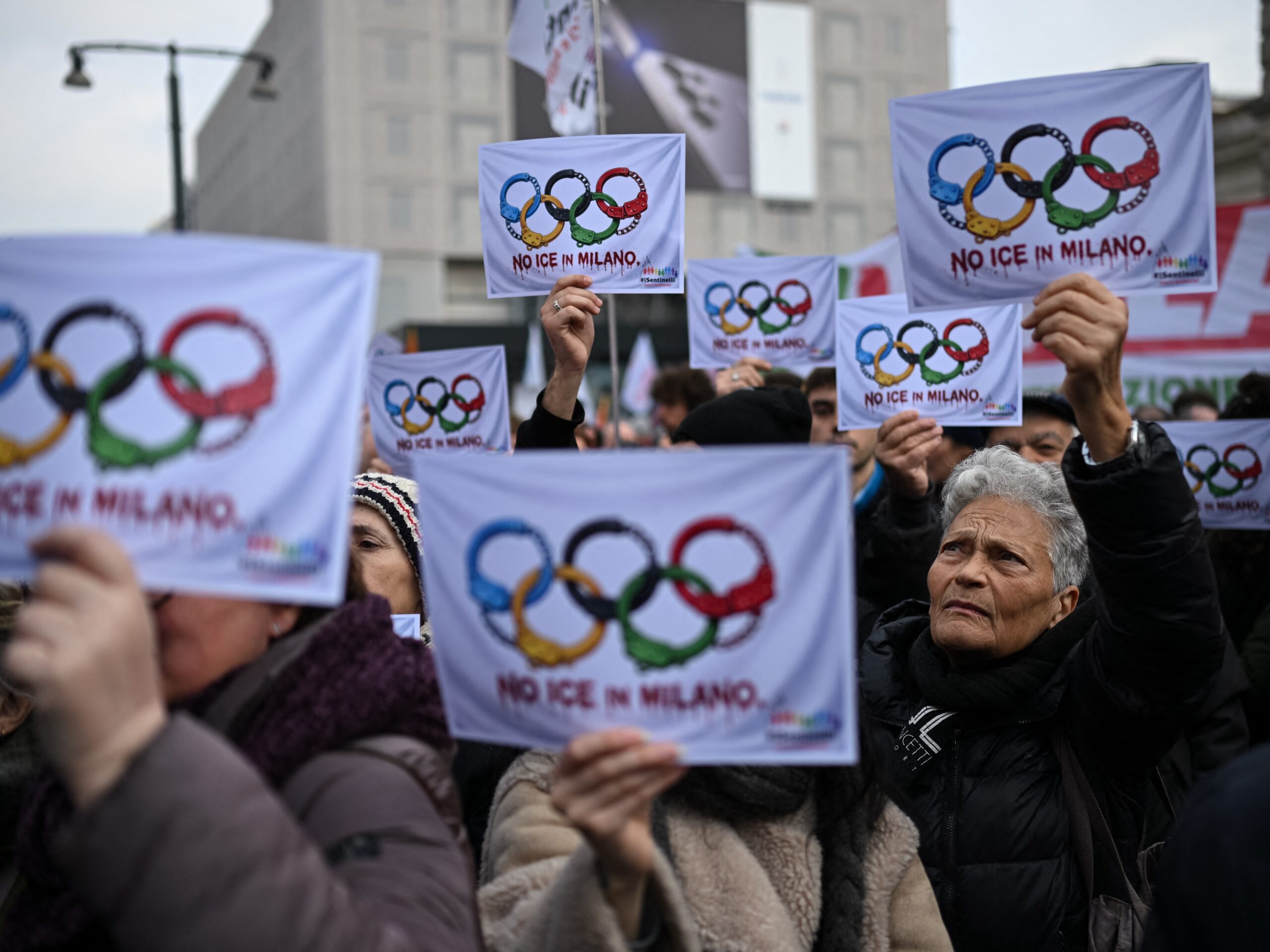
In February, at the beginning of the Milan-Cortina Winter Games, protests erupted around the city over the presence of U.S. Immigration and Customs Enforcement (ICE) agents. While ICE was aiding the event’s security rather than enforcing U.S. immigration laws, for many, the word “ice” has become strongly associated with the Trump administration’s immigration crackdown, such that a U.S. hospitality house in the Winter Olympic village was renamed from “Ice House” to “Winter House,” illustrating how U.S. domestic policy reverberates internationally.
U.S. domestic tensions have also prompted many athletes to speak out. Upon being asked about her home state, Minnesota, three-time medalist skier Lindsey Vonn stated, “My heart is incredibly heavy for everyone at home, we are more than what’s happening right now.” Freeskier Hunter Hess additionally stated, “Just because I’m wearing the flag doesn’t mean that I represent everything that’s going on in the U.S.” In response, President Trump lashed back on Truth Social, referring to Hess as a “real Loser” and deeming him “Very hard to root for.”
Athletes speaking up is concurrent with the witnessed consequences of politicization in the Games. Russian athletes are still barred from competing under their flag, and on February 12, Ukrainian skeleton racer Vladyslav Heraskevych was disqualified for displaying images of Ukrainian athletes killed during the war with Russia on his helmet, arguing that honoring the fallen athletes is “more important than medals.”
Derek Cheng, a former athlete for Hong Kong’s men’s national field hockey team, conveyed the complex dynamic of competing under the shadow of politics. “The thing about being an athlete is your main focus is athleticism. You’re playing the game. And politics, they don’t really come into play at all, which is, in a way, the beauty of sports,” Cheng said. In other words, choosing to take a political stand is not necessarily a small decision, but instead often involves risking one’s career.
Despite not being personally responsible for U.S. foreign diplomacy, American athletes carry both the weight and the honor of competing under its flag. Sing Yip, LWHS math teacher and a former athlete for Malaysia’s men’s national water polo team, said he understands the magnitude of representing one’s country. “Being able to represent Malaysia was a huge thing, not just for my own ego, but also for what it means to be able to put our flag out there…just a really honorable experience,” he said.
American athletes taking a stance spans the political spectrum. After ending a nearly 50-year Olympic gold medal drought with a dramatic win over Canada, the U.S. men’s hockey team received a congratulatory call from Trump. During the call, the team laughed along at a disparaging joke Trump made about the U.S. women’s team, which has won medals at every Olympics since women’s hockey was first introduced in 1998.
This summer, an equally, if not more, politically charged landscape is anticipated. The American Decade of Sports Act signals an intentional shift in the U.S. approach to sports diplomacy. “It’s not about participation. It’s not about friendship. It’s about who is the dominant force,” Van Rheenen said.
Co-hosted by the U.S., Mexico and Canada, this World Cup represents the first three-nation partnership of its kind. Although geopolitical tensions—including disputes over tariffs and deportations—have strained relations between the three countries, the tournament places them at the center of the global gaze. The U.S., in particular, will receive high visibility, hosting 78 matches across 11 cities and the watchful eyes of an estimated five billion viewers.
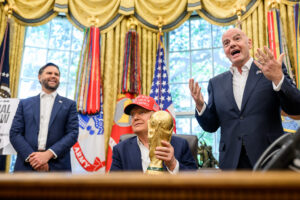
FIFA’s leadership is central to the World Cup political buzz. FIFA president Gianni Infantino holds a close relationship with Trump, even awarding him the inaugural FIFA Peace Prize last December at the World Cup draw in Washington, D.C.—shortly after Trump was passed up for the Nobel Peace Prize. Contrarily, former FIFA president Sepp Blatter has backed Swiss lawyer Mark Pieth’s call for international fans to boycott the U.S.-hosted games. “For fans, just one piece of advice: avoid the United States! …Upon arrival, fans should expect that if they don’t behave properly with the authorities, they will be immediately sent home. If they’re lucky…” Pieth said.
Many fans do not have a choice of whether they can attend. Despite Trump’s message to “welcome soccer fans from all over the globe,” U.S. visa restrictions and bans affecting over 75 countries will likely influence who can physically participate.
Economically, alongside the Act, the stakes of the U.S. as a host are tremendous. A FIFA-WTO study projects that the 2026 World Cup could generate over $40.9 billion in total gross domestic product (GDP) across North America and support more than 824,000 jobs globally. The Olympics similarly increase hosts’ GDP per capita by about three to four percentage points in the year of the event and the year prior. Beyond these figures, the Act underscores a broader message: the U.S. is a global power capable of financing and leading many of the world’s largest, most significant events.
“American sport becomes the metaphor to champion around the world,” Van Rheenen said. With the American Decade of Sports Act, the U.S. is no longer merely participating in international sports and diplomacy, but playing an active role in administering them. The question is not whether this decade of sport will be political, but how the U.S. will wield the events to shape its influence on the world stage.