Recent U.S.–Israeli strikes on Iran and the killing of Iran’s Supreme Leader Ali Hosseini Khamenei have brought into focus the wave of protests from December 2025 to January 2026, during which millions of Iranians expressed built-up anger towards an authoritarian government and economic struggles. Lick-Wilmerding High School students, particularly those interested in human rights activism and politics, and those of Iranian descent, seek to engage with and recognize nonproximate injustices.
According to Amnesty International, January 2026 marked the deadliest period of repression by the Iranian authorities. The Guardian and Iran International cite estimated casualties of 30,000-35,000 and injuries of around 350,000 civilians. Co-Leaders of Amnesty International Club at LWHS Imane Moosa ’28 and Funmilayo Terry-Koon ’29 discussed the ongoing unrest. “It started with the big collapse in the currency of the Iranian money, but it’s also rooted in a deeper conflict of this fundamentalist government really being very controlling of the Iranian people,” Moosa said.
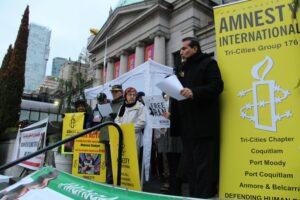
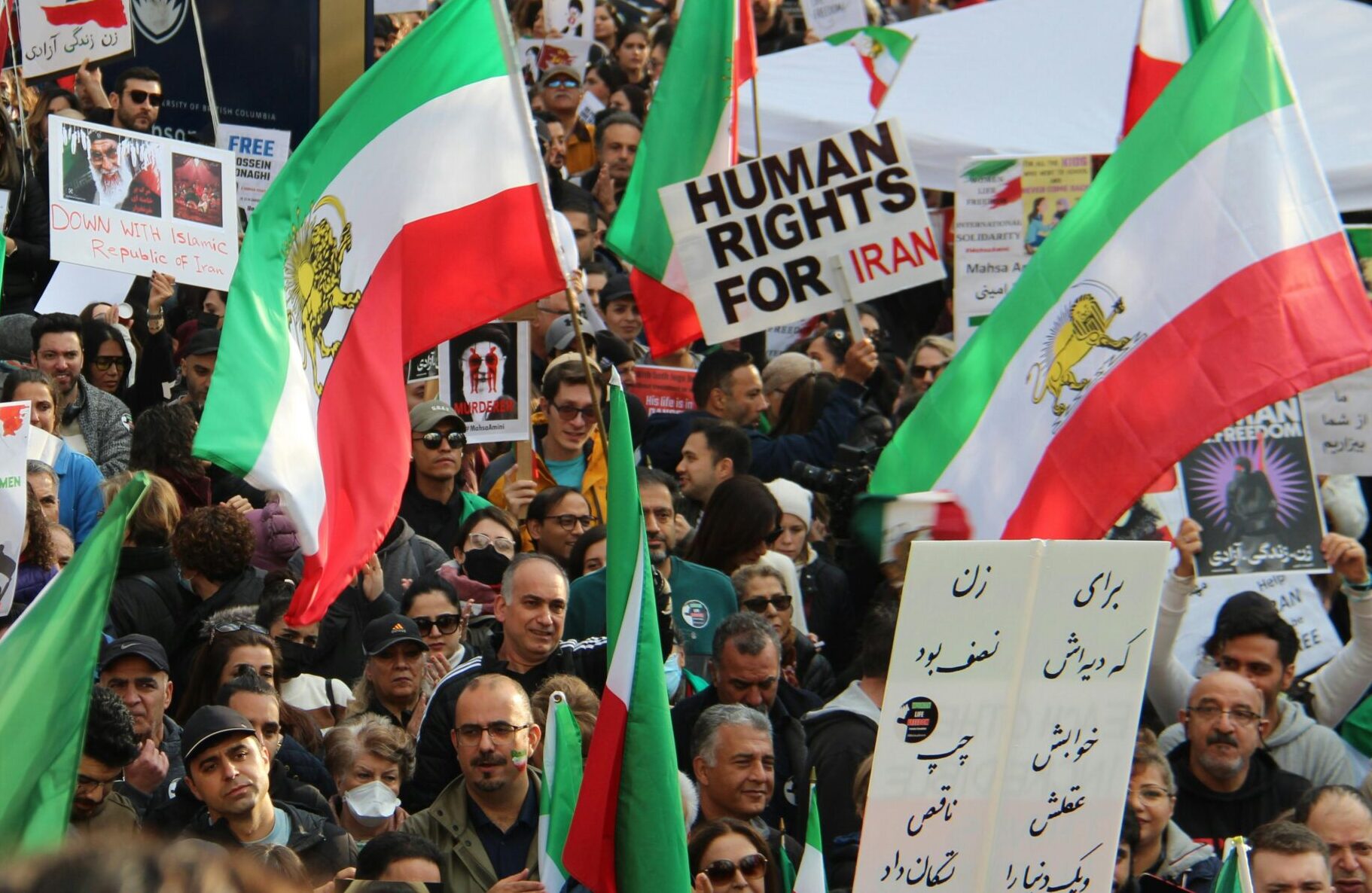
500 Iranian protestors in 2022.
photo courtesy of public domain
LWHS Current Events Club Co-Leader Kalista Chubb ’28, who hopes to “inform students about current events and to discuss them thoughtfully,” recalled her experiences seeing journalistic coverage of Iran. “I saw these bloody, scary videos … I read analyses on what was happening and on why it was happening, and I’m definitely shocked and disappointed in the suppression tactics,” Chubb said.
Arman Anoshiravani ’26, who is Vice President of LWHS’s South Asian Middle Eastern club (SAME) and of Iranian ancestry, recalled the 2022 protests supporting Mahsa Amini. “In 2022, there was a big influx of protests, and that one definitely caught the attention of the international media as well. But then this time, the stories about the brutal killing of the protesters is what sets it apart in my mind. It’s honestly kind of been overshadowed over the last couple of weeks,” Anoshiravani said.
On December 28, 2025, protests began in Iran’s capital, Tehran, particularly in business and trade districts, over economic grievances. The public outrage erupted on the same day, after the Iranian rial plunged to a record low of about 1.42 million rials to the U.S. dollar. In the days following, protests spread across 180 cities. On January 1, 2026, the first fatalities of the protests were reported.
On January 3, Iran’s Supreme Leader Ali Khamenei ordered “rioters to be put in their place,” whilst protests continued to expand to 170 locations in 25 provinces. On January 8 and 9—during which the highest number of protester casualties were cited, in addition to the beginning of widespread internet shutdowns and international phone cut-offs—protests spread across all 31 provinces.
Terry-Koon said she was “surprised by the breach of international law of the fundamentalist government with the murders, massacres and the internet shutdown.” The Iranian government enacted an internet shutdown for all civilians for over 17 days.
For observers worldwide, the lack of respect for human rights by the regime raised shock and disgust. “These people are just exercising their human right to protest…they’re expressing themselves and their beliefs. There are people, including journalists, lawyers and even children, who are getting incarcerated or killed for simply existing and expressing themselves … that’s especially concerning,” Terry-Koon said.
“Millions of people are living under a regime that does not respect their rights and does not respect their lives either. Millions of people have expressed their grievances and have shown the world that they feel oppressed. They feel like they are not getting their basic human rights, like freedom of speech,” Chubb said.
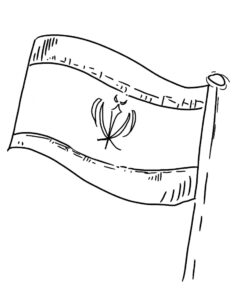
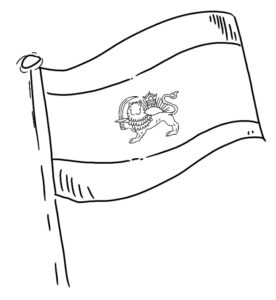
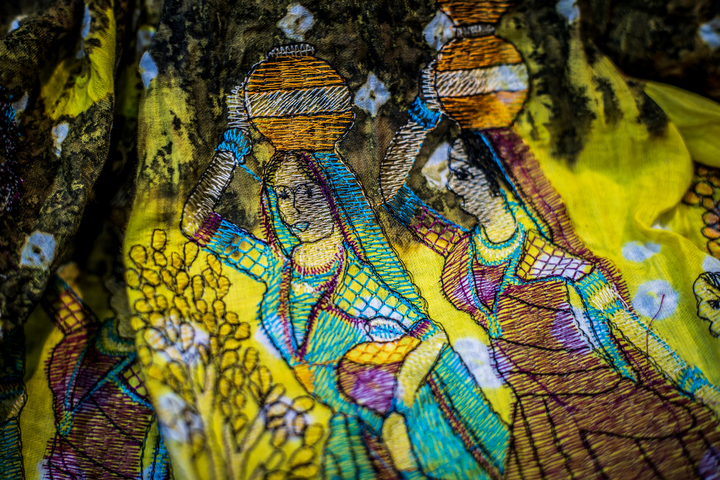
Iran’s current Islamic Republic flag (left) and Iran’s pre-1979 ‘lion & sun’ flag (right).
doodles by Noemi Guitron
As immediate news and death counts varied from different sources, viewers across the world expressed their confusion. “From what I could see, sources were conflicting, about [death counts, with numbers ranging] from the low 1,000s, to somewhere up to 30,000, which is huge. There are a lot of unknowns…it’s just a crazy situation,” Anoshiravani said.
On February 6, over a month following the beginning of widespread protests, the U.S. and Iran held nuclear talks in Oman, in which the U.S. demanded that Iran hand over its enriched uranium and limit the range of its ballistic missiles. In the days following, Trump instituted the biggest naval and air power buildup in the region since the 2003 Iraq invasion that toppled Saddam Hussein.
On February 28, the United States and Israel struck nuclear facilities in the region and killed Iran’s supreme leader. In response, Iran launched drones and ballistic missiles directed towards U.S. bases in nine Middle Eastern countries.
On February 11, around two weeks before the U.S. and Israel began striking Iran, Anoshiravani said, “External force never creates a stable government. So, if the U.S. was to do something, it’s not going to create peace in the region. I mean, there are hundreds of colonial examples of how that’s not true.”
Though U.S. President Donald J. Trump had spoken about becoming involved with little concrete plan, before the war unraveled, Chubb said, “[The U.S. has] a history of getting involved in the Middle East when it’s not really necessary for us to use military force.”
After the February 28 attacks, media coverage and conflicting views on the topic increased, further placing the future of Iran in a state of jeopardy and uncertainty. “I feel very conflicted. Something needed to happen, after a long time of people being unhappy especially after the massacres of January,” Anoshiravani said. “I would love to see a more democratic government, but generally the use of force in this way never results in this…especially with Netanyahu and Trump saying the Iranians should rise up and take their government, I think it’s not that simple,” Anoshiravani said.
“This is not an ideal situation for [Iranian civilians] to mount an organized revolution,” Chubb said. “I criticize Iran’s regime. There are a lot of things I don’t agree with in terms of domestic affairs, in terms of human rights, individual rights … but does a major bombing campaign that killed civilians actually help?”
On March 8, Mojtaba Khamenei, the ideologically like-minded son of deceased Ali Khamenei, was named Iran’s new Supreme Leader. Anoshirivani said, “He [Ali Khamenei] was behind a lot of the horrible stuff, but at the same time, he’s just one piece of the puzzle…him being gone does not mean that it [the regime] is going to crumble apart.” For the sizable 4-5 million global Iranian diaspora, the over 1 million Iranian-Americans and others observing the protests, the conflict and unrest bring up anxiety, confusion, and grief. Despite being 7,000 miles away from the region affected, LWHS students’ dialogue is an urgent reminder for all to stay aware of humanitarian and political crises around the world.