

Effective Friday, March 6, 2026, the federal government is requiring the California Department of Motor Vehicles (DMV) to cancel approximately 13,000 non-domiciled commercial driver’s licenses (CDLs), effective immediately. The cancellations target immigrant truck drivers, many of whom had temporarily retained their licenses under a tentative ruling in the Alameda County Superior Court following 60-day revocation notices issued in November. With shifting regulations, alongside threats from the Trump administration to withhold $160 million in funding to pressure the DMV into eliminating this key demographic of drivers, the livelihoods of approximately all 61,000 immigrant truckers across California remain in jeopardy.
“This, at its core, is discrimination against a class of people in the United States based on their immigration status,” Sahib Sohal, Immigrant Justice Fellow at the Sikh Coalition, said.
Immigrants constitute nearly one in every six truck drivers in the U.S. In 2025, a shortage of 60,000 to 80,000 drivers, according to Forum, pushed companies to rely more heavily on immigrant workers, many of whom were willing to haul long distances for lower pay. Notably, Sikh drivers represent about 20% of truckers nationwide and 35% of California’s trucking workforce, according to UNITED SIKHS—a global nonprofit aiming to empower marginalized communities.
Among them is Mandeep Singh Sarai, who entered the U.S. in 2023, securing asylum status, a four-year work permit and a CDL until 2029, only to receive notice in November 2025 that his license would be cancelled. “I have no options…I invested all of my money into trucking,” Sarai said.
In April 2025, President Trump issued the executive order “Enforcing Commonsense Rules of the Road for America’s Truck Drivers,” stressing English proficiency and calling Secretary of Transportation Sean Duffy to review state-issued licenses.
Two fatal crashes by immigrant Sikh drivers—one in Florida in August, and another in Ontario, California, in October—became political flashpoints, garnering further attention from the government.
Duffy stated, “licenses to operate a massive, 80,000-pound truck are being issued to dangerous foreign drivers—often times illegally. This is a direct threat to the safety of every family on the road.”
Following Trump’s order, the Federal Motor Carrier Safety Administration (FMCSA) revealed that 26% of a sampled 145 non-domiciled CDL records—those in the US under certain work visas—in California failed to comply with federal requirements, and that some had expiration dates past those on work visas, allowing drivers to potentially continue driving while being in the country unlawfully. The FMCSA introduced an interim rule limiting the abilities of lawfully present non-domiciled individuals to obtain CDLs, which was placed under stay.
In September 2025, the DMV announced it would cancel all non-domiciled CDL applications, as well as existing licenses that violated federal regulations. The federal government claimed that the DMV was not enforcing English proficiency requirements and, in response, withheld $40 million from California. The Sikh Coalition, Asian Law Caucus and Weil, Gotshal, and Manges LLP collectively filed a lawsuit against the DMV in December, claiming the state unfairly revoked CDLs and did not provide enough time to address licenses with clerical errors, thus punishing drivers for the DMV’s faults.
On February 13, 2026, the FMCSA released a Final Rule limiting CDL eligibility to certain employment-based visa holders, preventing those under Deferred Action for Childhood Arrivals, humanitarian parole, Temporary Protected status, asylum seekers and refugees—roughly 8% of California’s commercial driver’s license holders—from obtaining new CDLs or renewing their licenses upon expiration.
The enforcement implications of this rule remain uncertain, as two major nationwide unions have sued the Department of Transportation (DOT) to prevent the rule from taking effect. The state of California is also suing the DOT over its threats to withhold $160 million and block the state from issuing trucking licenses in the future.
“The impact is going to extend way beyond the drivers themselves,” Sohal said. “Trucks carry more than 8.29 billion tons of goods in the U.S. each year.”
Echoing this perspective from the front lines, Hernán Herrera, a trucker from Honduras who relocated from California to Texas after his CDL was suspended in November 2025, said, “I am an honest worker…My work helps feed America. Without truckers like me—immigrants, fathers, people just trying to support our families—shelves don’t get stocked.”
For those who have worked to establish themselves in the industry, the revocations could be disastrous. “Losing the ability to work is going to threaten their ability to survive,” Sohal said. Ultimately, this rule could force around 194,000 non-domiciled CDL holders out of the workforce.
Countless truckers describe a similar sense of helplessness. “I’ve sacrificed for it,” Herrera said. “I still have a family depending on me. But now I’m stuck, watching everything I worked for sit in a parking lot.”

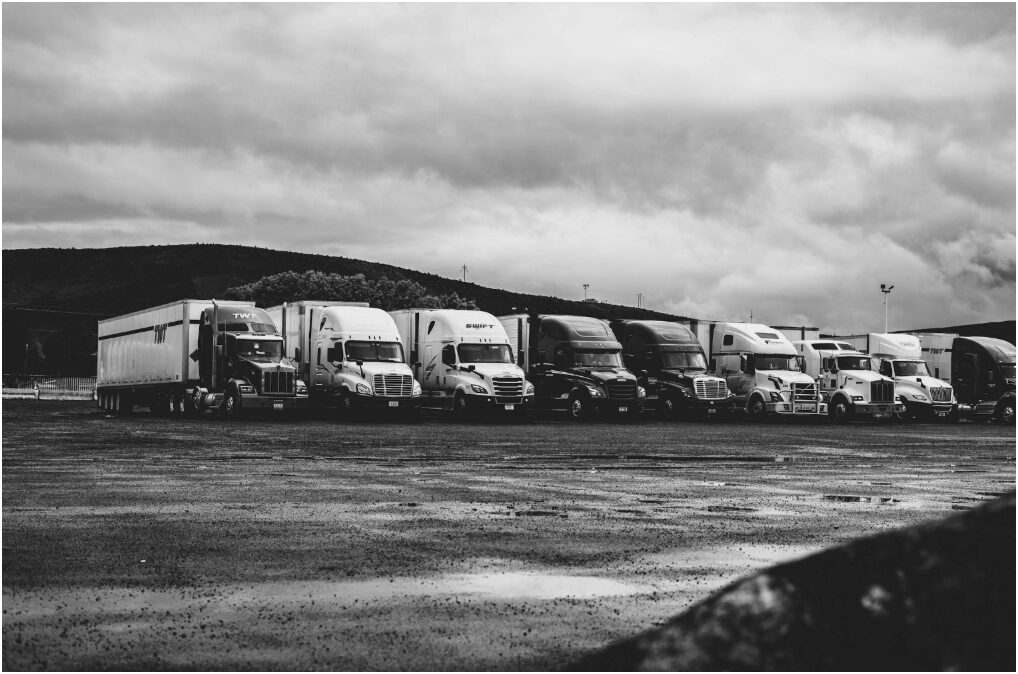
Photo courtesy of public domain
Many have expressed concerns that these rules perpetuate stereotypes about immigrants and amplify racial profiling. “In a political climate where immigration is more frequently framed in negative terms, immigrant truck drivers are an easy target,” Sohal said. “They’re highly visible…whether that be due to their race, their ethnicity or their religion, and that makes them particularly vulnerable to anti-immigration rhetoric.”
“Sometimes it feels like no matter how professional I am, I’m judged before I even open my mouth,” a driver, who requested to be referred to under the alias DP, said.
Immigration and Customs Enforcement (ICE) officers have increasingly targeted immigrant drivers for arrests and deportations. In December, ICE completed “Operation Highway Sentinel,” capitalizing upon the two accidents from 2025 to make sweeping generalizations about immigrant drivers and arrest over 100 California truckers.
“There’s been a small number of high-profile accidents involving immigrant drivers…it’s unfairly maligned the community, and it’s led to generalized assumptions about their competence and reliability,” Sohal said. “There is no actual data to suggest that immigrant drivers are less safe than non-immigrant drivers.”
Sarai and Herrera emphasized that, like all drivers, they care deeply about road safety. “[Highway patrol officers] assume I don’t understand safety rules or that I’m less qualified. But I know the regulations. I follow them carefully—probably more carefully than most—because I know I have to prove myself every day,” Herrera said. “I secure every load like someone’s family is driving next to me—because they are.”
Ultimately, these regulation changes will punish thousands of hardworking drivers. “I followed every rule to get here. I earned my California CDL legally. I studied the safety manual in English every night until I understood it,” Herrera said. “My record is clean because I respect the responsibility of driving thousands of pounds down the highway.”
Sarai emphasized that these sudden, sweeping rule changes feel disconnected from the FMCSA’s stated goal of safety. “A blanket complaint [about immigrant drivers] is not correct…and cancelling the license is not the solution,” Sarai said, frustrated with rhetoric that paints immigrant drivers as dangerous.
The Sikh Coalition calls for each trucker’s case to be reexamined so that they can continue driving without fear and uncertainty. “In the United States,” Sohal said, “everyone is entitled to fair and due process.”
Though a court ruling had allowed affected truckers to submit a new CDL application, the federal government is barring the DMV from processing pending applications, trapping drivers and the California trucking industry in uncertainty and potential disaster, and exacerbating the cost of truck loads across the state for all consumers.
“These immigrant truckers are what is keeping America rolling,” Bhupinder Kaur, Director of Operations at United Sikhs, said. “The reason why [immigrant truckers] are in America is because America is the land of opportunity. They’re all here just to live the American dream.”