




The lack of transparent conversations about AI use in our classrooms is a missed opportunity, one eroding trust between students and educators. I began writing this piece by seeking out some of those conversations, and in the following paragraphs, I hope to put into context the spectrum of perspectives I encountered.
“AI” is everywhere—in the news, in family conversations, on social media. If you navigate to the Lick-Wilmerding High School McCullough Library’s online search function, a little “AI-assisted search” toggle pops up. At the start of the 2026-27 school year, Lick-Wilmerding High School rolled out a new student AI policy, which calls for the creation of department specific guidelines. However, I’ve found the topic generally lacking from my classrooms, aside from a brief overview of student use guidelines at the beginning of the year. Instead, AI shows up in more subtle ways—for both students and teachers.
My friends and I have received assignments, feedback, lessons and worksheets with telltale marks of Large Language Model (LLM) generation: nested formatting, bullet points and bolding; vague summary sentences at the end of each paragraph; repeated sentence structures such as “it’s not just [], it’s []”; and the occasional ChatGPT emoji. Of course, none of these elements are inherently artificial, but together they make up a very specific writing style.
This is far from a universal experience across classrooms, but it’s a pretty relatable one across the student body. In other words, most students that I talked to had a story about material they knew or suspected to be AI. Sometimes, this is prefaced by a conversation or recommendation about how to use AI in our own study practice, and sometimes nothing is said at all. Like teachers, my peers and I have varying levels of comfort with AI, so we react differently to AI-created material. Often, there is frustration. Specifically with feedback, I’ve heard my peers express disappointment due to the feeling that something they put time and effort into maybe wasn’t given that same thought by their teacher.
Part of this frustration, I think, can be attributed to our inaccurate perception of equality with educators. There’s a pretty clear difference between using AI to replace learning and as a tool to support a job. The data is clear that AI adoption can have harmful effects on student capabilities: a 30 month study of Chinese secondary education by the Center for Economic and Policy Research found that use of AI increased homework scores by 18% but exam scores dropped 20%. The danger in off-loading intellectual struggle was something all of the teachers I talked to agreed upon.
For teachers grappling with workload and efficiency rather than cognitive development, the choice to use AI is a bit different. For one thing, educators often share resources and source materials externally. Christopher Schenk, English teacher, though he personally does not use AI, framed the technology as a new tool in an educator’s toolkit. “The experience of lesson planning and enacting a lesson within a class is always unique to that teacher anyway, and they collaborate to the degree that they want to, and so adding in sort of this AI collaborator doesn’t change the math of it,” he said.
In fact, many of the educators I talked to had sworn off AI entirely, for environmental or other reasons. However, in some subjects—particularly language and coding—AI is an undeniably useful tool.
Lizzy Brooks teaches Graphics and Game Design, a coding fundamentals course. “I used to be here until five every day, just solving all the problems that students were having,” she said. “Now, a lot of times, I just put it to Claude and have Claude debug the code, and then I teach my students to do that too.”
However, Brooks questioned whether increased efficiency actually led to more time. “In theory, this would allow me to spend more time working with students face to face,” she said. “But practically speaking, I have yet to see that return because it seems like the faster things are able to move, the busier we get, and that feels like I’m racing and juggling all the time, and I’m wondering when this supposed efficiency tool will pay back with the slowdown and the expansive time for being human.”
For Shaun Lopez, a history teacher, the reason he doesn’t use AI stems partially from his relationship with students. “The thing that nobody’s talking about is how important modeling is as a high school teacher…If I ask you to not use AI to write this paper, but then I used AI to write the rubric and fill in the rubric, I said: read Analise’s paper and then give it a grade based on my rubric…I can’t do that,” he said. “If kids even have the slightest whiff that we’re doing that, and I think they do, more than a whiff, then I think it’s like a house of cards that falls apart.”
Dean of Technology Charlotte Gjedsted has spearheaded the work done over the past two years to address the use of AI at LWHS. She explained her philosophy and some of the challenges she faces. “We all have to be in agreement about what is acceptable use,” she said. “What’s difficult is that for some of us any use is unacceptable and we can’t start there…one of the most difficult conversations that we’re having right now is how do we bridge the two polar opposites.”
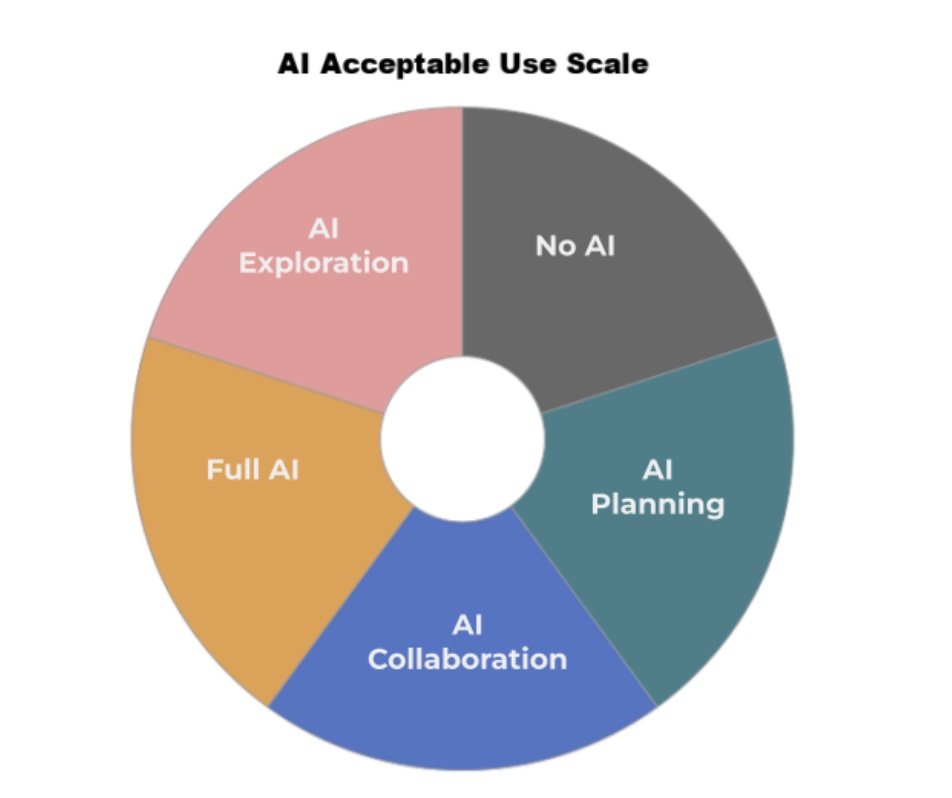
chart courtesy of LWHS Student Handbook AI Acceptable Use Policy
AI is a rapidly shifting, multifaceted issue, and LWHS lacks inner and interdepartmental alignment. That reflects the variability within the student body: I have friends who use ChatGPT for basic tasks, as well as friends who have never used and refuse to touch any kind of LLM. Still, though AI is complicated and divisive, I believe in the resilience of our community.
While teachers I talked to had varying opinions and concerns, one question that surfaced across the board was the purpose of education and what skills they, as educators, have a responsibility to nurture. Are they prepping students for the workforce or developing soft skills like critical thinking? Both? I know that when I think about the tools I want to graduate from LWHS with, one is definitely the practice of real discourse.
So teachers, here’s my ask: talk to students about AI. Don’t let it be a specter lurking awkwardly in the corner, because a lack of transparency degrades the trust essential to a thoughtful classroom. Explain your own use of AI: possible concerns you may have, hopes, and the thought process behind your perspective. Open conversation invites honesty in kind. Let’s talk about AI, because it isn’t going away.




+ There are no comments
Add yours