
As the school year begins, the U.S History Seminar: Asian American Activism PPP has returned to Lick-Wilmerding with a new focus on turning the study of Asian American history into activism.
This year, the course is now a Public Purpose Program (PPP) class for seniors, which explores Asian American activism through literature, art, community partnerships and conversations with activists.
For history teacher DA, the class is ultimately about more than learning historical events. “We’re telling, sharing and digging into histories of activism. This is the history of love,” she said.
One text the class explored was The Poet and the Silk Girl: A Memoir of Love, Imprisonment, and Protest by activist Satsuki Ina. This memoir is centered around Ina’s newlywed parents, who were forcibly removed from their home in San Francisco and placed in a Japanese American incarceration camp during World War II. Ina pulls diary entries, love letters and haikus written by her parents to encapsulate their experience as prisoners.
Through this text, the Asian American Activism students uncover the history of Japanese American incarceration through a deeply personal lens. The class obtained copies of the memoir from Harvey Dong, an Asian American activist, educator and scholar.
“I think [this memoir] is important because it allows you to ground the historical facts with the personal reality,” Sena Werdegar ’27 said.
By focusing on individual experiences, the text allows students to look beyond historical facts and understand the people behind them. It has also prompted students to consider how these stories are remembered and passed down through generations.
“[We] need to make sure the story gets passed down, and the historical memory doesn’t get changed to fit one narrative,” Werdegar said.
Throughout the semester, students will turn that learning into
action through public comments, community partnerships, art, oral history projects and workshops.
The class began the semester by submitting public comments for a future National Asian Pacific American Museum. The comments supported the effort to one day establish a national museum dedicated to preserving and sharing Asian Pacific American history and culture.
“If a future museum is meant to educate people about Asian American histories and experiences, language accessibility should be part of that mission,” Kaitlyn Sun ’27 wrote in her museum comment, connecting her own identity as the child of Chinese-speaking immigrant parents to the importance of making Asian American history accessible to immigrant families.
The class also explored ways to connect the histories they studied with contemporary activism. Students began working in support of Tsuru for Solidarity, a Japanese American-led organization that works toward social justice and an end to detention and incarceration, through nonviolent, direct action initiatives.
On October 15-18, Tsuru for Solidarity is hosting the Kintsugi Healing conference in Japantown’s Hotel Kabuki. The event focuses on intergenerational trauma within the Japanese American community, with most participants identifying as Japanese American or Nikkei (people of Japanese-American lineage). Their experiences will be centered throughout the program’s sessions and breakout discussions.
Following the conference, attendees will participate in a pilgrimage from Kinmon Gakuen, a former Japanese language and cultural school that was forced to close and later served as a processing center for Japanese Americans being sent to incarceration during World War II. The pilgrimage will end at 630 Sansome Street, officially known as the U.S. Appraisers Building, where the Immigration and Customs Enforcement (ICE) San Francisco Field Office is located.
To support Tsuru for Solidarity’s work, the class was tasked with creating art for the organization’s efforts to raise awareness about detention and incarceration.
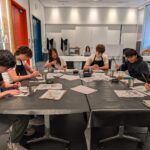
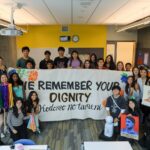
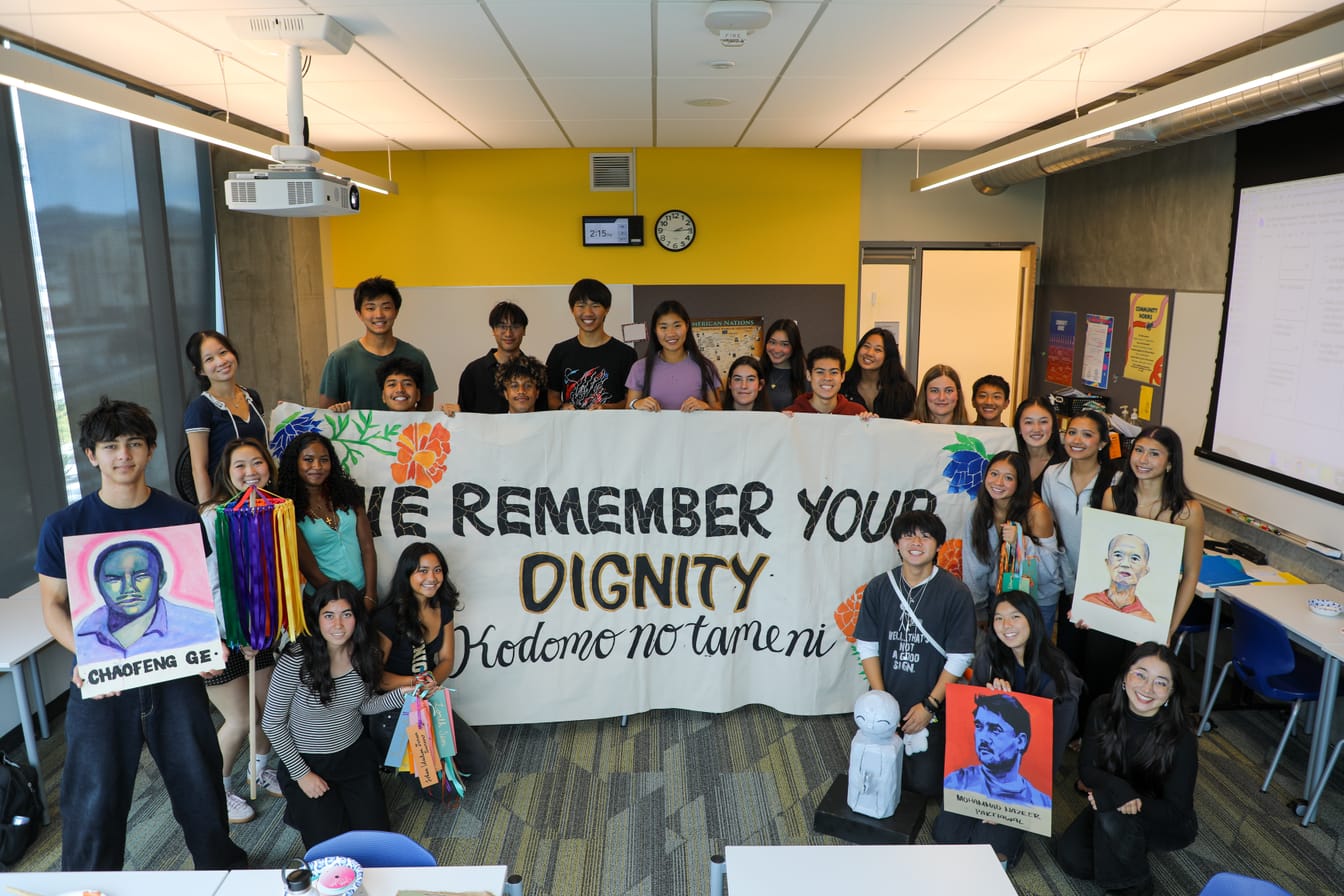
For two weeks, students collaborated to make a banner, build a Jizō sculpture and write music. They also wrote the names of the 58 people who were killed by ICE or died in ICE detention in 2026 on tags modeled after the identification tags Japanese Americans were required to wear while being processed for incarceration during World War II. The tags will be hung on lanterns as part of the event.
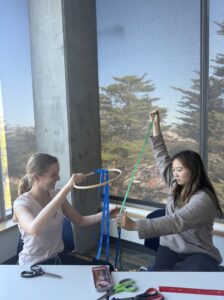
photo by Angie Woo ’27
Students, Aiden Weyer Jamora ’27, Jessie Scherer ’27 and Madelyn Hsieh ’27 drew portraits of Asian Americans killed in the custody of ICE.
This project gives students a way to explore activism through art, connecting the history of Japanese American incarceration with healing and solidarity. For Altomerianos, the students’ different approaches to art are part of what makes the project meaningful.
“This school is unique because it combines students who, in many ways, in my eyes, are artists in their own way,” said DA. “Everyone’s art form is different, but I feel like everyone is an artist in some way.”
After completing their work for the Kintsugi conference, students in Asian American Activism will collaborate with the Film 1 PPP class to create video projects, capturing the lives of Asian American activists.
“Us as a class, us as a community, us as youth, we need to unveil stories that are often hidden,” Emi Chan ’27 said.
After an extensive lesson about oral history from Cliff Mayotte, students researched local Asian American activists and began reaching out to them to learn about their experiences to preserve their stories.
“Unless we’re having elders and young people together in a room, I don’t know that we’re going to change situations [we’re in],” DA said, emphasizing the importance of intergenerational collaboration in creating social change.
To end the semester, the class will plan workshops for Sam Mihara Day of Justice in the spring, to share what they’ve learned with the wider LWHS community.
Students have moved beyond studying activism to actually participating in it. For Sun, that connection between learning and action is one of the reasons the PPP component is important.
“If we’re learning about activism, it’s only right for us to also work towards social change and public purpose,” she said. “As a community, we have the responsibility to come together and do good things for the world.”
That responsibility extends beyond participating in projects. For students, it also means considering what they can do with the history they have learned.
For DA, the goal is for students to leave the class with a stronger sense of connection, both to the people who came before them and to the role they play in society. “I hope students can feel a part of a lineage of those before us, whose love is an action contributed towards changing the society,” she said.
As students learn more about Asian American activism, they consider not only what happened in the past, but how they can turn that history into action in the present.
From Han Kang’s Light and Thread, the questions:
“Can the present help the past?”
“Can the past heal the present?”
Are a central theme in the class’s effort to connect historical memory with action today.
“My responsibility is to help the present,” Hailey Sapalo ’27 said.



+ There are no comments
Add yours