



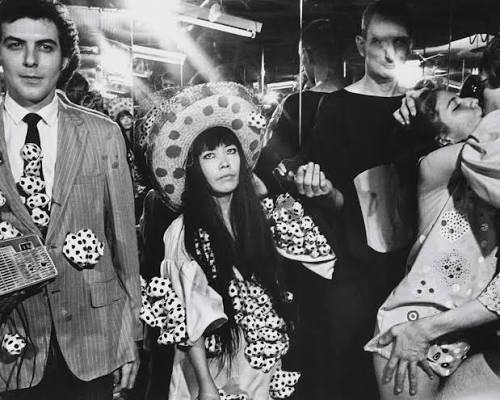
Dot by dot, let them multiply across the walls, climb toward the ceiling, crowd the corners. In Yayoi Kusama’s Obliteration Room, the vibrant, individual pinpoints accumulate until the room itself seems to dissolve into an ever-expanding field of color. Visitors, too, become part of the obliteration, their individuality absorbed into a collective whole of infinity: a recurring theme fashioned by the artist herself. By erasing the self through repetition and merging with the universe, she blurred the line between her private experience and the public persona built around her.
Kusama’s ‘return to the infinity’ (death) this past August 14, 2026 at the age of 97 leaves behind a body of work that is immediately recognizable but also invites a critical look behind the art she best became known for.
An avant-garde radical turned global cultural icon, Kusama revolutionized contemporary art and became one of the world’s most influential and commercially successful artists. Dr. Robert Mintz, Director of Art Programs at the Asian Art Museum commented on her life and legacy. “Through her art she transcended differences in culture, differences in language, and really spoke a kind of universal truth that I think touched many, many people,” he said.
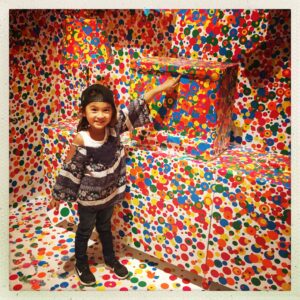
photo courtesy of Erik Hansen
On Kusama’s art, persona, and relationship to mental health Devin Duprey, Lick-Wilmerding’s school counselor, describes three-dimensional sculpture and installation art as a metaphor for defining a person from multiple angles. “You literally can’t take it all in from one space. You have to reposition yourself, so that you can get the vantage points of making sense of the whole thing,” she said.
As with Kusama, interpreting her life, body of work, and contribution to the world by reducing her to a single narrative fails to appreciate her story in its historical, cultural, and personal context.
Raised in wartime Matsumoto, Japan, Kusama grew up hiding in the flowers of her family’s gardening business, escaping her authoritarian mother’s punishments, a complicated relationship with her father, and the beginnings of her mental health struggles. Mintz connects the hallucinations of flashing lights, auras, and webs she first experienced as a young girl to the polka dots and themes of infinity that became hallmarks of her later work. “It is a fascinating insight in a way for people who don’t have her experience to be able to see the world the way that she saw it,” he commented.

Dr. Midori Yamamura, Associate Professor of Art History at the City University of New York and the Museum of Modern Art, and longtime scholar of Kusama argued against the tendency of applying mental health as the solitary lens in which we view her from. Kusama was a young, Japanese woman, arriving in post-war America in the shadow of Pearl Harbor and Hiroshima, and entered an art world dominated largely by white men. She was distinct and existed in a space between her Japanese peers and her U.S. contemporaries in the Pop Art and Minimalistic artistic movements, where she rejected both, but welcomed their audiences.
“I was more interested in historical reclamation of women artists than theoretical work, which had been very dominant in the field of art history since the 1970s,” shared Yamamura.
Yamamura urged a critical examination of the social structures behind artists, arguing that “History is written from a male point of view.” Kusama, she noted, was most certainly not recognized at the time like her male peers, namely Claes Oldenburg, Donald Judd and Frank Stella. Yamamura also points to a broader underlying pattern: “When women [artists] say they have mental problems or issues, it becomes easier for society to accept them.”
In 1977, to address her persistent struggles with anxiety, depression and suicidal thoughts, Kusama voluntarily entered a psychiatric institution in Tokyo where she remained a permanent resident until her passing. For years, she faded from public view—out of sight, out of mind. Then, in the 1990s, the art market rediscovered her. A string of high-profile exhibitions and her now-famous pumpkin sculptures on Japan’s Naoshima island propelled her back into fame. Kusama had been rebranded. She leaned into consumer culture this time, producing a paradoxical case of high supply generating high demand.
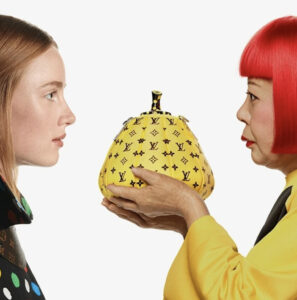
photo courtesy of @yayoi._.kusama on Instagram
But that commercial success forced a creative conflict: this radical artist was putting her name and image beside Louis Vuitton and Dior. Mintz observed, “As popularity around her work grew, it became less and less personal, less and less about her as an artist, and more about the corporate presence—almost like Kusama Incorporated.” She, ironically, was overshadowed by her own fame. Yamamura similarly commented, “There is a lack of critique in interpreting her art,” because, in the end, Kusama became more persona than person.
Mintz spoke on the museums’ responsibility to influence the public’s interpretation of both the artist and their work. “My personal view is we, as museums, serve as a stage or platform from which we hope the artists invited onto the stage are able to speak,” he said. The choice is in part “based on the artist’s depth or the meaning of their message. It’s also connected to our own sense of what our visitors and our community expect, need, and what they should hear.”
Kusama’s story, in the end, says a lot more about us than it does about her.





+ There are no comments
Add yours