



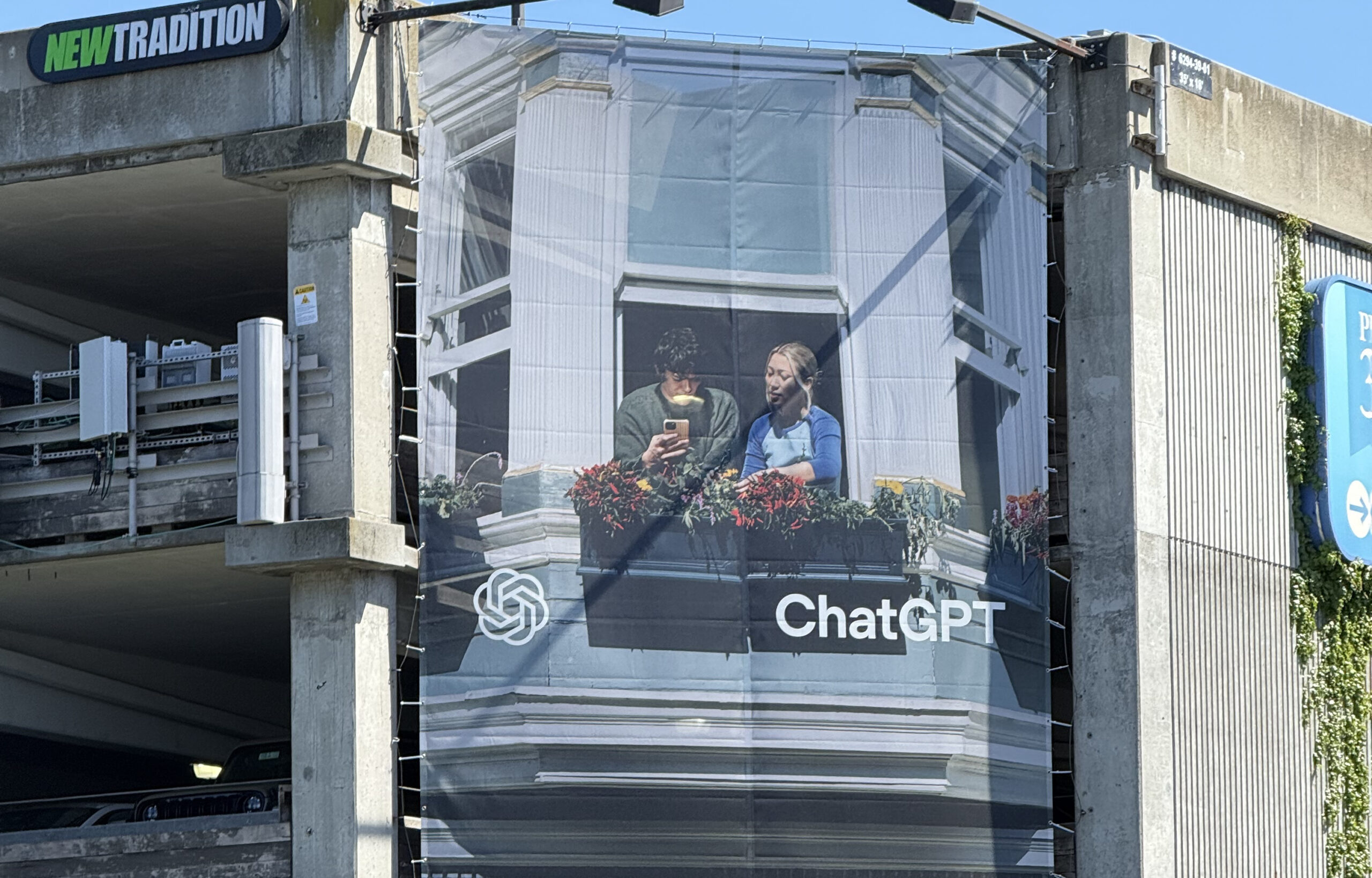
According to a study conducted by the San Francisco Chronicle in April, over half of billboards in San Francisco advertise some sort of Artificial Intelligence (AI) product; this growth reflects the large-scale economic and technological development of AI that is intensively transforming the city.
Massive amounts of money have been poured into AI startups—they made up over over 60% of global venture capital, and companies had raised over $305.6 billion just by August 2026. It doesn’t stop there, though; investment banking company Goldman Sachs forecasts that over $1 trillion will be invested in AI by the end of 2026.
San Francisco, the center of AI’s development, has been transformed by AI. Perhaps the most pertinent reminder of AI’s bubble is skyrocketing accommodation prices: ren
According to an August article in Fortune, “The AI boom is bringing workers, money, and demand for housing faster than the market can absorb them.” Even those who make six figures or more are struggling to find housing—and some houses are going for over a million dollars over asking price. In another physical manifestation of growing dominance, AI companies have bought millions of square feet in office space, specifically in downtown San Francisco.
Wendy Liu is the author of Abolish Silicon Valley: How to Liberate Technology From Capitalism. The book, published in 2020, examines the development of the technology industry and amplifies concerns about growing inequality and injustice. Six years later, Liu is writing a column on San Francisco’s AI billboards for the Bay Area Current.
“I wanted to write about them as a way of understanding what was happening in the industry,” Liu said. Specifically, what drew her to AI ads was their esoteric nature: “They are not even necessarily legible to ordinary people,” she said. “So many of them are for these very abstract enterprise software systems that maybe only 10 people in the world would ever be able to buy.”
“As someone who’s been writing about tech for almost a decade now, you know, I started to think about, okay, what is this company doing? Why are these billboards here?”
Louise Mozingo, professor of landscape architecture and environmental planning at the University of California Berkeley, shared that geographical proximity and urban layout play a role in billboards and their audiences. “Anthropic [and OpenAI] are in the South of Market area, and when you have dominant tech companies like that, surrounding them are 60 other little companies,” she said. “They’re talking to each other in these billboards.”
AI ads in San Francisco advertise many things: there are, of course, ads for well-known Language Learning Models (LLMs) like ChatGPT and Claude. Then, there are others—everything from AI receptionists to AI agents to AI software that manages other AI agents.
Overall, most AI product advertisements feature some sort of vague but bold slogan: “Own your SLAs.” “We do NOT sell dog toys.” “Build AI that works.” “That’s so agentic.” Often, these slogans, usually in bold typeface against a solid background, are paired with a logo and…not much else. Ostensibly, part of their purpose is to spark curiosity, focusing less on providing information to viewers.
Walking around the city, dwarfed by these massive tech slogans, can feel jarring. However, if you were walking around San Francisco from April to August, specifically South of Market Street, you may have seen a different type of AI ad. “ChatTJB.org,” the billboard reads. “The leading chat interface powered by AI*”.
If you were to look closer, you’d notice the fine print: AI in fact stands for “average individual.” ChatTJB is not an LLM; in reality, it is a human-powered chatbot created as an experiment by former Google employee Tucker Bryant. ChatTJB is not connected to any AI technology; Bryant himself types out answers to prompts.
A conceptual artist, Bryant had also become interested in San Francisco’s changing visual landscape. About the billboards, he said, “They’re impossible to not notice, but at the same time, they don’t feel like they’re talking to you,” Bryant said.
Many billboards feature vague phrases that are effectively incomprehensible for those not a part of Silicon Valley.
Bryant’s choice to advertise on a billboard was intentional. “There’s something visceral about a big thing that exists in real life,” he said. “I think there’s something that makes a real statement and stakes a claim in the real world that people gravitate to about billboards.”
Also in reference to the advertisements, Liu said, “I think what’s funny is that, you know, all of us normal people who live in the Bay Area, we kind of become collateral damage, where it doesn’t really matter what we see, you know?”
Bryant intended for ChatJTB not to make a statement, but rather to challenge people’s thinking. He leveraged the language used by real AI ads to masquerade his chatbot as the newest AI development.
“I kind of wanted to just comment on that [use of LLMs] by creating a chatbot that looks as futuristic as those LLMs, but where the experience is average because it’s run by a person, and use that as a way to get people to be curious about their relationship to technology,” he said.
While the project was active, Bryant spent hours a day responding to human-inputted prompts—with answers he described himself as “mid.” He discovered that, instead of the polished responses written by AI, many users craved human connection and presence.
As AI continues to grow, there have been increasing concerns about safeguards, both for AI itself and AI development. In late September, AI giant OpenAI reported that some of its research models escaped testing sandboxes (isolated environments that models are supposed to run within).
There is also an increasing link between America’s increasingly right-leaning political environment and AI regulations that increasingly favor military usage and disfavor climate change concerns; this notably contrasts with the tech industry’s political context as few as six years ago, when it was embraced by Democratic politicians and its environment leaned politically to the left.
Though debates about AI’s purpose, usage and guardrails will continue, its billboards accurately signal the direction San Francisco is going at breakneck speed towards: the growth of AI.
Ultimately, many of the massive changes happening in the tech industry will play out in exclusive offices. And yet, for San Franciscans, they will continue to affect everyday people through rising prices, a changing political environment and towering billboard reminders.




+ There are no comments
Add yours