



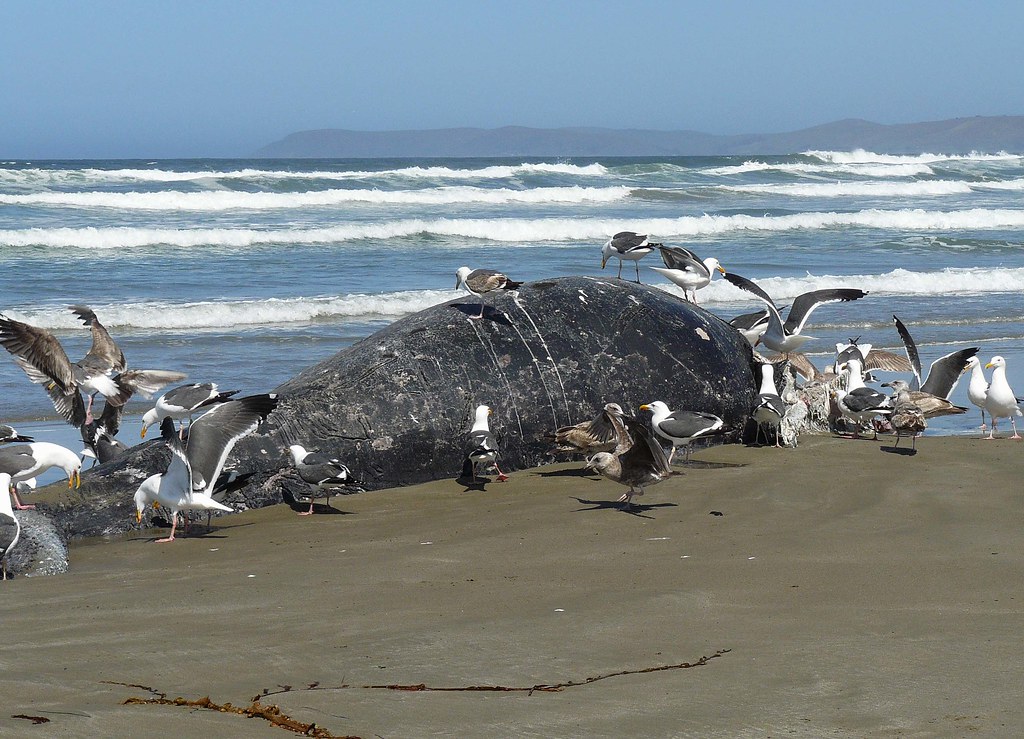
This past year, scientists have confirmed over 35 whale sightings in the San Francisco Bay, a stark contrast to the mere six in 2024. Despite the seemingly exciting discovery, at least 24 whales—21 gray, one minke and two baleen—were found dead, either floating in open water or beached on one of the Bay Area’s many scenic shores. This issue presents its concerns: postponing San Francisco’s Dungeness crab season, restricting Indigenous Ohlone foodways and even leading to the Center for Biological Diversity (CBD) and Friends of the Earth suing the Trump administration, National Marine Fisheries Service and the U.S. Coast Guard for failing to protect marine animals. Above all, it poses a complex question: why are whales back in the Bay?
The Bay Area has a long-standing history of whale activity. For centuries, whales were a major presence in Northern California waters and maintained ongoing relationality with the Ohlone, providing food when washed up on the shore.
At the turn of the 18th century, whales were mass-hunted, leading to San Francisco becoming known as the “whaling capital of the U.S.” Whalers sought to render fatty blubber into oil for lamps and lubricating machinery, craft bones into whalebone corsets and, eventually, reduced whale meat to an ingredient in pet food. However, overhunting whales during this period exhausted the population. Now, less than 5% of whales globally represent the population before the whaling industry’s rise, with similar results mirrored in the Bay.

photo courtesy of PICRYL
Yet, in 2025, whales have returned in considerable numbers—on any given day, there may be around six to eight gray whales in the Bay compared to an occasional two to three in typical years.
Although whales returning to their old habitat appears encouraging in the face of the climate crisis, it is not without consequences. “Whale deaths off the West Coast have always been a problem,” David Derrick, Staff Attorney in the Oceans Program at CBD, said.
The leading causes of whale deaths are vessel strikes and fishing net entanglements. Globally, roughly 20,000 whales die each year from vessel strikes, while 300,000 whales and dolphins die from accidental entanglements. In 2025, eight of the 35 Bay deaths were attributed to strikes.
Whale entanglements are a year-round concern, yet they become especially hazardous around the holidays—known to San Francisco foodies as Dungeness crab season. In the Bay, Dungeness crabs are usually commercially harvested using crab pots: bait-filled cages placed on the seafloor to attract and trap crabs. California regulations require crabbers to follow specific rules regarding trap placement and line length to reduce entanglements, yet these measures cannot eliminate all risks to wildlife.
With at least eight whales caught in the Bay this year, the California Department of Fish and Wildlife announced that the commercial Dungeness crab season will be delayed from November 15 to early January, depending on whether conditions improve.
For San Francisco restaurants, this has been a letdown. “Local is a big thing for us and for our guests. They want local crabs,” Bob Partrite, Chief Operating Officer of family-owned business Simco Restaurants, said. Inaccessibility to local crab forces restaurants to source seafood from out of state, such as fisheries in Washington or Oregon, leading to fluctuating prices and loss of the regional character.
Beyond affecting San Francisco crab-lovers, postponing Dungeness crab season also restricts Ohlone foodways, as crab is a traditional aspect of the Ohlone diet. Unlike federally recognized tribes such as the Yurok, the Ohlone are not exempt from California state fishing regulations. While California recognizes “Tribal Beneficial Uses” to protect cultural practices, state law does not explicitly guarantee a distinct right for the Ohlone to fish, hunt or gather on state lands, thereby limiting these protections and their rights to cultural foods.
Dungeness season aside, the increased whale deaths have culminated in a broader issue: CBD and Friends of the Earth filed a lawsuit against the Trump administration, the National Marine Fisheries Service and the U.S. Coast Guard for violations of the 1973 Endangered Species Act. “The Trump administration is legally required to look at how to minimize harm to whales and sea turtles, and officials need to take this problem seriously and make a plan,” Derrick said on CBD’s lawsuit release.
The 1972 Marine Mammal Protection Act and Endangered Species Act act as a safety net for endangered marine species by requiring agencies to demonstrate efforts to reduce animal harm. In 2017, agencies in the Bay’s ports analyzed shipping lanes, declaring them safe despite being placed where whales congregate. In response, CBD sued them, and the court agreed, striking down the agency’s analysis. However, the agencies that conducted this analysis never performed another evaluation, leading to the current lawsuit at hand. CBD is confident that once the court requires the agencies to reevaluate the lanes, the need to reduce shipping and vessel speed or move the lanes further from the whales will be revealed.
Yet the question remains: Why have whales returned to the Bay?
According to Doug McCauley, director of the Benioff Ocean Science Laboratory at the University of California, Santa Barbara, climate change is the cause of whales’ return, as declining food resources prompt them to search elsewhere. For example, during gray whales’ return from their annual migration from Northern Arctic feeding grounds to warm, Baja California, Mexico lagoons, they may hungrily veer off course into the Bay. However, marine ecology teacher Gillian Ashenfelter notes that understanding marine animal behavior is far more complex.
El Niño and La Niña years—opposite phases of a climate pattern—alter wind patterns and ocean currents. Changes in currents relocate food resources, prompting corresponding changes in marine animal behavior. Accordingly, systems to monitor and protect marine animals often become unreliable. “The ocean is not the same every year,” Ashenfelter said. “Normal in nature is never straight. There’s always shifting.”
Given the variability of marine animal behavior, data collected under specific conditions can quickly become outdated. Ashenfelter explained that to establish with certainty that climate change is the cause of the recent whale movements and deaths, data must be collected over about 50 years. Thus, while climate change is a plausible explanation, the exact causes remain unconfirmed.
With whales’ return to the Bay comes a reminder of the dangers they still face. San Francisco risks repeating a dark history of endangering marine life if protective measures are not implemented.