On February 24, 95.2% of Lick-Wilmerding High School students participated in the second annual Community Experience Survey, a poll designed to assess belonging across opt-in demographics, including gender identity, race, ethnicity and religious affiliation.
The survey—developed by Charlotte Gjedsted (Dean of Technology), JR Arimboanga (Director of Student Inclusion and Ethnic Studies Program), Matthew Oakland (Dean of Equity, Inclusion, & Belonging) and Raj Mundra (Head of School)—included both quantitative and qualitative measures geared towards understanding what factors, both demographic and social, enhance and hinder belonging among students.
The survey’s question format draws inspiration from several pre-existing questionnaires, including Harvard University’s ‘Pulse Survey,’ as well as work conducted by data collection and analysis organizations such as the National Association of Independent Schools (NAIS) and Challenge Success.
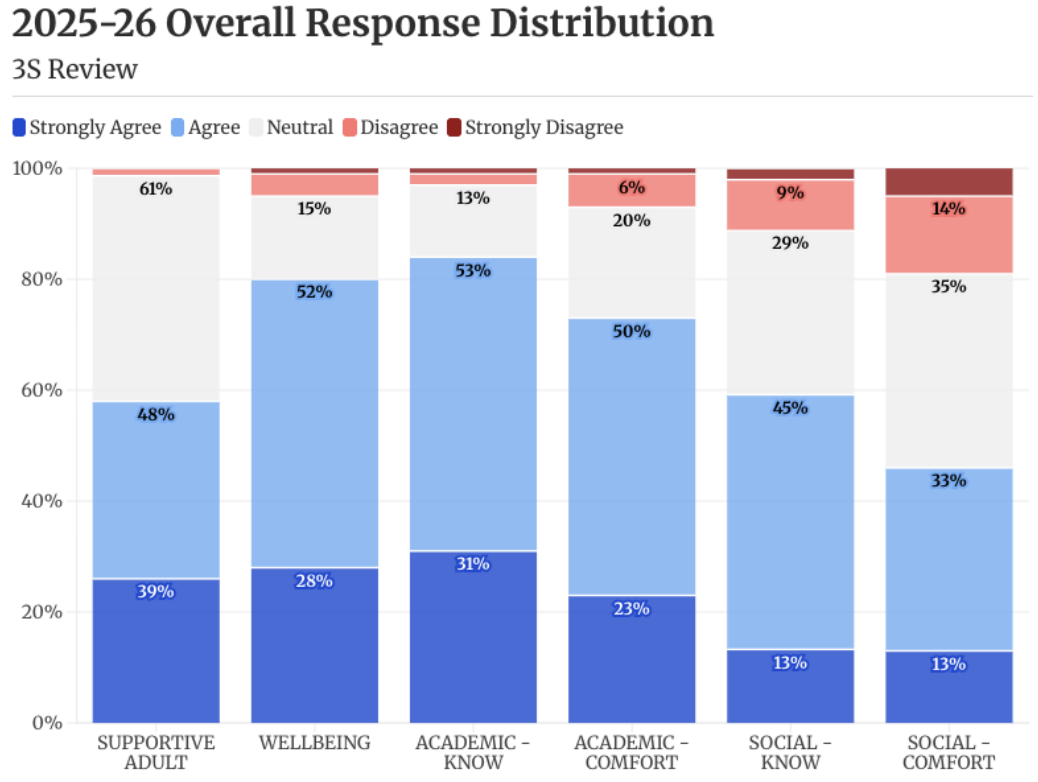
According to this year’s results, of the 534 students who responded, 82% reported that they feel they belong at LWHS. The national independent school benchmark, as reported by NAIS in 2025, is 56%.
For many, this sense of belonging at LWHS was cited in connection to peer relationships, in addition to engagement with co-curricular offerings including athletics, performing arts, clubs and affinity spaces.
Additionally, 97% of students said they feel connected to at least one peer and 87% of students said they feel supported by at least one adult. These figures similarly exceed the NAIS 2025 benchmark, which cites that 80% of students said they feel supported by at least one adult.
This year’s results also suggest that belonging varies most significantly by gender identity. Cisgender male students reported the highest belonging across all six measures, with 96% feeling connected to at least one peer and 80% feeling they can be their authentic selves. This figure compares to the 73% of cisgender female students who reported they felt they could be their authentic selves and 54% of nonbinary/genderqueer/gender fluid students who reported feeling they could be their authentic selves.
On February 8, LWHS students were preemptively notified via the eTiger of the survey’s February 24 administration date.
“As an independent school, the perspectives of every family member are invaluable to us. Your feedback is essential for helping us understand what we are doing well and identifying areas where we can grow and improve our students’ experience and our partnership with you,” a statement, written by Gjedsted and published in a later eTiger, said.
A day later, on February 9, a correction was issued, sharing that this year’s collected demographics had changed from years prior. “In partnership with the EIB department and, in an effort to ensure our students feel comfortable sharing, we’ve eliminated several options, including political party preference. While we ask for demographic information and while the information is valuable to our understanding and planning, providing this information is optional, and students are not required to disclose,” the email, sent by Gjedsted, said.
This choice to change collected demographics follows conversations among senior administrators surrounding last year’s results. “We’ve heard feedback that [political party preference and religious identity], are two pieces of students’ core identities that don’t feel well represented in conversations around belonging or affinity…the reason why we ultimately decided to do religion and take out political party was because we already know that we have a bias towards a more liberal, progressive agenda…and that is a growth area for us,” Gjedsted said. “For religious identity…we don’t yet know what work we might have to do in that space, and so we chose to include it.”
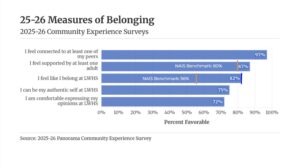
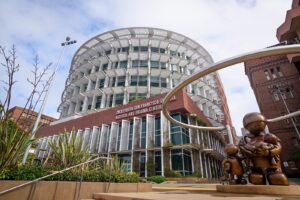
photo courtesy of Charlotte Gjedsted
Through the survey instrument platform Panorama Education, students were asked to respond to 28 questions across five sections: Schoolwide Events and Programming, School and Community Engagement, Systems of Support, Perception of Belonging, Open Ended Questions and Demographic Information. In total, five of the questions were open-ended, while the other 23 provided a five-point scale ranging from “strongly disagree” to “strongly agree.”
Once students completed the survey, Panorama processed responses and developed a “semi-cleaned up” version of the data, with identifying information removed. “First, I look at global trends…and that’s easier with the quantitative because that gives us the ‘likeness scale’…Then I toggle between our different identity markers and can see how different identity groups compare to the overall trend,” Gjedsted said.
Qualitative results, however, require more individual attention. “I created a code bank, with categories or themes…so like systemic or institutional things, or community and culture…And within those, there are sub-categories,” she said. “And then I read through every single line of feedback and coded where it belonged, calculated the total frequency of responses and finally pulled themes based on what stood out the most.”
From the open-ended results, it was revealed that students, overall, do not feel comfortable expressing their opinions. “[One next step is working] with the Equity, Inclusion and Belonging (EIB) department to deepen our work on psychological safety, particularly for nonbinary and gender-diverse students, and for students who experience the political and ideological climate as constraining,” Gjedsted said.
‘Real Talk Roundtables’ is an eight-program initiative—designed and launched this year by the EIB department—to “gather candid student feedback on equity, inclusion and belonging at LWHS.” This semester, eight sessions have been held for the following groups: South Asian & Middle Eastern Students, Black & African American Students, LGBTQ+ Students, Latinx Students, Jewish Students, Flex Tuition Students and Asian American Students, in addition to an Open Session available to all students.
“Quantitative data is only going to give us so much…The ‘Real Talk Roundtables’ that I’ve been hosting all semester are a program that we created to help supplement some of that, so we can get some real, anecdotal qualitative analysis from students, particularly from different affinities,” Arimboanga said. “Knowing this data, Matthew and I are hoping that we can create some short-term and long-term goals that are sustainable for us.”
This next school year, students can expect similar initiatives and work geared towards addressing the 2025-2026 survey results. “The school strives to achieve high levels of belonging for all students within its intentionally diverse community. This will remain a core goal for LWHS to measure,” the report, compiled by Panorama Education, reads.