



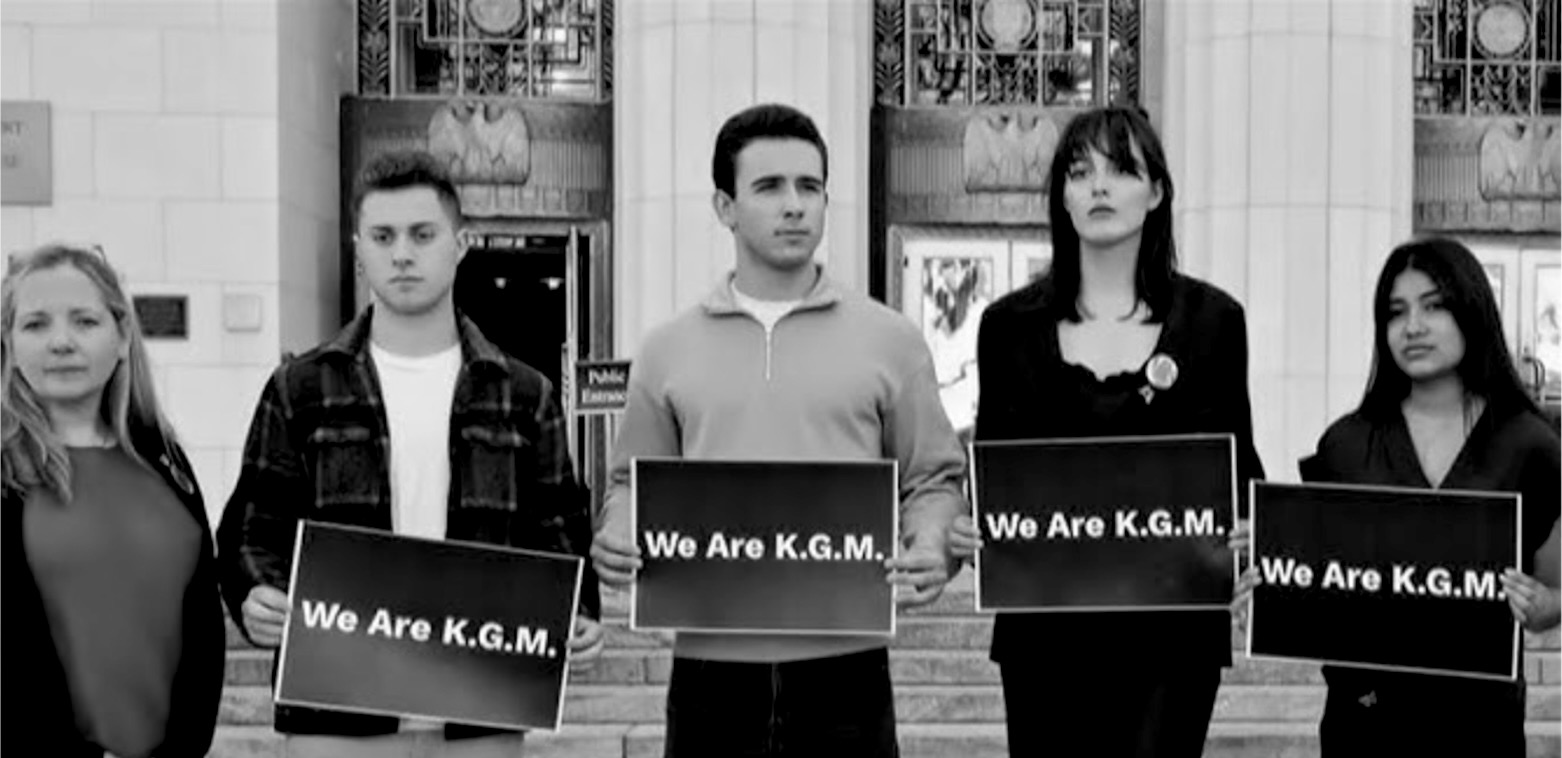
On March 25, 2026, in landmark court case K.G.M. v Meta, Silicon Valley giants Meta and Google were found guilty of addictive social media design that incites depression, thoughts of self-harm and body dysmorphia in its young users. The trillion-dollar companies were ordered by a Los Angeles jury to pay a combined $6 million to the plaintiff, a 20-year-old woman from Chico, California, who was referred to as K.G.M. throughout the court proceedings. The lawsuit is the first highly-publicized case of its kind, sparki
This California lawsuit follows a global crackdown on social media platforms, including the brief privacy-driven ban on TikTok in the U.S., as well as the December 2025 Australian social media ban for users under 16.
Frederik Riedel, the founder and Chief Executive Officer of One Sec, an award-winning social media use reduction app that has reached over 23,000 ratings on the Apple App Store, expressed the magnitude of the case that extended as far as his home country of Germany. “This case is a much stronger signal to these social media companies than a ban. Saying ‘social media is banned for people under 16’ is an easy law. This case flips the responsibility to the social media platforms and they have to think honestly about the consequences of certain features rather than ignore it,” he said.
In the opening statements of the case, the plaintiff’s argument relied on previous lawsuits against Big Tobacco companies, namely the Master Settlement Agreement (MSA), which ordered corporations to pay a combined $206 billion between 1998 and 2023 as a consequence of profiting off of underage tobacco users. In addition, MSA banned advertisements targeted at children as well as cartoons on packaging or advertising. The plaintiff’s language, such as “engineered addiction,” was directly borrowed from the 1998 agreement. Carrie Maslow, Lick-Wilmerding High School teacher and instructor of ‘Ethics in the Sciences and Technology’—among other courses—agreed with this comparison. “Addiction to a media thread is similar to a nicotine addiction in this sense. There seems to be more and more proof that what is going on when a person is scrolling and scrolling, even though they want to stop, is very similar to a chemical addiction,” she said.
According to a study conducted in 2023 by Gallup Familial and Adolescent Health, 51% of U.S. teenagers use social media for four or more hours per day. Meanwhile, a Journal of the American Medical Association Psychiatry investigation found that three or more hours of social media per day doubles an individual’s risk of anxiety and depression.
“At Lick, I often see people use social media as a way to recharge socially and take a break from interacting with people. In those moments when you feel burnt out, social media can be more harmful because you’re distracting yourself from your emotions,” Max Mercer ’27, Co-Leader of LWHS’ Self-Improvement Club, said.

photo by Addison Clem
Unlike most addictive products, social media harms cannot be traced physiologically. Meta lawyers pointed out that K.G.M. experienced abuse from within her family that was foundational to her mental health distress. They claimed that the use of an app—of which the sole purpose is to facilitate social connection, cannot itself be blamed.
However, addiction is classified as a “treatable, chronic medical disease involving complex interactions among brain circuits, genetics, the environment, and an individual’s life experiences,” according to the American Society of Addiction Medicine. This definition takes into account that some people are more prone to addiction because of personal or genetic factors. Therefore, the claim that social media cannot be blamed for its furthering of existing mental health conditions was not upheld in court.
During the closing statement, K.G.M.’s lawyer pivoted to villainizing the capital greed of each multi-trillion dollar company. They represented Google’s stockholder equity by holding a jar of M&M candies: each of the 415 color-coated orbs represented $1 billion. “Meta is very profitable. They have a ton of other products. I think that valuing profit over safety is the wrong direction to go. They have the responsibility to fix the app,” Charlotte Gjedsted, LWHS Dean of Technology, said.
On the other hand, Meta and Google advocates have expressed concern for free speech and the ability of the companies to make a profit. Members of the LWHS Self-Improvement Club expressed similar sentiments, stressing the importance of self-regulation rather than government pressure on companies.
“The government shouldn’t be able to cut down on what companies are doing, because the individual chooses to download it,” Samuel Brown ’27, Co-Leader of the Self-Improvement Club, said. All users agree to a list of terms and conditions before accessing their account, and they must state that they are at least 13 years of age prior to gaining access to the service.
Many government restrictions are necessary for the safe functioning of society. When these apps were cited as the root cause of mental health problems, company rights disappear into the ethical background for many. “Lots of studies seem to show connections between time spent on social media and anxiety, depression and eating disorders. The link is so strong that it should be seen as a public health issue where safeguards are needed—in the same way seatbelts and stop signs are needed to protect people when they drive.” Maslow said.

Hana Dahi, the head of SeniorPartnerships at Snap Inc. (the parent company of Snapchat), emphasized that social media companies also realize the duties necessary to protect their users’ privacy and prevent discrimination or harassment. “At Snap, it’s important to us that we think of our users and moderate content as much as possible and have technology in place to quickly flag something that shouldn’t be on the app,” she said. Dahi also pointed out the reasons companies may censor what their users can say on these platforms. “Speech can incite violence and dangerous behavior and activities. Free speech is important and should be protected, but within the guardrails that safety is top-of-mind,” she said.
Though $6 billion is a relatively small sum for companies of this size to pay, the significance of the case extends beyond the monetary losses. This case signals that the U.S. justice system will hold the mental health damages of social media to the same standard as addictions that harm physical health.
Still, intentional or helpful changes may never be made by these companies, so long as their goals remain to hook the user for the longest duration, sell advertisements to the highest bidder and make a substantial profit.
“If there is regulation, these companies try to implement the requirements in a very malicious way without fulfilling the purpose of the regulation,” Riedel said.
As of April, 2,465 cases are pending in court related to Adolescent Social Media Addiction, a drastic uptick from the 1,200 in January 2025. This wave of justice for victims of the mental health crisis can be attributed to K.G.M. v. Meta’s mass of publicity. While the case will not alone stop every child from social media harm, it continues to tear down the stigma surrounding young people’s mental health.