


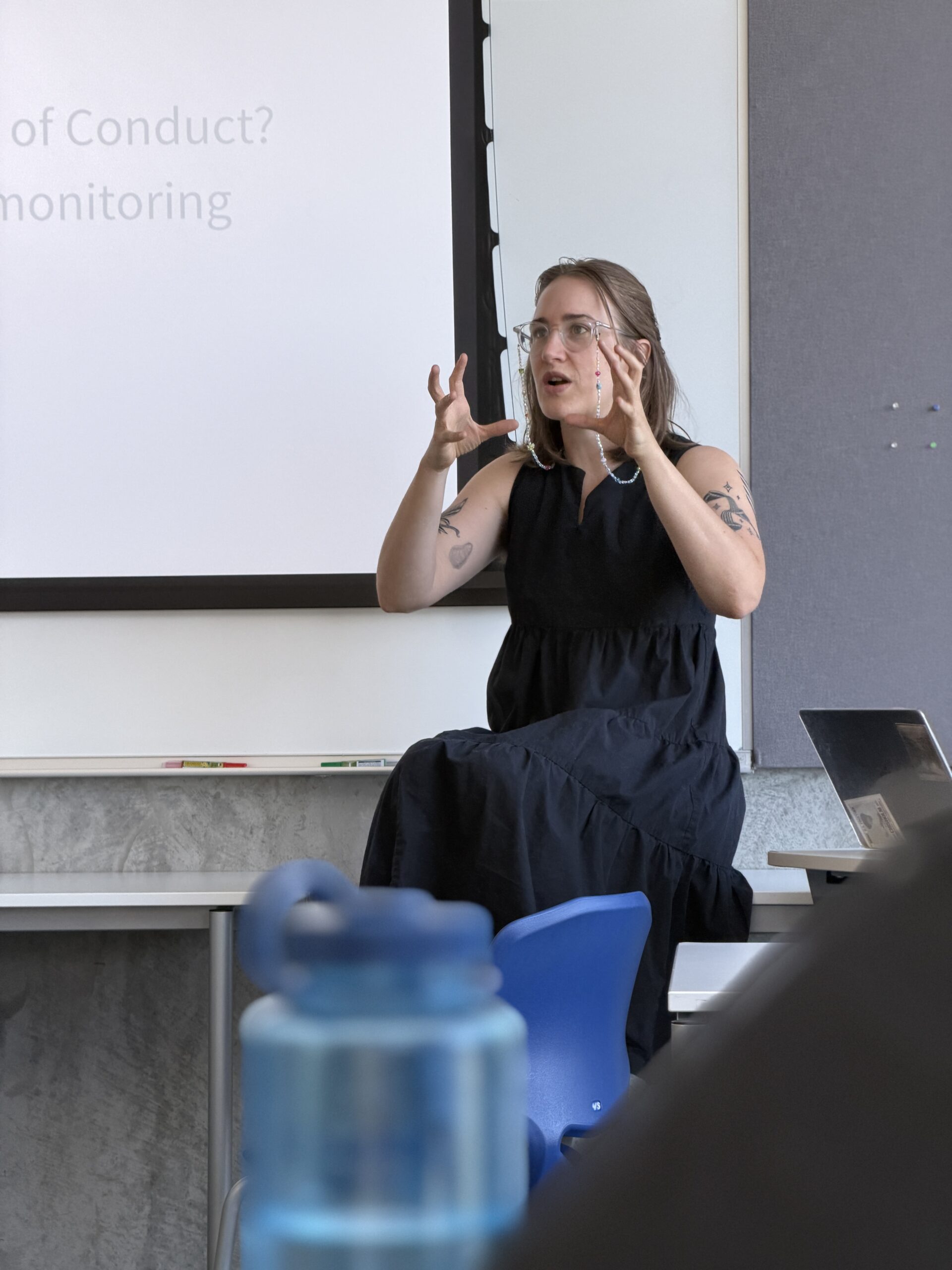
Constitutional Hinges,” US History teacher Marissa Cornelius’s senior seminar, is not only a history class, but also, as Cornelius describes it, “Lick-Wilmerding High School’s only [current] civics class to my knowledge.” The class looks at the Constitution through a modern lens, focusing on the people who analyze it most: the Supreme Court.
“Constitutional Hinges” analyzes legal reasoning of the Constitution and its application to the government in both the past and present. As the syllabus states, “Students will learn about the forces, philosophies and debates that shaped the creation of the U.S. Constitution, how the document was reshaped in the Reconstruction Era and how the Supreme Court has shifted in its interpretation of this document throughout the 20th and 21st centuries.”
The class was initially created at Cornelius’s former school, the Jewish Community High School, as a civics class to fill a gap. “[LWHS] assigned me a very broad title of Critical Hinges, and they told me to teach it about anything I wanted.”
Gavin Cameron ’26, a student who took Constitutional Hinges, expressed that he was surprised by the discussion-based structure of the class. “Most other history classes have a large focus on essay-writing and research skills, but [Constitutional Hinges] focuses on speech and argumentation.”
“We look at a lot of readings from lawyers, political professors and even Justices themselves.” Myles Marcus ’26 said.
One class source looked at the relatively new Supreme Court Code of Conduct–created on November 13th, 2023–and analyzed that text while also looking at Justices’ conduct before its creation, such as Clarence Thomas having been reported in April 2023 to have accepted luxury gifts from billionaire and GOP donor Harlan Crow for at least two decades. “When [I] thought of the Constitution, I thought of this ancient, irrelevant document,” student Julia Howe ’26 said. “But it actually really shaped the way I understand the news, especially surrounding the Supreme Court.” Being able to engage in conversations about the Constitution allows her to “hold [the Supreme Court] accountable,” and to forgo being a bystander.
The class starts around the point in history where Honors U.S. History starts, with the founding of the U.S. and the origins of the Constitution. Crucial sources include Marbury v. Madison, an 1803 Supreme Court decision that allowed American courts the power to strike down laws and statutes that violate the Constitution. This focus on the Constitution’s founding leads to the idea of the second founding of America, the belief that the end of the Civil War led to a rebirth of the U.S.
This second founding is also analyzed through the lens of the Constitution, namely the 13th, 14th and 15th Amendments, otherwise known as the Reconstruction Amendments. “I would say [the 14th Amendment] is the most important amendment in the Constitution,” Cornelius said. The 14th Amendment, among other things, grants birthright citizenship, a right highly discussed within the current administration.
The semester culminates in a unit dedicated to a Moot Court, a law school practice where students are given a real-world case to discuss and simulate. “[The Moot Court] really forces you to examine different interpretive styles and perspectives,” Nola Kra-Caskey ’26, who is taking on the role of a lawyer for a petitioner, said. “I’m arguing something I don’t personally believe in, but I’ve learned how to formulate a Constitutional argument.”
Seniors who were and are in the class have all sorts of positive sentiments for it. “Even though I have senioritis, I still want to pay attention,” Marcus said. “That class is a huge reason I want to pursue political science in college,” Noa Solomon-Carmel ’26 said. Kra-Caskey also mentioned that Cornelius dreams of bragging about teaching a Supreme Court Justice their first civics class, and with all these aspirations she’s inspired within her students, that dream might not be far off.