
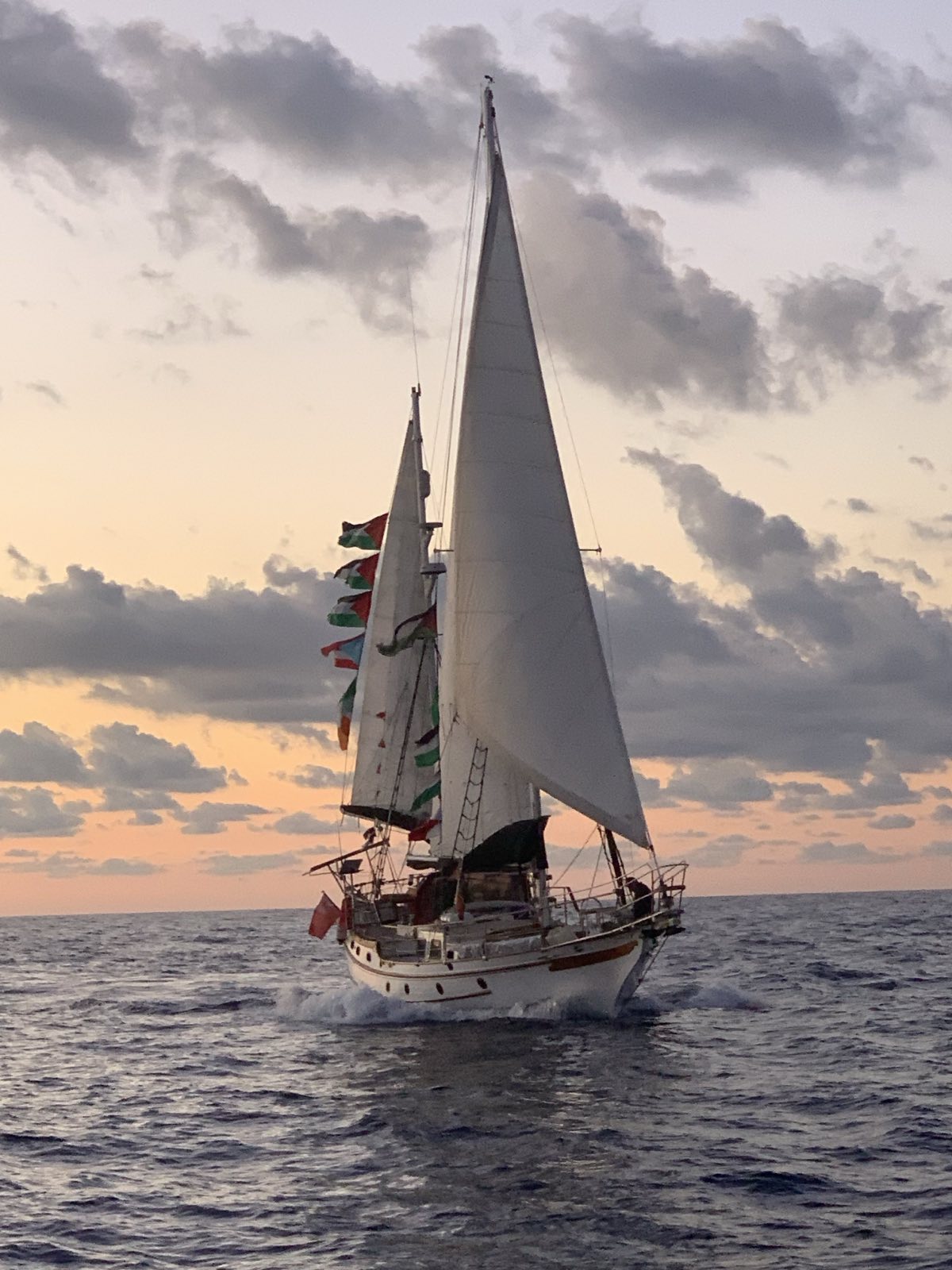
By October 3, 2025, Israeli military forces had intercepted all vessels of the Global Sumud Flotilla (GSF), a nonviolent maritime convoy carrying around 500 civilians on 42 boats bringing humanitarian aid to Gaza. Lick-Wilmerding High School alumnus and activist Logan Hollarsmith ’10 captained one of the flotilla’s ships, and was captured and detained in an Israeli prison for six days.
Hollarsmith grew up in San Francisco’s Noe Valley and graduated from LWHS in 2010. He worked in Tucson, AZ facilitating large-scale community construction projects before joining the GSF.
GSF launched on September 1, 2025, carrying roughly 500 people from 47 countries and aiming to deliver humanitarian aid to the Palestinian people, who are suffering what the United Nations describes as the “worst-case scenario of famine.” The flotilla’s efforts to ease the humanitarian crisis in Gaza drew international attention, sparking hope worldwide. “I think sailboats…capture the human imagination in such a way,” Hollarsmith said. “Just the thought that someone came on a sailboat and went thousands of miles. It really matters…It is a poetic endeavor.”
“We are a coalition of everyday people—organizers, humanitarians, doctors, artists, clergy, lawyers, and seafarers—who believe in human dignity and the power of collective action,” states the flotilla’s website.
Helena Awwad, a student at the University of California, Davis engaged in Students for Justice for Palestine, was inspired by the flotilla’s actions. “We saw direct action being taken in the hands of regular people and organizers internationally, which just felt very hopeful,” she said.
Hollarsmith recounted the collective inspiration he felt as the vessels prepared to launch. “It was a level of collaboration…a facet of humanity that up until then I had only read about. A true international revolutionary spirit, where everyone is working towards the same goal and coming from entirely different backgrounds,” Hollarsmith said. “I did think we were going to die, but…there was no fear among the sailors.”
The convoy departed from Barcelona and then sailed to North Africa, gathering additional delegations along the way. As GSF’s numbers grew, Hollarsmith explained that Israel’s efforts to stop the flotilla also increased dramatically, including buying up diesel so that ships could not be fueled. “[A boat] got bombed right next to us,” Hollarsmith said.
In addition to the resistance to the convoy’s efforts, however, global attention and support for the flotilla rapidly expanded. “An Italian warship [was sent] to join the flotilla…[to] rescue Italians should they get hurt. And I think that was a response that none of us saw coming, and it really upped the global reception of the flotilla, recognizing that, wow, so much of the world has our backs right now,” Hollarsmith said.
Diana Awwad, a sophomore at Riordan High School involved in the Arab Youth Organization, commented on the community and international support. “The Sumud Flotilla has shown that, obviously, we have a Bay Area community that has your back, but there’s also an international community that supports what you’re doing,” she said.
On October 2, Hollarsmith’s vessel was captured by Israeli forces. “They were spraying sulfur-infused water cannons on boats,” Hollarsmith said.
Helena Awwad expressed her disappointment over Israel’s treatment of GSF members. “I think it’s absolutely shameful. It is obvious—the denial of international law of human rights just shows that Israel is complicit in injustice in all forms, not just towards Palestinians, but towards anyone who tries to combat their continued injustice against Palestinians,” she said.
“People were getting very hurt, dragged off boats, put in holds with their arms pulled behind their backs, hit a lot, cuffed too hard, where people lost feeling, still have lost feeling in their hands,” Hollarsmith said. “[One soldier] spat on me.” He was blindfolded, cuffed and forced into a small metal cage, in which he was transported to the Kzi’ot prison in Southern Israel.
“I was in a cell with maybe 12 other people, and they’d pull people out and disappear, for days,” Hollarsmith said. Still, the flotilla members found a way to uplift their cause. “All night long, songs in Arabic echoing through those prison walls, and then returned with songs in Gaelic from the Irish captains,” he said. “People were trying to sing loud enough, knowing that there were Palestinian men in the cells underground…in isolation chambers.”
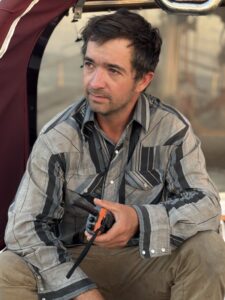
photos courtesy of Logan Hollarsmith
The Israeli prison forces interrogated the detained GSF members, seeking to identify the convoy’s sources of funding and organization. “I got pulled into the interrogation room…It was something I’d been nervous about. People have been getting guns shot right next to their head, or being forced to walk across the dunes while guns were going off,” Hollarsmith said. “They showed me paperwork, just all these laws that I, as Logan, had broken…I didn’t say anything, and they turned the paper around, and they signed my name under every charge.”
Zayna Elkarra, a Palestinian activist at Independence High School, described the necessity of GSF’s work. “It is inhumane, and it’s crazy, because these people are trying to bring in aid…it’s baby formula, it’s food, it’s things that people need to live,” she said. “The only reason that they’re doing this mission is because Israel isn’t allowing aid in…the flotilla is a result of Israel’s actions.”
Hollarsmith emphasized that his experiences with detainment were a small slice of the injustices committed against Palestinian people. “What shook me up the most…being in these rooms, witnessing part of the mechanisms of genocide firsthand, looking through the same barrel of a rifle that killed someone else.”
Learning of the mistreatment recounted by detainees, Helena Awwad said, “It hasn’t made me scared. It’s only inspired me and continues to motivate me to push further ahead in what we’re doing in organizing.”
24 California representatives signed a letter sent to Secretary of State Marco Rubio around October 6, demanding the safe release of detained U.S. citizens. Still, the U.S. consulate, Hollarsmith explained, did little to aid U.S. citizens detained. Instead, Jordan stepped in to help the American members of the flotilla, providing a hotel space in Amman, Jordan’s capital. “They had just served a huge spread,” Hollarsmith said. “And after not eating for about seven days, oh, I just cried on that rooftop buffet. It was so delicious.”
“Our boats did not reach Gaza,” reads the GSF website. “But our message—and the message of the Palestinian people—was carried across the world.”
After a ceasefire deal agreed upon on October 10, 2025, in which Hamas committed to releasing all hostages, hundreds of aid trucks have entered Gaza each day. Still, the number often falls short of the 600 trucks daily promised by Israel. Many carry commercial goods for sale rather than aid, failing to meet the needs of the nearly 1.9 million displaced and homeless Palestinians—90% of the total population—facing a brutally cold winter.
Helena Awwad affirmed that advocacy for the rights of the Palestinian people must continue. “This ceasefire does not mean there’s an end to the genocide,” she said.
The peace plan proposed by President Donald Trump leaves the sovereignty and future of Palestine uncertain. “There’s still so much that Palestinians need not only to live, but also to get back to where they were, and to slowly start rebuilding their lives,” Elkarra said. The ongoing famine in Gaza could have detrimental impacts on the health of generations of Palestinians to come, which is why action must be taken to reduce generational health complications for Gazans.
GSF plans to sail again in March, this time aiming for a convoy of around 200 vessels. “It’s like not even a question in my mind, whether or not to go out,” Hollarsmith said. “I’m still having nightmares…It’s something I don’t want to do right now. But…we had all made an agreement to continue sailing until Gaza was free, and that’s something I know I will keep doing.”
“Remember that you have your own voice, and it’s something to be used…There’s always a space, and if not, create one,” Diana Awwad said. “There’s always a way that you can participate in taking action.”
“Sumud” is an Arabic word meaning steadfastness, perseverance and resilience, which “reflects the unyielding spirit of the Palestinian people to resist injustice and occupation on their ancestral land,” states the GSF website.
“It’s so important and so hard to be ourselves, and to live fearlessly, and to show compassion for other people in solidarity,” Hollarsmith said.
The flotilla has illustrated the possibility for collective action taken by everyday individuals from across the world, sparking hope for many that they too can inspire positive change for suffering Gazans. “There’s always going to be a space for you, especially in the Bay Area,” Helena Awwad said. “[The flotilla is] an international call to action for everybody.”